Reliable electricity can make overlanding more comfortable and capable, whether you need to charge camera equipment, run a laptop, power a refrigerator, or operate essential appliances at camp. The right inverter converts your vehicle’s 12-volt battery power into usable AC power without exceeding your electrical system’s limits.
We selected 10 power inverters for overlanding across several output levels, waveform types, and installation styles. Use the comparison and buying advice below to match inverter capacity, surge performance, outlets, and safety features to your vehicle and camping setup.
Best 10 Power Inverters for Overlanding Picks for 2026
High-Capacity Pick
VEVOR 4000W Pure Sine Wave Inverter

- 4000W continuous and 8000W peak output
- Four AC outlets with USB and Type-C ports
- LCD display, wired remote, and six protections
Best For: High-demand RV, truck, and mobile-office power systems
Heavy-Duty Monitoring Pick
LANDERPOW 3000W Pure Sine Inverter

- 3000W continuous and 6000W surge output
- Hardwired terminal plus AC, USB, and 30W PD ports
- 15-foot remote with battery and error monitoring
Best For: RV, truck, and job-site systems with demanding loads
Compact Vehicle Pick
TWING 1000W Car Power Inverter

- Compact 3-pound vehicle-friendly design
- Two AC outlets plus QC 3.0 and 30W PD USB charging
- 750W continuous and 1000W peak output
Best For: Light-duty camping, travel, and emergency vehicle charging
Balanced Midrange Pick
BELTTT 2000W Pure Sine Inverter

- 2000W continuous and 4000W surge output
- Pure sine wave power with over 93% stated efficiency
- LCD display, 20A outlet, hardwire port, and 23-foot remote
Best For: Midrange RV, truck, and off-grid power installations
Best for Easy Setup
Cummins 5000W Modified Sine Wave Inverter

- 5,000W continuous and 10,000W peak output
- Four covered AC outlets plus USB and USB-C
- Cable kit, Bluetooth control, and built-in protections
Best For: High-demand vehicle and camping power setups
Remote-Control Powerhouse
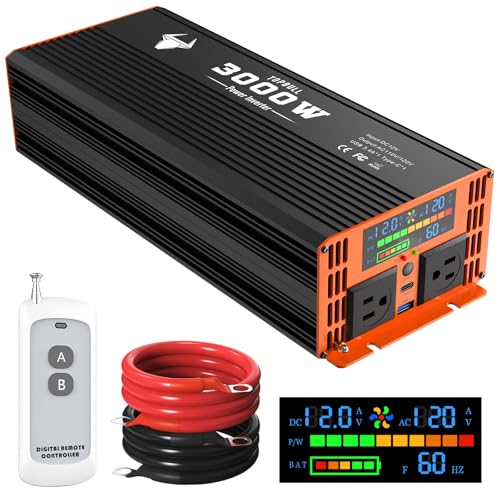
TOPBULL 3000W Pure Copper Inverter

- 3,000W continuous and 6,000W peak output
- 20A AC outlets plus USB and 30W USB-C charging
- Wireless remote, LED monitoring, and multiple protections
Best For: Remote-managed RV and overlanding installations
Balanced Heavy-Duty Option
Energizer 4000W Vehicle Inverter

- 4,000W continuous and 8,000W peak output
- Two AC outlets and two 2.4A USB ports
- LCD monitoring with included 0AWG cables
Best For: High-output camping and vehicle electronics
Best with Extra Features
5000W Modified Sine Wave Inverter

- 5,000W continuous, 10,000W peak output
- LCD monitoring and 150-foot wireless remote
- Four AC outlets with built-in protections
Best For: High-demand RV and off-grid overlanding systems
Battery-Friendly Option

- 4,000W continuous, 8,000W peak output
- Adjustable 9.5V–11V low-voltage shutdown
- Four AC outlets, USB, and 30W USB-C
Best For: Multi-battery-type RVs, trucks, and mobile workstations
Feature-Rich Midrange Pick
- 3,000W continuous, 6,000W peak output
- Two 20A AC outlets plus USB and USB-C
- Color display and 200-foot remote operation
Best For: Vehicle camping and mobile power with moderate-to-high AC needs
High-Capacity Pick – VEVOR 4000W Pure Sine Wave Inverter
For demanding overlanding setups, the VEVOR 4000W is one of the power inverters for overlanding designed to run multiple devices and higher-draw appliances from a 12V battery system. Its pure sine wave output, four AC outlets, USB ports, Type-C charging, LCD monitoring, and wired remote make it practical for RVs, trucks, and mobile workspaces.
Best For: Overlanders needing substantial continuous power for appliances, electronics, and several devices at once.
Pros:
- 4000W continuous output with 8000W peak capacity
- Pure sine wave output supports sensitive electronics and high-load appliances
- Four AC outlets plus USB and Type-C charging ports
- Includes LCD display, 9.8-foot remote, and multiple protections
Cons:
- Its high power rating requires a suitably capable 12V battery system and installation
- At 15.7 pounds, it is less convenient for lightweight mobile setups
The VEVOR stands out when maximum capacity and connection flexibility matter more than minimizing size. The included protections and remote monitoring add useful convenience for truck and RV installations.
Heavy-Duty Monitoring Pick – LANDERPOW 3000W Pure Sine Inverter
The LANDERPOW 3000W combines clean pure sine wave power with a hardwired terminal for higher-current equipment. Among power inverters for overlanding, it is a strong fit for users who want RV and job-site versatility, fast USB-C charging, thick battery cables, and a long wired remote with real-time status information.
Best For: Overlanders running sensitive electronics, tools, or larger appliances who want detailed remote monitoring.
Pros:
- 3000W continuous output and 6000W surge capacity
- Pure sine wave output is suited to sensitive and inductive loads
- Three AC outlets, a hardwired terminal, USB, and 30W PD charging
- Includes 15-foot remote, 1 AWG battery cables, and six safety protections
Cons:
- Higher-power equipment needs careful battery and cable installation
- The supplied details do not specify the complete physical dimensions
This LANDERPOW model offers a well-rounded combination of output, connection options, and remote control. Its included heavy-gauge cables and rugged metal housing are useful additions for demanding vehicle-based use.
Compact Vehicle Pick – TWING 1000W Car Power Inverter
The TWING 1000W is a compact option for lighter vehicle-based needs. As one of the more portable power inverters for overlanding, it provides two AC outlets, USB charging, and a digital display, while connecting through a 12V battery or vehicle cigarette-lighter setup.
Best For: Casual overlanding, camping, and emergency charging of laptops, lights, cameras, and other modest loads.
Pros:
- Compact 3-pound design for easier vehicle carry
- Two AC outlets plus QC 3.0 USB and 30W PD charging
- Can connect through a cigarette lighter or directly to a 12V battery
- Digital display, cooling fan, and multiple safety protections
Cons:
- Provides 750W continuous power, despite the 1000W peak rating
- Modified sine wave output may be less suitable for some sensitive or motor-driven equipment
- Cigarette-lighter connection is limited to lower-power use
The TWING is best viewed as a convenient supplemental power source rather than a whole-camp inverter. Its small size and charging ports make it practical when portability matters more than running large appliances.
Balanced Midrange Pick – BELTTT 2000W Pure Sine Inverter
The BELTTT 2000W offers a useful middle ground for overlanding builds that need more capacity than a compact car inverter but do not require a 3000W or 4000W model. Its pure sine wave output, 4000W surge rating, LCD display, hardwire port, and long remote suit RVs, trucks, and off-grid systems.
Best For: Overlanders seeking reliable midrange power for electronics, entertainment equipment, and moderate appliance loads.
Pros:
- 2000W continuous output with 4000W surge capacity
- Pure sine wave output supports sensitive and inductive loads
- Includes dual AC sockets, a 20A outlet, USB, and hardwire port
- 23-foot remote cable and LCD show operating and battery information
Cons:
- Requires direct battery wiring for its higher-power capabilities
- Only a one-year warranty is listed in the supplied details
The BELTTT is a practical choice for a balanced overlanding electrical system. Its long remote cable is especially useful when the inverter is mounted away from the cab or main living area.
Best for Easy Setup – Cummins 5000W Modified Sine Wave Inverter
For overlanders who need substantial vehicle-based power, this Cummins inverter converts 12V battery power to 110V AC with a 5,000-watt output. Its four AC outlets, USB charging, included cable kit, and Bluetooth compatibility make it a versatile option for larger devices, appliances, and tools.
Best For: Overlanding setups that prioritize high output and multiple AC connections.
Pros:
- 5,000 watts of continuous output with 10,000 watts peak power.
- Four covered AC outlets plus standard USB and USB-C ports.
- Includes a full cable kit and offers short-circuit and overload protection.
Cons:
- At 24.8 pounds, it is relatively heavy for a vehicle inverter.
- Modified sine wave output may be less suitable for some sensitive electronics.
- The large 23.7-inch length requires careful mounting space.
This is a strong choice when your power inverters for overlanding setup must handle demanding loads and several devices at once. Confirm your battery, cabling, ventilation, and mounting space can support its high output.
Remote-Control Powerhouse – TOPBULL 3000W Pure Copper Inverter
The TOPBULL 3000W inverter is designed for overlanders who want heavy-duty 12V power with detailed monitoring and remote operation. It delivers 3,000 watts continuously, includes high-power AC outlets and fast-charging ports, and displays battery and output information in real time.
Best For: RVs, mobile workspaces, and overlanding rigs needing high output with remote monitoring.
Pros:
- 3,000 watts continuous output and up to 6,000 watts peak power.
- Two 20A/120V AC outlets, USB fast charging, and 30W USB-C.
- 200-foot wireless remote, color LED display, and dual smart fans.
- Lists extensive protections, including overload, overheating, reverse connection, and short circuit.
Cons:
- The supplied notes do not specify the unit’s physical dimensions or weight.
- Its high-output design may require substantial battery capacity and appropriate installation.
- The product listing describes a longer feature set, so buyers should verify included accessories and enclosure details.
Among power inverters for overlanding, this model stands out for its remote control and live status display. It is particularly practical when the inverter is installed somewhere difficult to reach, provided your 12V or 12.8V battery system and wiring are properly sized.
Balanced Heavy-Duty Option – Energizer 4000W Vehicle Inverter
This Energizer inverter provides 4,000 watts of continuous power from a 12V battery, making it a capable choice for overlanding trips involving appliances, entertainment gear, and mobile electronics. Its LCD readout, hardwire kit, battery cables, and safety protections help simplify installation and monitoring.
Best For: Campers and travelers who need high output with straightforward battery-status monitoring.
Pros:
- 4,000 watts continuous output with 8,000 watts peak power.
- Two 15A AC outlets and two 2.4A USB ports.
- LCD displays input voltage, output wattage, battery level, and protection alerts.
- Includes 3-foot 0AWG cables and a hardwire kit.
Cons:
- Modified sine wave output may not suit every sensitive electronic device.
- Only two AC outlets are provided.
- The listed dimensions appear unusually small for a 4,000-watt inverter, so confirm the physical specifications before mounting.
For power inverters for overlanding, the Energizer offers a useful middle ground between output and monitoring features. Its included cables and LCD make it convenient, but the high wattage still calls for a properly sized 12V battery and installation.
Best with Extra Features – 5000W Modified Sine Wave Inverter
For overlanders who need substantial battery-based AC power, this 5000-watt inverter offers 5,000W continuous output and 10,000W peak power from a 12V system. Its LCD, wireless remote, four AC outlets, and built-in protections make it practical for larger RV and off-grid setups.
Best For: RVs, motorhomes, trucks, and off-grid camping systems with high power demands.
Pros:
- High 5,000W continuous and 10,000W peak output.
- LCD shows input/output voltage, battery capacity, load capacity, and error codes.
- Includes a wireless remote with a stated 150-foot range.
- Provides four AC outlets plus built-in cooling and multiple safety protections.
Cons:
- Modified sine wave output may not suit every sensitive electronic device.
- Large power capacity requires careful battery, cable, ventilation, and installation planning.
- At 9.9 pounds, it is less focused on ultralight travel setups.
This is a strong option when an overlanding electrical system needs considerable AC capacity and remote monitoring. Verify appliance compatibility and battery-system capability before using the full rated load.
Battery-Friendly Option – 4000W RV and Truck Inverter
This 4,000-watt modified sine wave inverter is a practical pick for overlanding rigs that need multiple outlets and flexible battery compatibility. It adds adjustable low-voltage shutdown, an LCD display, wired remote control, USB-C charging, and 8,000W peak capacity.
Best For: RVs, trucks, vans, trailers, and mobile workstations using LiFePO4, AGM, GEL, flooded lead-acid, or deep-cycle batteries.
Pros:
- Delivers 4,000W continuous and 8,000W peak power.
- Adjustable low-voltage protection from 9.5V to 11V helps match battery requirements.
- Offers four AC outlets, a 3.1A USB port, and 30W USB-C charging.
- LCD reports battery voltage, output voltage, and fault codes.
Cons:
- Modified sine wave output may be unsuitable for some sensitive equipment.
- High output demands appropriate battery capacity and cabling.
- The supplied remote is wired rather than wireless.
The adjustable shutdown threshold is a useful differentiator for mixed battery setups, while the outlet selection supports everyday camp appliances and electronics. Set the protection level according to the battery manufacturer’s guidance.
Feature-Rich Midrange Pick – 3000W Vehicle Power Inverter
For overlanders seeking a balance of output and onboard convenience, this 3,000-watt vehicle inverter supplies 6,000W peak power from a 12V or 12.8V battery. It combines two 20A AC outlets, USB charging, a color display, remote operation, and extensive protective features.
Best For: Vehicle-based camping, mobile offices, emergency power, and off-grid systems with moderate-to-high AC needs.
Pros:
- Provides 3,000W continuous and 6,000W peak output.
- Includes two high-power 20A AC sockets, 3.4A USB, and 30W Type-C charging.
- Color display shows voltage, power, and operating status.
- Offers a stated 200-foot remote range and broad protection coverage.
Cons:
- Two AC outlets provide less outlet capacity than some larger models.
- High-wattage appliances still require a suitably sized battery and installation.
- The supplied notes do not specify the output waveform.
This model stands out for overlanding users who value monitoring, remote switching, and charging flexibility without moving to a 5,000-watt unit. Confirm waveform and appliance requirements before connecting sensitive electronics.
How We Picked the Best Power Inverters for Overlanding
We focused on the specifications that matter most away from the grid: continuous wattage, peak surge capacity, output waveform, connection options, outlet layout, controls, and suitability for vehicle or RV installation. The selection includes compact units for light electronics as well as higher-output models for demanding loads.
Because product listings can vary by configuration, verify the manufacturer’s manual for cable requirements, battery compatibility, grounding, ventilation, and protection features before installation. An inverter’s advertised peak wattage is not the same as its sustainable operating capacity.
Quick Comparison
| Power class | Best suited to | Typical use |
|---|---|---|
| 1,000W | Light-duty vehicle use | Chargers, laptops, small electronics, and compact appliances |
| 2,000W | Balanced camp power | Multiple electronics, kitchen devices, and moderate startup loads |
| 3,000W–4,000W | Large RV or overlanding systems | Higher-demand appliances and several devices at once |
| 5,000W | Heavy-duty installations | Large loads, provided the battery bank and wiring can support them |
Key Buying Factors for Power Inverters for Overlanding
Continuous and Surge Wattage
Add the running wattage of everything you may operate simultaneously, then leave headroom for startup surges from motors, compressors, pumps, and power tools. A refrigerator or induction appliance may briefly require substantially more power than its running rating.
Pure Sine Wave Versus Modified Sine Wave
Pure sine wave models generally provide cleaner AC power and are the safer choice for sensitive electronics, chargers, medical equipment, variable-speed motors, and modern appliances. Modified sine wave units can cost less and may work well with simple loads, but compatibility should be confirmed first.
Battery, Cabling, and Installation
High-wattage inverters draw substantial current from a 12-volt system. Use appropriately sized cables, short cable runs, correctly rated fuses, and secure connections. At full output, even a 3,000-watt inverter can demand hundreds of amps, so a starter battery alone is rarely an ideal long-term power source. A dedicated deep-cycle or lithium battery bank, adequate charging, and ventilation are often necessary.
Controls, Outlets, and Protection
LCD displays and wired or wireless remotes make it easier to monitor voltage, load, and fault conditions. Also look for low-voltage shutdown, overload, over-temperature, short-circuit, and over-voltage protection. Count the AC outlets and USB ports, but do not treat more outlets as evidence of higher performance.
Who Should Buy Which Power Inverters for Overlanding?
Choose a 1,000-watt model for phones, laptops, camera batteries, and other light loads. A 2,000-watt pure sine wave inverter is a practical all-around choice for many solo or couple-based setups. Select 3,000 to 4,000 watts when you need to run several appliances or equipment with demanding startup surges. A 5,000-watt unit is best reserved for a properly engineered auxiliary electrical system, not a basic vehicle battery.
For most overlanders, pure sine wave output and a correctly sized battery system are more valuable than simply choosing the highest wattage. Confirm your appliance requirements and vehicle wiring before buying.