The right duty gear keeps frequently used supplies accessible without crowding your belt or slowing a response. But a glove pouch, tourniquet holder, rescue tool, and jump bag solve different problems.
These 10 picks cover on-body carry, access tools, and larger medical bags. Use your assignment and existing kit to decide what belongs within reach—and what belongs in the vehicle.
Best 10 Ems Duty Gear for First Responders Picks for 2026
Trauma Kit Organizer

- Adjustable flap fits tourniquets up to 6.7 inches
- Shear slot, side pockets, and marker loops
- Vertical or horizontal belt/MOLLE mounting
Best For: Keeping a tourniquet and small trauma accessories together
Flat-Profile Glove Carrier

- Two separate pockets for disposable gloves
- Attaches without removing the belt
- Slim nylon pouch folds flat
Best For: Low-bulk access to disposable gloves on a duty belt
Vehicle Rescue Multitool
StatGear T3 Tactical Auto Rescue Tool

- Blade, seatbelt cutter, and window punch
- Built-in 5-lumen LED
- Includes nylon duty-belt sheath
Best For: Consolidating vehicle-rescue functions into one carried tool
Durable Glove Storage
1680D Nylon Duty Belt Glove Pouch

- 1680D nylon construction
- Compact 4.2 × 3.2 × 0.6-inch profile
- Hook-and-loop closure; 2.1-inch belt loop
Best For: Compact disposable-glove storage with a durable nylon build
Glove Access
Slim Two-Pocket Duty Belt Pouch

- Holds two or more pairs of exam gloves
- Fits duty belts up to 2.25 inches
- Removable strap uses hook-and-loop and snaps
Best For: Keeping spare exam gloves on your belt
Retractable ID Access

- 32.5-inch steel cable
- 360-degree swivel carabiner clip
- Includes key ring and ID strap
Best For: Frequent access to an ID badge or lightweight keys
Door Control
Militaur MOLLE-Compatible Door Stops

- Three door stops per pack
- Attach to MOLLE-compatible gear
- Paracord aids retrieval
Best For: Portable door control during repeated entry and exit
Vest-Mounted Pouch
PETAC GEAR Roll-Up First Aid Pouch

- Attaches to hook-and-loop panels
- Removable, fully unfolding insert
- Bottom tourniquet strap
Best For: Organizing medical supplies on a compatible vest or chest rig
Large Jump Bag

- Removable foam dividers
- Extra-large side pockets
- Reflective bag and shoulder strap
Best For: A large, customizable kit without an oxygen bottle
Visible Trauma Bag
Primacare KB-RO74-R First Responder Bag
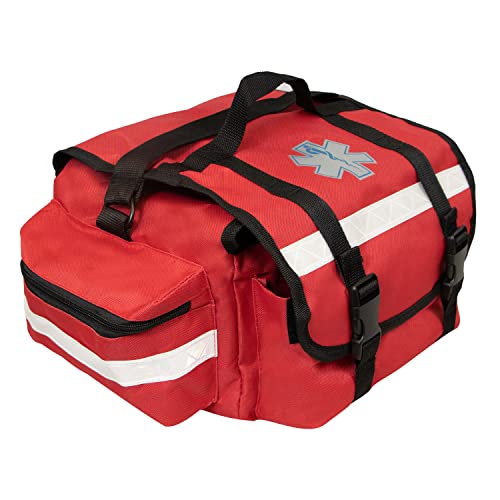
- Three padded center compartments
- Two zippered side pockets
- Red exterior with reflective strips
Best For: A portable, organized bag that's easier to locate in low light
Trauma Kit Organizer – WYNEX Tourniquet Holder Pouch
For ems duty gear for first responders, this WYNEX pouch keeps a tourniquet alongside shears, markers, and small rescue supplies. Its 500D nylon body supports several belt or MOLLE mounting positions.
Best For: Responders who want a dedicated tourniquet holder with space for nearby trauma accessories.
Pros:
- Main compartment has an adjustable hook-and-loop flap and easy-pull tab.
- Rear shear slot, side pockets, and four elastic loops organize additional tools.
- Includes a glow-in-the-dark cross patch and vertical or horizontal mounting straps.
Cons:
- Listed flap capacity is limited to tourniquets up to 6.7 inches long.
- Included components list the pouch and patch, not a tourniquet or shears.
Choose this if keeping trauma tools grouped on your belt or MOLLE gear matters more than a minimal pouch. Check your tourniquet’s dimensions before buying.
Flat-Profile Glove Carrier – TACNEX Duty Belt Glove Pouch
Among ems duty gear for first responders, the TACNEX pouch is a compact way to keep disposable gloves on your belt. Two separate pockets hold two pairs of latex gloves, while the nylon pouch folds flat when lightly loaded.
Best For: Responders who want quick access to disposable gloves without adding much belt bulk.
Pros:
- Two pockets separate glove pairs.
- Hook-and-loop belt attachment lets you add or remove it without taking off your belt.
- Low-profile design fits the listed 1.5- to 2-inch belt widths.
Cons:
- Gloves are not included.
- Designed for disposable gloves, not heavy-duty tactical gloves.
This is the simpler glove-carry option if you value a slim footprint and easy belt changes. Its stated capacity is two pairs of latex gloves; nitrile-glove capacity may vary with how they are packed.
Vehicle Rescue Multitool – StatGear T3 Tactical Auto Rescue Tool
For ems duty gear for first responders who work around vehicles, the StatGear T3 combines a folding blade, folding seatbelt cutter, spring-loaded window punch, and small LED light. It comes with a nylon sheath for duty-belt carry.
Best For: Responders seeking several vehicle-rescue functions in one belt-carried tool.
Pros:
- Includes a partially serrated 440C stainless-steel blade and locking seatbelt cutter.
- Spring-loaded window punch adds a dedicated glass-breaking function.
- Built-in 5-lumen LED and included sheath round out the carry setup.
Cons:
- At 8 ounces, it is heavier than a small standalone belt accessory.
- The 5-lumen LED is modest; it is not a substitute for a brighter work light.
The T3 makes sense when you prefer one sheath-mounted tool over carrying separate cutting and window-punch tools. Consider whether its size and weight fit your belt layout.
Durable Glove Storage – 1680D Nylon Duty Belt Glove Pouch
This 1680D nylon pouch adds compact disposable-glove storage to ems duty gear for first responders. Measuring 4.2 by 3.2 by 0.6 inches, it uses a hook-and-loop closure for access without a zipper or snap.
Best For: Responders who want a slim glove pouch made from heavier-duty nylon.
Pros:
- 1680D nylon is specified for resistance to everyday wear, tears, and scratches.
- Slim dimensions keep the pouch compact on a belt.
- Hook-and-loop closure and a 2.1-inch belt loop support straightforward access and mounting.
Cons:
- The notes do not specify an exact number of glove pairs it will hold.
- Its small size limits how much extra gear can fit alongside gloves.
Pick this pouch if material durability and a compact profile are priorities. Confirm your belt fits its 2.1-inch loop, and pack it with your preferred gloves to gauge usable capacity.
Glove Access – Slim Two-Pocket Duty Belt Pouch
For ems duty gear for first responders, this compact nylon pouch keeps spare disposable exam gloves on your belt instead of buried in a pocket. Its two compartments can hold at least two pairs of latex or nitrile gloves.
Best For: EMTs and other responders who want extra exam gloves within easy reach.
Pros:
- Slim design fits duty belts up to 2.25 inches wide.
- Hook-and-loop pouch closure allows quick access.
- Rear strap has hook-and-loop fastening and two snaps, so you can remove the pouch without undoing your belt.
Cons:
- Not intended for tactical gloves.
- Gloves are not included.
This is a practical pick when spare exam gloves matter more than carrying bulky tools. Check your belt width before buying.
This Star of Life badge reel is a small addition to ems duty gear for first responders who need to present an ID or reach keys without digging through pockets. Its steel cable extends 32.5 inches, and the carabiner clip swivels 360 degrees.
Best For: EMS staff who regularly reach for an ID badge or lightweight keys.
Pros:
- Long retractable cable offers reach from a belt loop or backpack.
- Swiveling clip gives you flexibility in where you attach it.
- Includes a key ring and ID strap.
Cons:
- Listed retracting force is 6–8 ounces, so check the weight of anything you plan to attach.
- The blue Star of Life design may not suit a uniform requiring a plain accessory.
Choose this reel for frequently used ID and small essentials, rather than assuming every tool will work comfortably on a retracting cable.
For crews building ems duty gear for first responders, this three-pack of Militaur door stops offers a compact way to help keep a door from latching during an entry or exit. They can ride on MOLLE gear and be placed at a door edge, top, or hinge.
Best For: Responders who need portable door stops during calls involving repeated movement through doorways.
Pros:
- Three stops let you distribute them across your gear or crew.
- MOLLE compatibility supports several carry positions.
- Attached 550 nylon paracord makes retrieval easier.
Cons:
- They must be placed and retrieved at each door.
- Keeping a door open may be inappropriate in some situations; follow scene procedures.
These are worth considering if doorway access is a recurring issue on your calls. Their value is in being easy to carry and deploy, not in replacing your crew’s access or safety procedures.
Vest-Mounted Pouch – PETAC GEAR Roll-Up First Aid Pouch
For ems duty gear for first responders worn on a vest or chest rig, this PETAC GEAR pouch offers a compact way to organize medical supplies. It attaches to hook-and-loop panels, and its removable inner bag unfolds for access to the contents.
Best For: Responders who want a removable medical pouch on compatible hook-and-loop gear.
Pros:
- Pull tabs at both ends help remove the inner bag quickly.
- Internal elastic bands secure items such as gauze, markers, and medical scissors.
- A bottom strap can hold a tourniquet.
Cons:
- Mounting requires a compatible hook-and-loop panel.
- Only the pouch is listed as an included component; medical supplies are not listed.
Choose this for an organized, removable pouch rather than a standalone supply bag. Its 500D nylon construction keeps the design lightweight, while the fully unfolding insert makes contents easier to reach.
Large Jump Bag – Lightning X EMT Trauma Bag
If your ems duty gear for first responders needs room for a larger collection of supplies, the Lightning X jump bag offers a spacious main compartment with removable foam dividers. Extra-large side pockets provide additional storage.
Best For: Responders assembling a large, customizable trauma kit without an oxygen bottle.
Pros:
- Removable foam dividers let you adjust the main compartment.
- Heavy-duty, water-resistant nylon helps protect the bag in routine use.
- Reflective striping appears on both the bag and padded shoulder strap.
Cons:
- The product notes say it does not accommodate an oxygen bottle.
- Its large format may be more bag than a compact kit requires.
This is the option for buyers prioritizing adjustable storage and visibility over a small carry format. Plan a separate solution if your setup includes an oxygen bottle.
Visible Trauma Bag – Primacare KB-RO74-R First Responder Bag
Among ems duty gear for first responders, the red Primacare KB-RO74-R is a straightforward choice for sorting supplies into dedicated spaces. It pairs three padded center compartments with two zippered side pockets.
Best For: Responders who want a portable, compartmentalized bag that is easier to locate in low light.
Pros:
- Three padded center compartments and two side pockets separate supplies.
- Two reflective strips add visibility in low-light conditions.
- A handle and sling strap offer carrying options.
Cons:
- At 17 x 9 x 7 inches, it has less room than a larger jump bag may offer.
- The supplied notes do not describe removable dividers.
This bag suits a kit whose contents benefit from a consistent layout. Its red exterior, medical logo, and reflective strips also help identify it among other bags.
How We Picked This Ems Duty Gear for First Responders
We organized these 10 products by the job each is intended to do: carry gloves or a tourniquet, support rescue and access tasks, keep an ID or keys handy, or organize medical supplies. We favored clear use cases over treating every pouch or bag as interchangeable. The product names and listed features establish the categories here; they do not verify field durability, included medical supplies, or compatibility with your particular belt and protective equipment. Check current specifications and your agency’s policies before buying.
Quick Comparison: What Belongs Where?
For frequent patient contacts, a duty-belt glove pouch keeps replacement gloves close. The TACNEX holder and the two other listed glove pouches fill that role; compare their attachment methods and how easily you can restock them. The WYNEX tourniquet holder provides dedicated on-body placement for a compatible tourniquet, while the PETAC GEAR drop pouch offers a different carry format for a small medical kit. Neither replaces a stocked trauma bag.
For scene tasks, the StatGear T3 combines a folding rescue knife with a seatbelt cutter, window breaker, and light. The Militaur door stops serve an access-control purpose, and the medical badge reel is for carrying an ID or keys. For larger loads, compare the Lightning X jump bag and Primacare trauma bag by the amount and layout of supplies you actually carry—not by bag size alone.
Key Buying Factors for Ems Duty Gear for First Responders
Access and Attachment
Start with your existing belt, vest, or MOLLE layout. Confirm the attachment type, available space, and whether you can reach the item while wearing gloves. Put time-sensitive equipment where authorized users can find it consistently. Avoid stacking pouches so tightly that one blocks another or catches on a seat belt.
Capacity and Organization
Match each carrier to its contents. Verify tourniquet fit before choosing a holder, and check that a glove pouch protects spare gloves while allowing quick replacement. With trauma bags, consider dividers, opening style, visibility of supplies, and how the loaded bag will be carried. A larger bag is only helpful if you can locate the right item quickly.
Role, Maintenance, and Policy
Choose gear for your scope of practice and response setting. Check whether a rescue knife or door stop is permitted, inspect fabric and closures regularly, and clean reusable gear according to its maker’s instructions and your infection-control procedures. Budget for the supplies that go inside an empty pouch or bag.
Who Should Buy Which Ems Duty Gear for First Responders?
Choose a glove pouch if routine patient care is your main on-body need; add a dedicated tourniquet holder only if it fits your issued equipment and carry plan. Consider the PETAC GEAR pouch for a compact kit, the StatGear tool for approved vehicle-rescue tasks, or the Militaur stops for teams that need them for access. A badge reel suits ID-focused carry. Pick the Lightning X or Primacare bag when you need a larger, organized supply load, then confirm its dimensions and layout against your inventory.