The right compression sack can shrink a bulky sleeping bag into a more manageable load while protecting it from damp ground, spills, and packed-gear abrasion. The best option depends on your bag’s packed size, the space available in your backpack, and how much weather resistance you need.
We’ve gathered 10 lightweight sleeping bag compression sacks ranging from compact stuff sacks to larger multi-size options, including water-resistant nylon and ripstop designs. Use the guide below to compare capacities and choose a sack that compresses efficiently without adding unnecessary weight.
Best 10 Lightweight Sleeping Bag Compression Sacks Picks for 2026
Lightweight Space Saver
Frelaxy Small Compression Sack

- About 90 g for a low-weight option
- Four adjustable straps for even compression
- Water-resistant polyester with a carry handle
Best For: Smaller sleeping bags and compact backpacking loads
Compact Nylon Organizer

- 110 g nylon construction
- Four adjustable compression straps
- Compact 12L-class capacity
Best For: Smaller sleeping bags and soft camping gear
Versatile Mid-Size Pick
Frelaxy Medium Compression Sack

- About 120 g in the medium size
- Four straps with quick-release buckles
- Water-resistant, tear-resistant polyester
Best For: Medium-volume backpacking and camping loads
High-Capacity Option

- 45L-class capacity for bulky soft gear
- About 125 g despite the larger size
- Four adjustable straps for compression
Best For: Large sleeping bags and high-volume camping loads
Best Space Saver
Frelaxy 40% More Space Compression Sack
- Claims up to 40% additional packing space
- Four adjustable straps for even compression
- Five sizes from 11L to 52L
Best For: Backpackers needing flexible capacity and low weight
Best Weather Protection
M-Tac Military Nylon Compression Sack
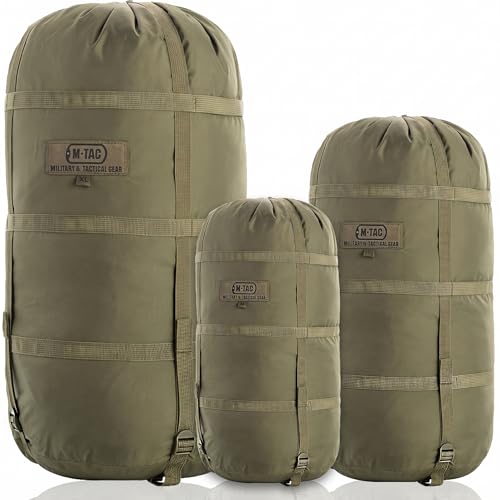
- Durable 100% nylon construction
- Water-resistant for outdoor conditions
- 12-liter cylindrical design with compression straps
Best For: Campers wanting sturdy, weather-resistant storage
Best Large Capacity
Frelaxy XX-Large Compression Sack
- 52-liter capacity for bulky camp gear
- 160-gram lightweight construction
- Four straps with quick-release buckles
Best For: Packing oversized sleeping bags and soft equipment
Compact Waterproof Organizer
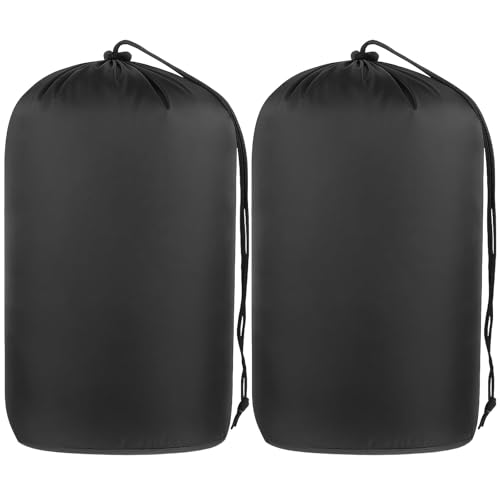
- Two lightweight 210T ripstop nylon sacks
- Waterproof construction with buckle closure
- Compact option for sleeping bags and travel gear
Best For: Campers wanting two waterproof organizer sacks
Adjustable Space Saver
Frelaxy 11L–52L Compression Sack

- Five sizes from 11L to 52L
- Four adjustable straps for even compression
- Reinforced 210T polyester construction
Best For: Backpackers compressing bulky soft gear
High-Visibility Compression
Frelaxy Orange Compression Sack

- Orange color improves pack visibility
- 11L–52L size range for flexible packing
- Four straps and reinforced seams
Best For: Backpackers wanting a visible compression sack
Lightweight Space Saver – Frelaxy Small Compression Sack
For hikers seeking lightweight sleeping bag compression sacks, this small Frelaxy model weighs about 90 g and uses four adjustable straps to reduce the packed volume of soft gear. Its water-resistant polyester construction also helps protect contents from light moisture.
Best For: Compact sleeping bags, clothing, blankets, and other soft gear in smaller backpacking loads.
Pros:
- Four straps support even compression, including quick-release buckles.
- Lightweight 210T tear-resistant polyester construction with a water-resistant coating.
- Bottom pull handle makes the sack easier to carry.
- Available in multiple sizes and colors for pack organization.
Cons:
- The small size may not fit bulkier sleeping bags.
- Designed for compressible soft items, not rigid equipment.
This is a practical choice when low carrying weight and organized packing matter most. Check your sleeping bag’s packed dimensions before choosing the 11L size.
Compact Nylon Organizer – 12L Compression Sack
This 12L nylon sack is one of the more compact lightweight sleeping bag compression sacks for soft camping gear. Its four adjustable straps help reduce bulk, while the listed 110 g weight keeps it suitable for backpacking, hiking, travel, or general gear storage.
Best For: Smaller sleeping bags, jackets, blankets, and clothing that need compact organization.
Pros:
- Four adjustable compression straps help reduce packed volume.
- Lightweight nylon fabric and webbing straps provide reusable storage.
- Useful for sleeping bags and other compressible soft gear.
- Compact 12L-class size suits smaller loads.
Cons:
- Requires careful size checking because packed gear dimensions vary.
- Not intended for rigid or hard-sided equipment.
- Includes the sack only; sleeping bag and gear are not included.
Choose this model when you want a straightforward, compact compression sack without excess bulk. Measuring your packed sleeping bag first is especially important with the smaller capacity.
Versatile Mid-Size Pick – Frelaxy Medium Compression Sack
The medium Frelaxy sack offers a useful balance for shoppers comparing lightweight sleeping bag compression sacks. It uses tear-resistant 210T polyester, weighs about 120 g in the medium size, and includes four straps for compressing sleeping bags, clothing, blankets, or similar soft items.
Best For: Medium-volume backpacking loads that need flexible organization and compression.
Pros:
- Medium capacity provides more room than the small version.
- Four adjustable straps distribute compression across the sack.
- Water-resistant coating adds protection against light moisture.
- Bottom pull handle and quick-release buckles improve handling.
Cons:
- Medium capacity may still be insufficient for very bulky gear.
- Compression sacks work with soft items rather than rigid equipment.
This model is a sensible middle-ground option for campers who need more capacity than a compact sack but do not want a larger, heavier design. Compare its packed dimensions with your gear before ordering.
High-Capacity Option – 45L Compression Sack
This 45L nylon sack is the high-capacity choice among these lightweight sleeping bag compression sacks. Despite its larger size, it weighs about 125 g and uses four adjustable straps to organize and compress bulky soft gear for camping, hiking, travel, or storage.
Best For: Large sleeping bags, blankets, jackets, and other bulky compressible gear.
Pros:
- 45L-class capacity accommodates larger soft loads.
- Four adjustable straps help reduce volume and organize contents.
- Lightweight nylon construction and webbing straps support reusable use.
- Suitable for backpacks, luggage, and camping storage.
Cons:
- Its larger footprint may be excessive for compact sleeping bags.
- Capacity and packed dimensions vary by the shape and fill of the gear.
- Not intended for rigid or hard-sided equipment.
Consider this sack when capacity is more important than having the smallest possible packed footprint. Measure your gear first, since a large compression sack is only useful if it fits your storage or pack setup.
Best Space Saver – Frelaxy 40% More Space Compression Sack
For hikers comparing lightweight sleeping bag compression sacks, the Frelaxy offers a practical balance of reduced bulk, carrying convenience, and everyday durability. Its four adjustable straps help compress sleeping bags and other soft gear, while the water-resistant polyester exterior adds protection from light moisture.
Best For: Backpackers who want multiple size options and straightforward internal pack organization.
Pros:
- Designed to free up as much as 40% additional space.
- Lightweight construction, with listed sizes ranging from 80 to 160 grams.
- Four straps support even compression, and a bottom pull handle makes carrying easier.
- Available in five capacities from 11L to 52L for sleeping bags, clothing, blankets, or tents.
Cons:
- The product is water-resistant rather than described as fully waterproof.
- Choosing the correct capacity is important because the listed sizes vary considerably.
Overall, this Frelaxy sack is a versatile choice when low weight, adjustable compression, and size flexibility matter more than a fully waterproof design.
Best Weather Protection – M-Tac Military Nylon Compression Sack
Among lightweight sleeping bag compression sacks, the M-Tac stands out for its military-inspired nylon construction and water-resistant design. Its cylindrical 12-liter format uses compression straps to reduce packed volume while accommodating sleeping bags, clothing, or other outdoor essentials.
Best For: Campers and travelers who prioritize durable nylon construction and added protection from wet conditions.
Pros:
- Made from 100% nylon and designed for repeated outdoor use.
- Water-resistant construction helps keep stored items dry and clean.
- Compression straps and easy-pull slings help reduce volume for transport.
- Large cylindrical shape can hold sleeping bags, clothing, or even a tent.
Cons:
- At 190 grams, it is heavier than some of the supplied lightweight alternatives.
- The listed version is a 12-liter medium size, offering less capacity flexibility than multi-size options.
- Its drawstring closure may be less quick to operate than a buckle-based closure.
The M-Tac is a sensible pick for rougher trips where nylon durability and water resistance are especially useful, provided the 12-liter capacity fits your sleeping bag.
Best Large Capacity – Frelaxy XX-Large Compression Sack
If you need lightweight sleeping bag compression sacks for bulky equipment, this XX-large Frelaxy model provides a listed 52-liter capacity and a four-strap compression system. The water-resistant polyester construction helps organize larger sleeping bags, blankets, clothing, or tents without adding much weight.
Best For: Backpackers carrying large-volume soft gear who want compression and a bottom carry handle.
Pros:
- XX-large 52-liter format is suited to bulky sleeping bags and camp gear.
- Weighs 160 grams, keeping the sack relatively light for its capacity.
- Two compression straps and two quick-release buckle straps support adjustable packing.
- Includes a handle and water-resistant coating for easier handling and added moisture protection.
Cons:
- The large capacity may be excessive for compact sleeping bags or small packs.
- Water resistance does not establish that the sack is fully waterproof.
- Its rectangular shape may occupy space differently from a cylindrical stuff sack.
Choose this version when capacity is the priority. Its 52-liter design is better suited to bulky loads than minimalist kits, while the 160-gram weight keeps the storage solution reasonably packable.
Compact Waterproof Organizer – Quinnsus 2-Pack Stuff Sacks
For shoppers comparing lightweight sleeping bag compression sacks, the Quinnsus 2-pack is a compact, waterproof storage option made from 210T ripstop nylon. Its drawstring-and-buckle closure and stable round base make it useful for organizing sleeping bags and other essentials in a camping or travel pack.
Best For: Campers and travelers who want two lightweight waterproof organizer sacks for sleeping bags, clothing, toiletries, or small gear.
Pros:
- Includes two stuff sacks for flexible packing and organization.
- Waterproof 210T ripstop nylon resists wear, tearing, and fading.
- Adjustable drawstring with buckle helps secure contents.
- Compact 5.1 x 9.8-inch size and stable round base support efficient packing.
Cons:
- The supplied specifications do not list a compression-strap system for progressive compression.
- The listed size may be limiting for especially bulky sleeping bags.
This Quinnsus set is better suited to waterproof storage and straightforward organization than heavy-duty compression. The two-sack format adds versatility, while the lightweight ripstop construction helps keep pack weight down.
Adjustable Space Saver – Frelaxy 11L–52L Compression Sack
The Frelaxy is a strong fit for anyone seeking lightweight sleeping bag compression sacks with more capacity flexibility. Available in five sizes from 11L to 52L, it uses four adjustable straps and reinforced seams to help compress sleeping bags, blankets, clothing, and other soft gear.
Best For: Backpackers and campers who need selectable capacity and adjustable compression for bulky soft items.
Pros:
- Five size options—11L, 18L, 30L, 45L, and 52L—cover varied packing needs.
- Four strong adjustable straps provide even compression.
- 210T tear-resistant polyester balances durability with a listed 70g weight for the small size.
- Double-reinforced seams target stress points, and the bottom pull handle aids carrying.
Cons:
- The product listing shows a zipper closure, which may add complexity compared with a simple drawstring sack.
- Weight varies by size, reaching 140g for the largest listed option.
With a claimed ability to free up 40% additional space, this Frelaxy sack is the most compression-focused option in the group. Choose the capacity carefully, since both dimensions and weight increase across the range.
High-Visibility Compression – Frelaxy Orange Compression Sack
For lightweight sleeping bag compression sacks that are easier to spot inside a pack, this orange Frelaxy model combines a bright color with the same practical space-saving design. Its four adjustable straps, slippery interior, and reinforced seams are designed for compressing and organizing soft outdoor gear.
Best For: Campers and backpackers who prefer a high-visibility orange sack for sleeping bags, blankets, clothing, or pillows.
Pros:
- Orange color can make the sack easier to identify among packed gear.
- Five available capacities range from 11L to 52L.
- Four adjustable straps support even compression and the listing claims up to 40% more storage space.
- Reinforced stress-point seams and a 12-month warranty support repeated outdoor use.
Cons:
- The small size is listed at 70g, while larger sizes weigh more.
- It is designed for soft compressible items, not rigid equipment.
This version offers the same broad size range and compression features as the other Frelaxy option, with orange fabric for a more visible packing system. It is a practical choice when quick identification matters as much as space savings.
How We Picked These Lightweight Sleeping Bag Compression Sacks
We focused on the features that matter most when packing a sleeping bag: listed capacity, compression design, material, water resistance, weight, and versatility. We also considered whether each sack is offered in multiple sizes, since a sack that is too small can over-compress insulation, strain seams, or make packing unnecessarily difficult. Options with adjustable straps, drawcord closures, and durable lightweight fabrics are especially useful for backpacking and travel.
Product descriptions and specifications can vary by size and seller, so confirm the exact capacity, dimensions, and included components before ordering. A compression sack is not automatically waterproof unless it has a sealed or roll-top construction.
Quick Comparison
| Best For | What to Look For | Typical Advantage |
|---|---|---|
| Ultralight backpacking | Light nylon, compact capacity, reliable straps | Lower pack weight |
| Wet-weather trips | Water-resistant or waterproof fabric and covered closures | Better protection from splashes and damp surfaces |
| Large or bulky sleeping bags | 30L–52L capacity range | Easier packing without forcing the insulation |
| Organizing multiple items | Two-pack or multi-size options | Flexible storage for clothing and camp gear |
Key Buying Factors for Lightweight Sleeping Bag Compression Sacks
Capacity and Fit
Check the sleeping bag’s compressed volume rather than its fully lofted size. A sack should hold the bag without excessive empty space, but it should not require extreme force to close. Smaller bags can suit summer quilts and compact down bags, while synthetic or cold-weather bags often need a larger 30L or 45L-plus model.
Compression System
Four-point webbing straps generally provide more even compression than a simple drawstring. Look for strap adjusters that are easy to operate with cold or gloved hands, reinforced attachment points, and a closure that stays secure when the sack is packed tightly.
Fabric and Weather Protection
Lightweight nylon and ripstop fabrics reduce bulk while resisting ordinary trail abrasion. Water-resistant material helps with condensation and splashes, but it should not replace a dry bag when your sleeping insulation must remain completely dry.
Weight and Durability
For backpacking, compare the sack’s weight with the compression and protection it provides. A slightly heavier design may be worthwhile for frequent use, larger sleeping bags, or rough travel. Inspect stitching, buckles, and strap anchors because these parts receive the most stress.
Who Should Buy Which Lightweight Sleeping Bag Compression Sacks?
Choose an ultralight, smaller-capacity sack if you carry a compact down sleeping bag and prioritize every gram. Select a larger multi-size Frelaxy-style option if you want flexibility for different bags or bulky synthetic insulation. Water-resistant models are a practical choice for damp campsites and general outdoor travel, while waterproof or sealed designs are better for exposed pack storage and heavy rain.
A two-pack such as the Quinnsus option can suit couples, families, or hikers who want separate organizers for sleeping gear and clothing. For rugged, utilitarian use, a military-inspired nylon compression sack such as the M-Tac model may be appealing. Whichever style you choose, match the sack to the packed volume first, then compare weight, weather protection, and hardware quality.