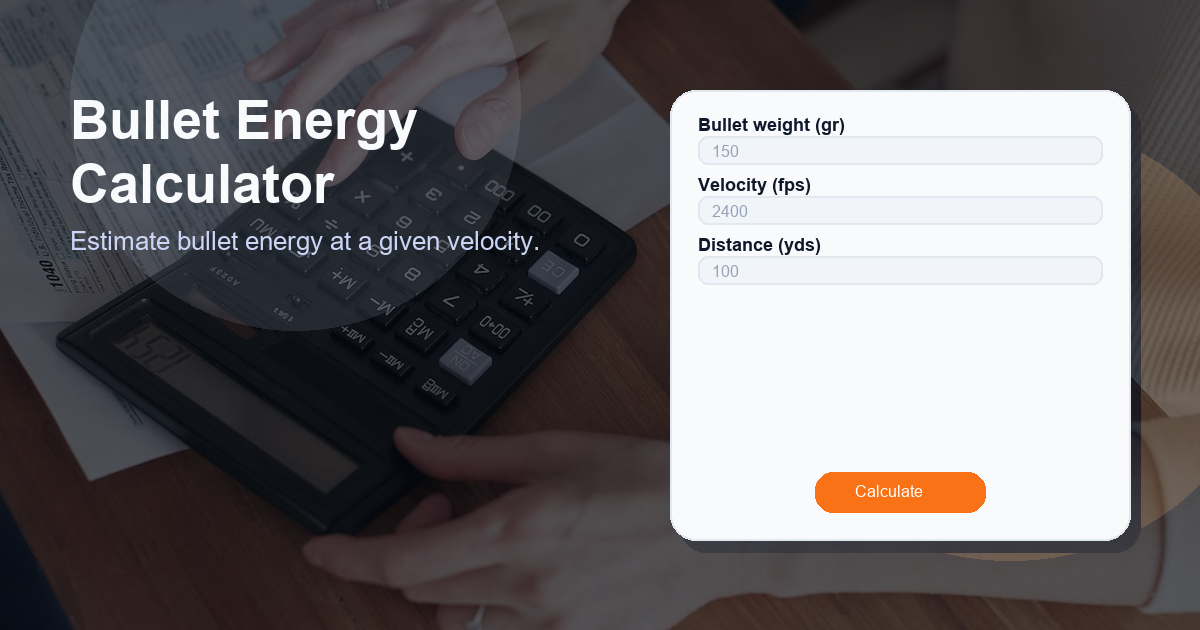
Estimate bullet energy at a given velocity. Use this Bullet Energy Calculator to quickly convert bullet weight and velocity into kinetic energy (foot-pounds), with an optional distance field to note where the velocity was measured.
What this Bullet Energy Calculator calculator does
This Bullet Energy Calculator converts a bullet’s mass in grains and its velocity in feet per second into kinetic energy using a standard ballistics formula. The result is presented as Energy (foot-pounds). Use this tool when you want a fast, reliable estimate of kinetic energy for comparison, load development, hunting considerations, or educational purposes.
Key features:
- Input bullet weight in grains (gr) and velocity in feet per second (fps).
- Optional distance (yards) — useful to record the range at which the velocity was measured or estimated.
- Output energy in foot-pounds (ft·lb), labeled Energy.
How to use the Bullet Energy Calculator calculator
Using the calculator is straightforward. Enter the bullet weight in grains and the measured or estimated velocity in feet per second. Optionally include the distance (in yards) at which the velocity was measured or estimated. Then click the Calculate Energy button to see the kinetic energy.
Result: Energy: —
How the Bullet Energy Calculator formula works
The calculator uses a widely adopted ballistics formula to convert bullet weight and velocity into kinetic energy measured in foot-pounds. The exact formula used by this tool is:
Energy = bullet_weight_gr * Math.pow(velocity_fps, 2) / 450240
Explanation of the components:
- bullet_weight_gr: the mass of the bullet in grains. There are 7,000 grains in one pound.
- velocity_fps: the bullet’s speed in feet per second.
- 450240: a constant that converts grains and feet/second into foot-pounds of energy. It combines unit conversions and the 1/2 factor in kinetic energy (1/2 m v^2) in a convenient integer.
Why this constant? The full kinetic energy in foot-pounds is:
KE (ft·lb) = 1/2 * mass (lb) * (velocity ft/s)^2 / g_c
When mass is provided in grains, and you convert grains to pounds and simplify constants, the shortcut divisor 450240 results. This makes quick, accurate calculations easy for shooters and reloaders.
Important: The formula itself does not inherently account for distance, drag, atmospheric conditions, barrel length, or bullet design. The velocity you enter should represent the velocity at the distance you want the energy for (muzzle velocity, 100 yards, 200 yards, etc.). If you only know muzzle velocity but want energy at a distance, use a ballistic calculator or chronograph data to estimate velocity loss over distance, then input that velocity here.
Use cases for the Bullet Energy Calculator
This calculator is useful for a range of practical and informational purposes. Typical use cases include:
- Hunting: Estimate the energy a bullet will deliver at typical hunting distances to evaluate stopping power for game species.
- Load development: Compare the energy of different loads and bullet weights when developing ammunition for accuracy and terminal performance.
- Ballistics education: Teach the relationship between mass, velocity, and kinetic energy.
- Comparative analysis: Quickly compare different cartridges or bullet weights to see how energy scales with velocity and mass.
- Field decision-making: Make informed choices about shot placement and range when you know the energy at the intended impact distance.
Because kinetic energy scales with the square of velocity, small increases in velocity produce relatively large increases in energy. For example, a 10% increase in velocity yields roughly a 21% increase in energy.
Other factors to consider when calculating Bullet Energy
While this Bullet Energy Calculator gives an accurate conversion from mass and velocity to kinetic energy, there are several additional factors that affect real-world performance and the utility of energy as a metric:
- Bullet construction and design: Two bullets with the same energy can behave very differently on impact — expanding, tumbling, or penetrating to different degrees.
- Ballistic coefficient (BC): BC determines how well a bullet resists air drag. Higher BC bullets retain velocity better at long ranges, so energy at distance is often influenced strongly by BC.
- Atmospheric conditions: Air density (altitude, temperature, humidity) affects drag and velocity retention.
- Barrel length and twist rate: These affect muzzle velocity and stabilization, altering energy and terminal performance.
- Range and velocity loss: Energy at impact depends on the velocity at the impact range — use chronographs or ballistic calculators to estimate this accurately.
- Shot placement and target composition: Energy alone doesn’t guarantee effectiveness — where the bullet hits, and what it strikes, are critical.
Use this tool as part of a larger ballistics workflow: measure or estimate velocity at the relevant distance, consider bullet design and BC, and account for environmental factors to get a realistic picture of terminal performance.
FAQ
Q: What unit of energy does the calculator output?
A: The calculator outputs energy in foot-pounds (ft·lb), a common unit in ballistics for kinetic energy.
Q: Why is distance an input if it doesn’t appear in the formula?
A: The formula requires bullet weight and velocity only. Distance is included so you can note or record the range at which the velocity was measured or estimated. Energy at a distance depends on the velocity at that distance — if you want energy at 200 yards, enter the velocity at 200 yards.
Q: How accurate is the energy result?
A: The arithmetic is precise for the input values provided. Accuracy depends on the accuracy of your weight and velocity inputs. For energy at range, you must supply an accurate velocity at that distance (from a chronograph or reliable ballistic model).
Q: Can I use this to compare different cartridges?
A: Yes. The calculator is ideal for comparing kinetic energy across cartridges, bullet weights, and velocities. Remember that energy is just one factor in terminal performance — bullet construction and shot placement matter too.
Q: Is this calculator suitable for legal or safety decisions?
A: This calculator is informational and educational. It should not be the sole basis for legal, medical, or safety-critical decisions. Always follow local laws, safe handling practices, and consult experts where appropriate.