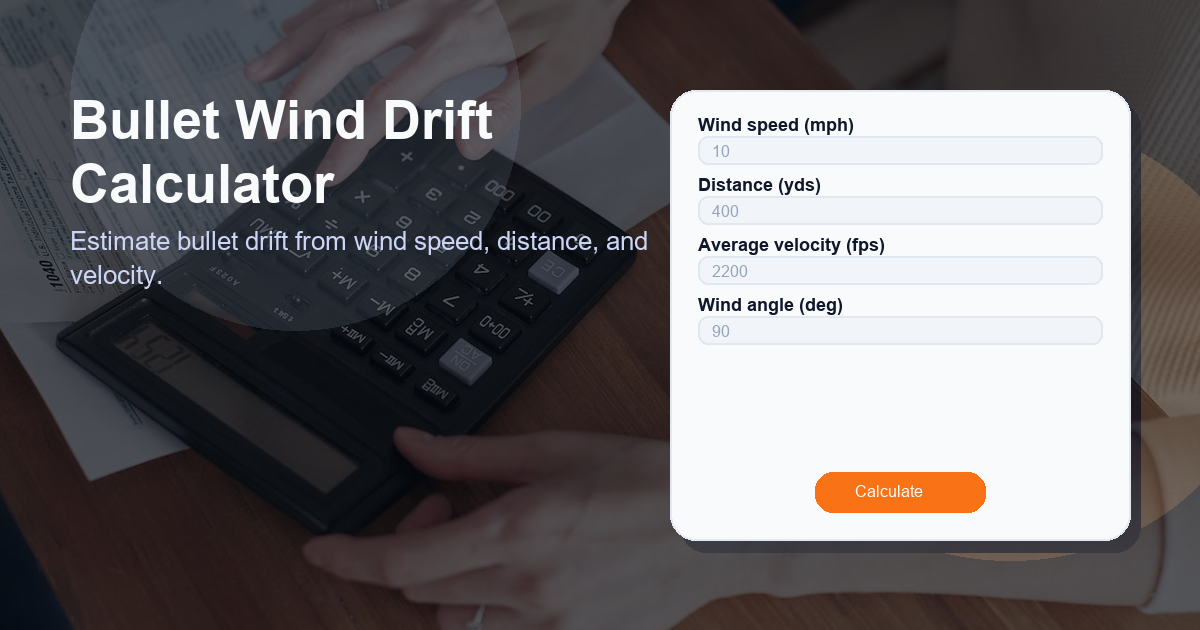
Bullet Wind Drift Calculator
Estimate bullet drift from wind speed, distance, and velocity. This Bullet Wind Drift Calculator helps shooters, hunters, and precision marksmen quickly estimate crosswind drift to plan holds or scope adjustments. Use the inputs below to get an instant approximation of expected lateral displacement (Drift).
What this Bullet Wind Drift Calculator does
The Bullet Wind Drift Calculator provides a fast, practical estimate of how far a bullet will be blown off line by crosswind over a given distance. It combines simple inputs — wind speed, range, average bullet velocity, and wind angle — to produce a single result labeled Drift. The calculator is designed for quick field use and planning rather than ultra-precise ballistics modeling, making it ideal for:
- Range estimation during shooting sessions
- Hold-off planning for open sights or reticles
- Ballistics training and quick decision-making
- Comparing scenarios (different winds, ranges, or bullet speeds)
Inputs:
- Wind speed (mph)
- Distance (yds)
- Average velocity (fps)
- Wind angle (deg)
Result label: Drift (approximate lateral displacement in inches)
How to use the Bullet Wind Drift Calculator
Using the Bullet Wind Drift Calculator is straightforward. Follow these steps to get a reliable quick estimate:
- Enter wind speed (mph) — the steady wind velocity in miles-per-hour. For gusty conditions, use the average effective wind or the gust that will most likely affect the shot.
- Enter distance (yds) — the range to the target in yards.
- Enter average velocity (fps) — the bullet’s average velocity over the flight in feet-per-second. If you only know muzzle velocity, use that as a close approximation, or take a ballistic table value for average velocity to the range.
- Enter wind angle (deg) — the angle of the wind relative to the shooting line. 90° is full crosswind, 45° is half-effect, 0° (or 180°) is head/tail wind with essentially zero lateral drift.
- Read the result — the calculator returns Drift, an estimated lateral displacement. This value is given in inches (see formula explanation below).
Example: Wind = 10 mph, Distance = 500 yds, Average velocity = 2500 fps, Wind angle = 90°.
- Convert distance to feet: 500 yds × 3 = 1500 ft
- Flight time ≈ distance_ft / avg_velocity_fps = 1500 / 2500 = 0.6 s
- Crosswind speed in ft/s ≈ 10 mph × 1.467 = 14.67 ft/s → lateral displacement ≈ 14.67 × 0.6 = 8.8 ft = 105.6 in
- The calculator uses the formula below and returns Drift ≈ 105.6 inches.
How the Bullet Wind Drift Calculator formula works
The calculation implemented in the Bullet Wind Drift Calculator is intentionally simple and fast to compute. The formula used (in programming ternary form) is:
avg_velocity_fps > 0 ? wind_speed_mph * 17.6 * (distance_yds * 3 / avg_velocity_fps) * (wind_angle_deg / 90) : 0Explanation of components:
- avg_velocity_fps > 0 ? … : 0 — safety check to avoid division by zero; if average velocity is zero or negative the result is 0.
- wind_speed_mph — input wind speed in miles per hour.
- 17.6 — a constant that converts wind speed in mph to inches-per-second effect over time and aligns units so the final result is in inches. It effectively encapsulates mph→ft/s conversion and ft→in conversion for an intuitive output.
- (distance_yds * 3 / avg_velocity_fps) — estimates the time of flight in seconds by converting yards to feet (×3) and dividing by average velocity (fps).
- (wind_angle_deg / 90) — scales the effect based on wind angle, where 90° is full crosswind (100% effect) and 0° is no lateral effect.
Unit note: The formula yields an estimated lateral displacement in inches. If you need yards or MOA adjustments for scope clicks, convert accordingly:
- Inches to yards: divide by 36
- Inches to MOA at a given range: MOA ≈ (inches / range_inches) × (3438) — use standard MOA conversion formulas for precision adjustments
Use cases for the Bullet Wind Drift Calculator
The simplicity and speed of the Bullet Wind Drift Calculator make it useful in many real-world scenarios where a quick drift estimate is valuable:
- Hunting: Determine a hold-off for a quick follow-up shot when a consistent wind is present and you need a fast approximation.
- Competition shooting: For stage planning or quick checks when dialing every click is impractical between shots.
- Training & education: Demonstrate how wind, distance, and velocity affect drift without a full ballistic solver.
- Field checks: Compare different loads or sighting options to get a sense of which setup reduces wind sensitivity.
- Ballistics software validation: Use the calculator’s estimate as a sanity check against more comprehensive ballistics models.
Other factors to consider when calculating drift
While this Bullet Wind Drift Calculator gives a quick estimate, several additional factors affect real-world bullet behavior and should be considered for higher accuracy:
- Ballistic coefficient (BC): Bullets with higher BCs resist wind drift better. The simple formula does not explicitly use BC.
- Air density and altitude: Temperature, humidity, and elevation change air density and thus drift. Higher altitudes usually reduce drag and wind effect.
- Crosswind profile: Winds often vary downrange. Layered or gusting winds can produce very different results than a steady value.
- Spin drift and Coriolis: At extreme ranges, gyroscopic spin and earth rotation contribute small but measurable lateral shifts.
- Target exposure and movement: Target movement, shooter position, and firing platform stability all influence the practical effect of calculated drift.
- Muzzle velocity vs. average velocity: Using muzzle velocity without accounting for drag will overestimate velocity over long ranges. Use average velocity to the target range for better estimates.
Frequently Asked Questions (FAQ)
Q: What units does the Bullet Wind Drift Calculator return for Drift?
A: The calculator returns an approximate lateral displacement in inches. You can convert inches to other units (yards or MOA) as needed for your sighting system.
Q: Can I use muzzle velocity for the average velocity input?
A: You can use muzzle velocity as a rough approximation, but average velocity to target is more accurate. For long ranges, consult a ballistic table or software to get average velocity to the distance.
Q: How accurate is the Bullet Wind Drift Calculator?
A: This tool provides a practical, quick estimate. It is not a substitute for full ballistic modeling that includes BC, air density, and downrange wind profiles. Expect useful approximations for short-to-medium ranges and steady winds.
Q: Why is wind angle important?
A: Wind angle determines how much of the wind’s force acts laterally on the bullet. A full 90° crosswind produces maximum lateral drift, while head/tail winds (0° or 180°) produce almost no lateral displacement.
Q: How should I handle gusting winds with this calculator?
A: For gusty conditions, use the most likely effective wind that will influence the bullet during its flight (often a conservative higher value) or perform multiple calculations for different gust speeds to plan a range of possible holds.