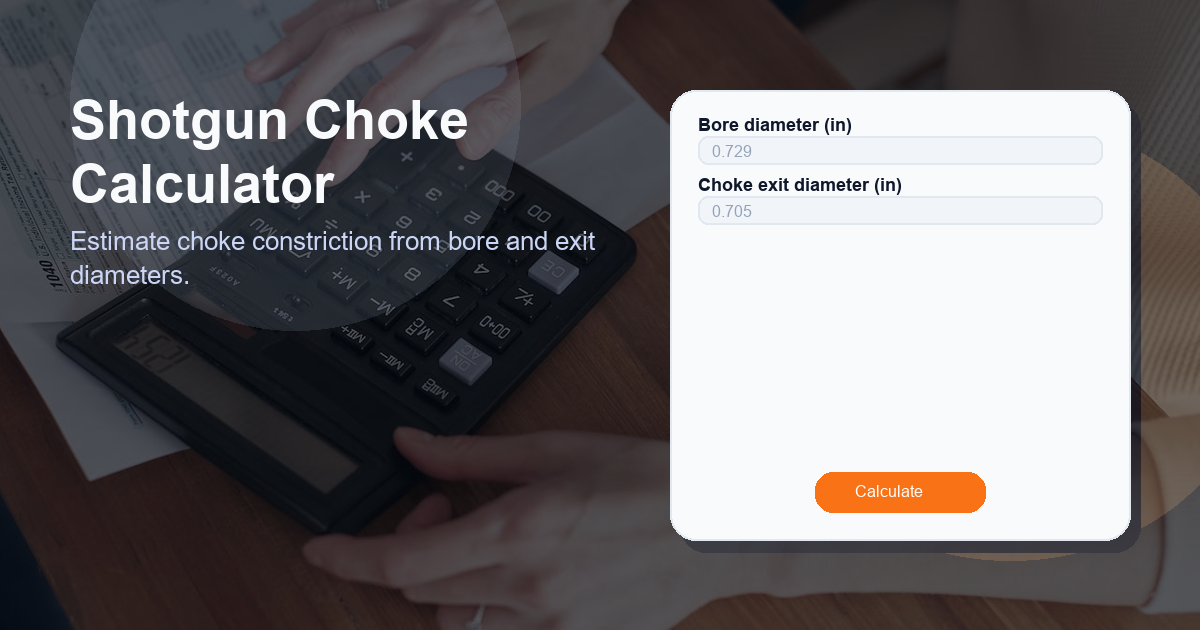
Shotgun Choke Calculator
Description: Estimate choke constriction from bore and exit diameters.
What this Shotgun Choke Calculator calculator does
The Shotgun Choke Calculator is a simple, focused tool designed to compute the amount of constriction in a shotgun barrel or choke tube by comparing the barrel’s bore diameter to the choke exit diameter. The calculator returns a single numeric value labeled Constriction, representing how much smaller the choke exit is relative to the bore. This value helps shooters, gunsmiths, and ammunition professionals understand patterning effects and select or specify chokes for different shooting situations.
Key features:
- Inputs: Bore diameter (in), Choke exit diameter (in)
- Formula: bore_diameter_in – choke_exit_in
- Result label: Constriction
- Units: Inches (in)
How to use the Shotgun Choke Calculator calculator
Using the Shotgun Choke Calculator is straightforward. Follow these steps to get a reliable constriction value:
- Measure the bore diameter: Use a precise caliper or bore micrometer to measure the internal diameter of the shotgun bore where the shot passes through. Record this measurement in inches.
- Measure the choke exit diameter: Measure the internal diameter at the choke exit (the muzzle end of the choke tube or fixed choke). Record this in inches as well.
- Enter the values into the calculator: Input the bore diameter (in) and the choke exit diameter (in) into the calculator fields.
- Calculate: The calculator uses the formula
bore_diameter_in - choke_exit_into compute the Constriction value. The result appears in inches. - Interpret the result: The returned constriction value tells you how much the choke reduces the bore diameter. A smaller constriction implies a more open pattern; a larger constriction indicates a tighter pattern at range.
Example:
- Bore diameter = 0.730 in
- Choke exit diameter = 0.666 in
- Formula: 0.730 – 0.666 = 0.064 in
- Result (Constriction): 0.064 in
How the Shotgun Choke Calculator formula works
The Shotgun Choke Calculator uses a direct subtraction formula to determine constriction:
Constriction = bore_diameter_in – choke_exit_in
Why subtraction? Because constriction is defined as the difference between the two diameters: the bore is the starting passage for the shot, and the choke exit is the restricted opening that modifies the shot column as it leaves the barrel. Subtracting the choke exit diameter from the bore diameter produces the absolute reduction in diameter expressed in inches.
Important technical notes:
- Sign and direction: If the choke exit diameter is smaller than the bore, the result is a positive constriction value. If the choke exit diameter equals the bore, constriction is zero (no choke effect). If the choke exit appears larger than the bore (rare or measurement error), the calculator will return a negative value — which indicates inconsistent or incorrect inputs and should be investigated.
- Precision: Use a caliper or bore gauge with sufficient resolution (0.001 in or better) for useful results, as choke constrictions are often small and minor differences can change pattern behavior.
- Units consistency: Both inputs must be in inches. Converting from millimeters first improves accuracy if you measured in metric units.
Use cases for the Shotgun Choke Calculator
The Shotgun Choke Calculator is useful in several practical situations where understanding constriction matters:
- Pattern tuning: Hunters and sport shooters who are adjusting chokes to obtain desirable shot patterns at specific ranges can use the constriction value to communicate and compare choke specifications.
- Choke selection: When choosing interchangeable choke tubes, the constriction number helps match a choke tube to your shooting needs (e.g., open patterns for close-range targets, tighter patterns for longer distances).
- Comparing barrels and chokes: Gunsmiths and enthusiasts can compare constriction values across different barrels or choke designs to assess performance differences objectively.
- Documentation and specification: For product descriptions, repair notes, or sharing setup details, the constriction value is a concise measure to record.
- Troubleshooting: If shot patterns are unexpectedly tight or open, verifying bore and choke exit diameters and computing constriction can reveal measurement or installation issues.
Other factors to consider when calculating x
While the Shotgun Choke Calculator gives a precise geometric measure of constriction (denoted here as x), several other real-world factors influence shot patterns and performance beyond simple diameter difference:
- Shot size and load: Different shot sizes and payloads respond differently to the same constriction. Larger shot may show different patterning behavior than smaller shot at the same constriction value.
- Barrel length and smoothness: Internal barrel condition, length, and any fouling affect shot dispersion. Two barrels with identical constriction values may still pattern differently.
- Shot column deformation: Modern choke designs aim to control the shot cloud with minimal deformation. How the choke shapes and compresses the shot column, not just the exit diameter, matters.
- Shot material and wad: Lead vs. steel shot, and the type of wad used, interact with chokes differently and change pattern density and distribution.
- Manufacturing tolerances: Chokes and barrels have tolerances. Repeated measurements and high-quality instruments reduce uncertainty when calculating constriction.
- Environmental conditions: Temperature, humidity, and range distance can all influence shot spread and should be considered when using constriction values to predict field performance.
FAQ
Q: What is the unit of the constriction result?
A: The Shotgun Choke Calculator returns constriction in inches (in). Both inputs — bore diameter and choke exit diameter — must be entered in inches for an accurate result.
Q: Can this calculator tell me the choke type (e.g., Modified or Full)?
A: No. The calculator provides the raw Constriction value only. Choke naming (Modified, Full, etc.) varies by manufacturer and is based on constriction ranges, but there is no universal standard. Use the constriction value to compare against manufacturer charts or patterning results.
Q: What if the calculator returns a negative constriction?
A: A negative value usually means the choke exit diameter was measured larger than the bore diameter. This can result from measurement error, damage, or a non-standard choke. Re-measure both diameters carefully with calibrated tools.
Q: How precise do my measurements need to be?
A: Constriction values are often small; measure to at least 0.001 in accuracy when possible. Higher precision reduces ambiguity in choke selection and pattern prediction.
Q: Does the calculator account for shot deformation or choke shape?
A: No. The Shotgun Choke Calculator calculates geometric constriction only. Factors such as choke profile, shot deformation, wad type, and barrel condition are not included and should be assessed separately through pattern testing.