The best backcountry snowshoes help you travel efficiently through deep, uneven snow while providing dependable traction on steep, icy terrain. The right pair should match your weight, pack load, route, and preferred pace.
We compared technical mountaineering models, versatile trail snowshoes, women’s-specific options, and budget-friendly kits to help you choose the right setup for winter hiking and off-trail exploration.
Best 10 Backcountry Snowshoes Picks for 2026
Technical Pick

- Lightweight 4.33-pound pair
- 360-degree traction for traverses
- Heel lift for steep climbs
Best For: Mountaineering and rugged backcountry terrain
Traction-Focused Pick

- Pro-Step frame with Soft-Tec decking
- Toe and heel crampons for grip
- 19-degree heel lift for climbs
Best For: Climbing-oriented backcountry outings
Modular Value

- 22-inch deck with molded steel traction
- Glove-friendly Tri Fit bindings
- Optional tails support up to 250 pounds
Best For: Versatile trips with changing load requirements
Comfort Pick

- Torsion deck improves uneven-terrain comfort
- Quick-Fit binding adjusts easily
- 16-degree lift reduces calf strain
Best For: Comfortable hiking on varied backcountry terrain
Reliable Trail Pick

- Steel traction components grip reliably.
- Bindings fit many footwear types.
- Optional tails add flotation.
Best For: Moderate trails and adaptable winter outings
Comfort-Focused Women's Pick

- Torsion deck supports a natural gait.
- BOA binding provides precise fit.
- Heel lift helps on steep climbs.
Best For: Women tackling uneven, hilly terrain
Technical Terrain Pick
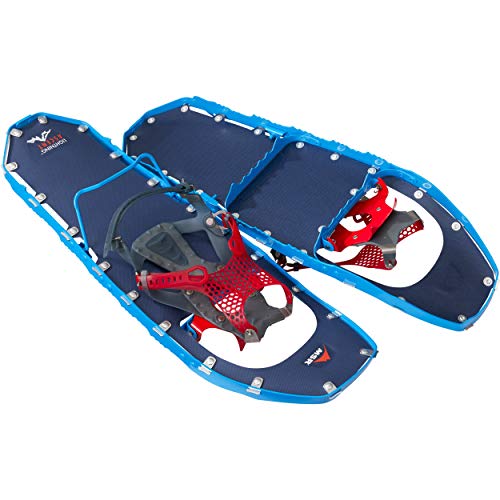
- 360-degree frame grips on traverses.
- DTX crampons bite into steep terrain.
- Heel lift supports uphill efficiency.
Best For: Mountaineering and aggressive backcountry routes
Complete Trail Kit

- Includes snowshoes, poles, and gaiters
- 30-inch aluminum snowshoes
- 220-pound maximum recommendation
Best For: Trail walkers seeking an all-in-one winter kit
Comfort-Focused Value Pick

- Padded EVA binding and fast ratchet closure
- Aluminum crampons with heel lift
- Includes poles and tote bag
Best For: Winter hikers wanting comfort and bundled accessories
High-Capacity Set

- 36-inch size with 300-pound recommendation
- Includes trekking poles
- Fast ratchet bindings and aluminum crampons
Best For: Users needing a larger platform and higher stated capacity
Technical Pick – MSR Lightning Ascent
For demanding backcountry snowshoes routes, the MSR Lightning Ascent combines a lightweight build with aggressive traction. Its 360-degree traction frames and steel DTX crampons are designed for traverses, steep alpine terrain, and rugged approaches.
Best For: Mountaineering, technical terrain, and aggressive backcountry pursuits.
Pros:
- Ultralight 4.33-pound-per-pair design with a 220-pound maximum load.
- 360-degree Traction Frames provide edge-to-edge grip on traverses.
- Paragon bindings contour around boots for secure alignment and pressure-free control.
- Ergo Televator heel lift helps improve uphill efficiency and reduce fatigue.
Cons:
- Its technical traction focus may be more capability than casual users need.
- The 25-inch length and 220-pound load limit may not suit every user or load.
The Lightning Ascent is a strong choice when traction, climbing efficiency, and low weight matter more than simplicity. Its USA-made construction and three-year warranty add confidence for demanding use.
Traction-Focused Pick – Tubbs Mountaineer
The Tubbs Mountaineer is a traction-oriented option among backcountry snowshoes, pairing a Pro-Step frame and Soft-Tec decking with dedicated toe and heel crampons. Its binding and heel-lift features support controlled movement on varied terrain.
Best For: Backcountry users who want articulated decking, secure bindings, and climbing assistance.
Pros:
- Pro-Step frame and Soft-Tec decking provide an articulated platform.
- Anaconda toe and Python heel crampons provide traction.
- ActiveFit 2.0 bindings and an EZ Heel Buckle support a secure fit.
- ActiveLift 19-degree heel lift assists on uphill terrain.
Cons:
- The listed maximum recommended load is 91 kg, limiting heavier users or gear.
- The supplied details do not specify a total pair weight clearly; the 16-ounce listing may be incomplete.
With its 19-degree lift and dedicated crampons, the Mountaineer is aimed at users who expect climbs and changing terrain. Verify sizing and load needs before choosing it for extended trips.
Modular Value – MSR Evo Ascent
The MSR Evo Ascent offers practical traction and modular load capacity for backcountry snowshoes trips. Molded-in steel rails and brake bars provide grip, while optional Evo Tails can expand carrying capacity when conditions or gear demands change.
Best For: Users seeking a versatile 22-inch snowshoe with optional flotation for heavier loads.
Pros:
- Steel traction rails and brake bars are molded directly into the deck.
- Tri Fit bindings accommodate a wide range of footwear and remain glove-friendly.
- Televator heel lifts help reduce fatigue and improve traction on steep terrain.
- Optional modular tails raise the recommended combined load from 180 to 250 pounds.
Cons:
- The standard maximum recommended load is 180 pounds including user and gear.
- Additional Evo Tails are sold separately for the higher load capacity.
The Evo Ascent is a sensible pick when packability and adaptable load support are priorities. Its shorter 22-inch deck and optional tails make it useful across changing trip requirements.
Comfort Pick – Tubbs Flex TRK
The Tubbs Flex TRK emphasizes natural movement on uneven ground, making it a comfortable choice among backcountry snowshoes. Its torsion deck, Flex Tail, and traction rails work together to support a rolling gait and grip on uphill, downhill, and sidehill terrain.
Best For: Hikers who prioritize flexible movement, comfort, and straightforward adjustment on varied terrain.
Pros:
- Torsion Deck enhances articulation, traction, and comfort on uneven terrain.
- Flex Tail promotes a more natural heel-to-toe roll.
- Quick-Fit bindings use easy-pull straps and a roller-buckle heel strap.
- ActiveLift provides a 16-degree heel lift to reduce calf and Achilles strain.
Cons:
- The supplied notes do not provide a maximum load recommendation.
- Its 24-inch size may not offer the flotation of a longer snowshoe in deep snow.
The Flex TRK stands out for gait-friendly design rather than an aggressively technical profile. It is a practical option for uneven trails and mixed slopes where comfort and easy fit adjustments matter.
Reliable Trail Pick – MSR Evo Trail 22
MSR Evo Trail Snowshoes, 22 Inch Pair, Midnight | Why We Like The MSR Revo Trail 22 Snowshoe
Check Price On AmazonThe MSR Evo Trail is a practical choice for backcountry snowshoes when you want dependable traction, straightforward bindings, and a durable deck for established trails and moderate winter terrain. Its 22-inch size balances maneuverability with useful flotation, while optional tails add capacity for deeper powder or heavier loads.
Best For: Trail users seeking durable, easy-to-operate snowshoes for loads up to 180 pounds before adding optional flotation tails.
Pros:
- Steel crampons and traction rails provide reliable grip.
- Stretch-mesh bindings fit a broad range of footwear and use glove-friendly straps.
- Durable injection-molded deck offers useful flex.
- Compatible with optional 6-inch flotation tails.
Cons:
- Optional tails are sold separately.
- The 22-inch deck may provide less flotation than longer models in deep powder.
The Evo Trail stands out as a versatile, low-fuss option for users who value easy entry and reliable traction. Its modular tail system also lets you expand flotation when conditions or pack weight demand it.
Comfort-Focused Women's Pick – TUBBS Women's Flex VRT
The TUBBS Women’s Flex VRT is designed for backcountry snowshoes users who want responsive traction and a more natural stride on uneven terrain. Its torsion deck, BOA-equipped binding, aggressive toe crampon, and heel lift support comfort and control across variable snow and steeper sections.
Best For: Women seeking precise fit, sidehill traction, and reduced calf strain on uneven or hilly terrain.
Pros:
- Torsion Deck supports articulation and preserves a natural gait.
- BOA Dynamicfit binding distributes pressure evenly for secure control.
- Carbon-steel toe crampon and curved rails provide aggressive traction.
- 19-degree ActiveLift heel lift can reduce strain on climbs.
Cons:
- The listed 25-inch size is less compact than a shorter trail model.
- Its technical traction features may be more than casual flat-trail users need.
With its articulated deck and climbing-oriented heel lift, the Flex VRT is particularly appealing for variable terrain. The BOA closure adds convenient adjustment when a precise boot fit matters.
Technical Terrain Pick – MSR Lightning Ascent
The MSR Lightning Ascent is built for demanding backcountry snowshoes trips, from mountaineering approaches to steep and rugged terrain. Its 360-degree traction frame, steel DTX crampons, contouring bindings, and heel lift combine edge-to-edge grip with climbing support.
Best For: Experienced users pursuing steep ascents, traverses, and aggressive backcountry routes with loads up to 220 pounds.
Pros:
- 360-degree Traction Frames maintain grip across traverses.
- Steel DTX crampons provide serious bite on steep terrain.
- Paragon bindings contour securely around boots without rigid pressure points.
- Ergo Televator improves uphill efficiency and can reduce fatigue.
Cons:
- At 4.33 pounds per pair, it is heavier than the MSR Evo Trail listed here.
- Its technical design may be unnecessary for simple, flat trails.
The Lightning Ascent is the strongest match in this group for steep, technical objectives. It trades some weight for a higher stated load capacity and traction system suited to traverses and alpine terrain.
Complete Trail Kit – Xplore Snowshoe Package
TUBBS Xplore Kit, Color: Silver/Blue, Size: 30 (X190100601300) | Xplore Snowshoe Kit
Check Price On AmazonFor shoppers comparing backcountry snowshoes, the Tubbs Xplore Kit stands out as a bundled option with snowshoes, adjustable poles, and gaiters. Its aluminum construction, 30-inch size, and 220-pound maximum weight recommendation suit trail walking and winter outings where having the core accessories together is convenient.
Best For: Trail walkers who want a coordinated snowshoe, pole, and gaiter package.
Pros:
- Includes snowshoes, two-part adjustable poles, and gaiters.
- Aluminum frame construction keeps the kit purpose-built for winter use.
- 30-inch snowshoes have a maximum recommended load of 220 pounds.
- Includes a one-year manufacturer warranty.
Cons:
- The kit weighs 6.5 pounds, so it is not the lightest option listed.
- The 30-inch size and 220-pound recommendation provide less capacity than some larger alternatives.
The Xplore Kit is a practical choice when convenience matters as much as the snowshoes themselves. Because poles and gaiters are included, it can simplify preparing for a trail outing, though buyers should confirm the size and weight recommendation fit their needs.
Comfort-Focused Value Pick – G2 Ratchet Snowshoes
These G2 backcountry snowshoes combine lightweight HDPE decking with aluminum crampons and a padded ratchet binding. The 30-inch version supports up to 250 pounds and adds a heel lift, trekking poles, and a tote bag for a more complete winter hiking setup.
Best For: Winter hikers who prioritize easy adjustments, cushioning, and included accessories.
Pros:
- HDPE decking is designed to provide flotation while keeping the snowshoes lightweight.
- One-pull ratchet buckles are designed for easy fastening in cold conditions.
- Padded EVA interiors add cushioning and warmth.
- Includes trekking poles and a tote bag, with a heel lift for uphill travel.
Cons:
- The listed 30-inch model weighs 6.5 pounds.
- Its maximum recommended load is 250 pounds, so sizing and total carried weight require attention.
- The product is offered in multiple sizes, and the 30-inch specification may not suit every user or snow condition.
With comfort-oriented padding, a cold-friendly ratchet system, and a heel lift, this G2 set is well equipped for recreational winter hiking. It offers useful extras without requiring separate purchases, provided the selected size matches the intended load.
High-Capacity Set – G2 36-Inch Snowshoes
For buyers looking at backcountry snowshoes for deeper snow or heavier loads, this G2 set pairs 36-inch snowshoes with trekking poles. It features aluminum construction, anti-slip crampons, fast ratchet bindings, and a maximum weight recommendation of 300 pounds.
Best For: Adults or youth users who need a longer snowshoe size and higher stated load capacity.
Pros:
- 36-inch size and 300-pound maximum recommendation support higher-load use.
- Includes trekking poles for a more complete setup.
- Fast ratchet bindings are designed for one-handed adjustment in cold conditions.
- Aluminum crampons and an anti-slip sole are intended to improve grip on snow and ice.
Cons:
- The 36-inch format may feel less compact than shorter snowshoes.
- The listed set weighs 4.8 pounds, but the longer size may still be bulkier to transport.
- The supplied listing identifies the blue version with poles, so color and configuration should be checked before ordering.
This set is the strongest match of the three for shoppers focused on load capacity and a longer platform. Its flex pivot bar, crampons, and poles make it a versatile option for flats and uphill routes, while the larger dimensions deserve consideration for storage and transport.
How We Picked the Best Backcountry Snowshoes
We focused on the features that matter most beyond groomed trails: flotation, traction, climbing aids, binding security, durability, and overall usability. The selection includes snowshoes suited to steep mountain routes, rolling backcountry terrain, packed trails, and occasional winter outings.
We also considered size options, user fit, packability, included accessories, and value. Because snow conditions vary widely, no single design is ideal for every trip. A compact pair may be easier to maneuver in dense woods, while a longer deck can provide better flotation in deep powder.
Quick Comparison
| What to Compare | Best For | What to Look For |
|---|---|---|
| Traction | Steep or icy routes | Steel crampons, side rails, and secure toe engagement |
| Flotation | Deep powder and heavy loads | Longer decks or compatible tails |
| Bindings | All-day comfort and reliability | Easy adjustment, secure hold, and resistance to snow buildup |
| Climbing support | Hills and mountain travel | Heel lifts that reduce calf strain |
| Weight and size | Long approaches or technical terrain | Light construction without sacrificing rigidity |
Key Buying Factors for Backcountry Snowshoes
Match the Size to Your Total Load
Snowshoe sizing should account for your body weight, clothing, boots, and backpack. Heavier users or anyone carrying winter camping gear generally needs more surface area. Shorter models are easier to control in forests and on narrow trails, but they may sink more in unconsolidated snow.
Prioritize Traction for Technical Terrain
For mountain routes, look for aggressive crampons and side traction rails rather than relying on flotation alone. A rigid frame and dependable binding help keep your foot aligned when traversing slopes or stepping over uneven crust.
Consider Binding Convenience
Bindings should be easy to operate with gloves and should hold boots firmly without pressure points. Ratchet systems can be quick to adjust, while flexible bindings may provide a comfortable, natural stride on rolling terrain.
Look for a Heel Lift When Climbing
A heel lift supports your foot on steep ascents and can reduce strain in your calves. It is especially useful for frequent backcountry climbing, though it adds a feature you may not need for flat trail walking.
Who Should Buy Which Backcountry Snowshoes?
Choose a technical mountaineering model if you regularly tackle steep slopes, icy traverses, or demanding off-trail routes. A versatile trail-oriented pair is a better fit for packed snow, rolling terrain, and recreational winter hikes. Women’s-specific models may offer a narrower deck and fit that improves stride efficiency for some users.
Budget kits with poles and carrying bags can be practical for beginners, families, and occasional users, but verify the weight rating and traction design before committing to difficult terrain. Whichever style you choose, size the snowshoes for your complete winter load and pair them with insulated boots, gaiters, and trekking poles for safer, more comfortable travel.