A power outage can leave familiar rooms unexpectedly hard to navigate. Emergency light bulbs offer a convenient backup: many charge in an everyday fixture and provide light when household power fails.
These 10 options span four- to eight-packs, different daylight color temperatures, and models with adjustable brightness. The right choice depends on where you need light, how much you need, and how you plan to use the bulbs during an outage.
Best 10 Emergency Light Bulbs Picks for 2026
Best Six-Pack
A21 Rechargeable Daylight Bulbs

- Six bulbs for multiple rooms
- Rated for 4–5 hours of backup light
- Hooks allow portable use
Best For: Covering several household fixtures
Best Higher-Capacity Battery

- 1500mAh battery per bulb
- Includes portable-use hooks
- Not for dimmer switches
Best For: Buyers prioritizing stated battery capacity
Best Longer Backup Window

- Rated for 5–7 hours of backup light
- 5000K daylight-white color
- Hooks and lamp connectors included
Best For: Extended outages and portable lighting
Best Adjustable Backup Light

- Three emergency brightness levels
- Up to 4–6 hours at 110 lumens
- Hooks and plug caps included
Best For: Adjusting brightness to conserve backup power
Best for Whole-Home Coverage
KeepLit 8-Pack Rechargeable Emergency Bulbs

- Eight A19 bulbs with E26 bases
- Three brightness settings; up to 48 hours on low
- 5000K daylight; up to 800 lumens
Best For: Preparing several rooms for outages
Best for Portable Backup
6-Pack 6000K Rechargeable Bulbs

- Six bulbs with hanging hooks
- Up to 6 hours on low in emergency mode
- 450-lumen maximum emergency output
Best For: Moving backup light between rooms or taking it camping
Best for Extended Low-Light Use
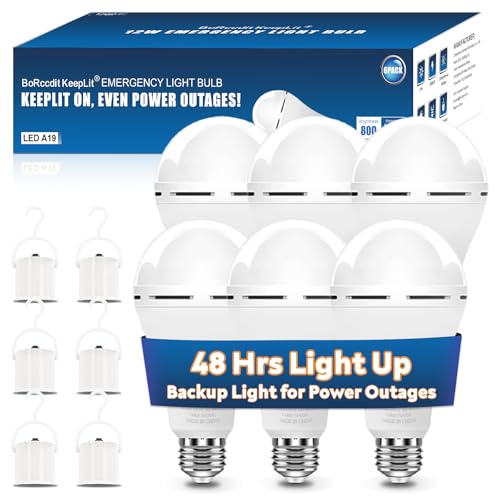
- Six A19 bulbs with E26 bases
- Three settings; up to 48 hours at 10%
- 5000K daylight; up to 800 lumens
Best For: Indoor backup lighting with a long-running dim option
Flexible Backup Pick
Neporal LITE Rechargeable A19 Bulb

- E26 A19 bulb recharges during normal use
- Three battery-mode brightness settings
- Hook hanger allows portable lighting
Best For: Adjustable backup light that can move between rooms
Whole-Home Pack
KeepLit 8-Pack Rechargeable A19 Bulbs

- Eight bulbs and eight hanging hooks
- Up to 48 hours claimed at 10% brightness
- 800 lumens rated for daily use
Best For: Equipping several rooms with matching backup bulbs
Six-Room Set
KeepLit 6-Pack Rechargeable A19 Bulbs

- Six bulbs and six hanging hooks
- Three battery-mode brightness levels
- Up to 48 hours claimed at 10% brightness
Best For: Covering key rooms with a six-bulb backup set
Best Six-Pack – A21 Rechargeable Daylight Bulbs
These emergency light bulbs come in a six-pack, making it practical to cover several rooms before an outage. They charge during everyday use and are rated to provide 4–5 hours of backup lighting.
Best For: Households that want backup bulbs in multiple fixtures.
Pros:
- Six bulbs cover more fixtures than a four-pack.
- E26/E27-compatible bases work with many household lamps.
- Included hooks let you use the bulbs away from a fixture.
Cons:
- Cool 6500K light may not suit rooms where you prefer a warmer tone.
- The A21 bulb is 5.47 inches tall, so check fixture clearance.
Choose this set if coverage matters most; its cool-white light and larger size are worth checking against your existing fixtures.
Best Higher-Capacity Battery – Neporal A23 Four-Pack
Neporal’s emergency light bulbs pair everyday fixture use with a 1500mAh backup battery in each bulb. The four-pack provides 6000K daylight and includes hooks for portable lighting when a socket is not convenient.
Best For: Buyers who prioritize a higher stated battery capacity and daylight-white light.
Pros:
- Each bulb has a stated 1500mAh battery that charges during regular use.
- Hooks offer another way to use the bulbs during an outage.
- Listed overcharge, overdischarge, short-circuit, and overcurrent protections.
Cons:
- Not compatible with dimmer switches.
- Stored bulbs need recharging every 60 days, according to the instructions.
This is a sensible pick if battery capacity is your priority, provided you have non-dimming fixtures and can keep stored bulbs charged.
Best Longer Backup Window – JackonLux 5000K Four-Pack
These JackonLux emergency light bulbs offer a stated 5–7 hours of gradually dimming backup light after a full charge. Their 5000K daylight-white color is less cool than the 6000K and 6500K options in this roundup.
Best For: Buyers who want a longer stated backup window and portable-use accessories.
Pros:
- Rated for 5–7 hours of backup illumination with gradual dimming.
- Includes four hook caps and two short connectors for lamp use.
- E26 base is also listed as compatible with E27 sockets.
Cons:
- A full charge requires 10–12 hours of cumulative or continuous use.
- Backup brightness gradually decreases over the stated runtime.
The longer stated lighting window is useful for extended outages, but plan ahead for the charging time and declining brightness.
Best Adjustable Backup Light – Three-Level A19 Four-Pack
These emergency light bulbs stand out for their three battery-powered brightness settings. Each A19 bulb provides a stated 800 lumens on mains power; in backup mode, you can choose brighter light for a shorter period or dimmer light for longer.
Best For: Households that want to adjust backup brightness to the situation.
Pros:
- Three stated emergency settings range from 450 lumens for 2–3 hours to 110 lumens for 4–6 hours.
- A19 shape measures 4.72 inches tall.
- Four hooks and two plug caps are included.
Cons:
- The stated 4–6-hour runtime applies only at the lowest, 110-lumen setting.
- The battery takes a stated 7–8 hours to charge fully.
The adjustable output gives you more control during a blackout, as long as you match your runtime expectations to the brightness setting.
Best for Whole-Home Coverage – KeepLit 8-Pack Rechargeable Emergency Bulbs
If you want emergency light bulbs in several rooms before an outage, this KeepLit eight-pack offers standard A19 bulbs with E26 bases that recharge during everyday use. Each delivers up to 800 lumens at a daylight 5000K color temperature.
Best For: Households looking to equip multiple lamps and fixtures with adjustable backup lighting.
Pros:
- Three brightness settings offer a stated 2–5 hours at 100%, 6–9 hours at 50%, or up to 48 hours at 10%.
- Eight bulbs make it easier to cover bedrooms, hallways, and other frequently used spaces.
- Included on/off hooks let you hang individual bulbs away from a socket.
Cons:
- The advertised 48-hour runtime applies to the lowest brightness setting, not full output.
- Its 5000K daylight tone may not suit buyers who prefer warm light.
The main advantage is coverage: you can prepare several rooms at once, then lower the brightness when extending runtime matters more than illumination.
Best for Portable Backup – 6-Pack 6000K Rechargeable Bulbs
These emergency light bulbs work in E26/E27 sockets during normal use and come with hooks for portable lighting during an outage or camping trip. The six-pack produces 6000K daylight light, with a stated 800-lumen output on mains power.
Best For: Buyers who want fixture-based backup bulbs that can also be hung where lighting is needed.
Pros:
- Three emergency brightness levels provide stated runtimes of 2–3 hours on high, 3–4 hours on medium, or 4–6 hours on low.
- Includes six hooks and three plug caps for flexible use.
- Bulbs are stated to hold their charge for up to 60 days when not in use.
Cons:
- Emergency output tops out at a stated 450 lumens, below the 800-lumen mains output.
- Its cool 6000K light may feel harsh if you prefer warmer lighting.
This set is a practical choice if portability matters, but compare its emergency-mode brightness—not its mains rating—when deciding how much light you need during a blackout.
Best for Extended Low-Light Use – KeepLit 6-Pack 48-Hour Bulbs
For emergency light bulbs that prioritize endurance, this KeepLit six-pack offers three brightness settings and a claimed runtime of up to 48 hours on its lowest setting. The A19 bulbs use E26 bases, recharge during everyday use, and provide 5000K daylight light.
Best For: Households that want backup lighting in several indoor rooms and can use a dim setting to conserve battery power.
Pros:
- Stated runtimes range from 2–5 hours at 100% brightness to 6–9 hours at 50% and up to 48 hours at 10%.
- Up to 800 lumens of output and three settings let you choose between brightness and runtime.
- On/off hooks allow use outside a light socket.
Cons:
- Reaching the advertised 48-hour runtime requires the dimmest setting.
- The product details specify indoor use, so do not assume it is suitable for exposed outdoor conditions.
Choose this six-pack if you want the KeepLit brightness controls without buying eight bulbs; its longest runtime is most useful for low-level navigation rather than full-room illumination.
Flexible Backup Pick – Neporal LITE Rechargeable A19 Bulb
The Neporal LITE is an emergency light bulb for buyers who want backup lighting in a familiar E26 fixture, plus a bulb they can carry during an outage. It recharges while the lamp is on in normal use and includes a hook hanger for portable use.
Best For: Households that want adjustable backup light they can move between rooms.
Pros:
- Three battery-mode brightness choices: 10%, 50%, and 100%.
- Three stated runtime choices: 2–3, 6–7, and 12 hours.
- A19 shape and E26 base fit compatible everyday fixtures.
Cons:
- Brightness adjustment is specified for battery mode, not ordinary plugged-in use.
- The supplied runtime claims are inconsistent: the title says up to 48 hours, while the feature bullets give shorter figures.
This is a practical choice if portability and selectable light levels matter more than a clearly established maximum runtime.
Whole-Home Pack – KeepLit 8-Pack Rechargeable A19 Bulbs
If you need emergency light bulbs for several rooms, this KeepLit eight-pack offers matching A19 bulbs with E26 bases and eight hanging hooks. The bulbs provide 5000K daylight light, recharge in normal fixture use, and switch to battery backup during an outage.
Best For: Stocking multiple compatible fixtures with the same backup bulb.
Pros:
- Eight bulbs and eight hooks are included.
- Up to 48 hours of claimed battery light at the 10% setting; stated runtime is 6–9 hours at 50% or 3–5 hours at 100%.
- Three battery-mode brightness levels, with switch-based control.
- Rated at up to 800 lumens in daily use.
Cons:
- The 48-hour figure applies to the dimmest setting, not full brightness.
- The fixed 5000K daylight color may not suit buyers seeking warm light.
Choose this pack when broad room coverage is the priority; plan around the shorter stated runtimes at brighter settings.
Six-Room Set – KeepLit 6-Pack Rechargeable A19 Bulbs
These KeepLit emergency light bulbs offer the same fixture-first approach in a six-pack: screw the A19 bulbs into compatible E26 sockets for everyday lighting and battery backup during outages. Six included hooks also let you use the bulbs away from fixtures.
Best For: Buyers who want a six-bulb backup set for key rooms and walkways.
Pros:
- Includes six rechargeable bulbs and six hanging hooks.
- Offers 10%, 50%, and 100% battery-mode brightness settings.
- Claims up to 48 hours at 10% brightness, with 6–9 hours at 50% and 3–5 hours at 100%.
- Rated for 800 lumens in normal use and a 6–8-hour recharge.
Cons:
- Full-brightness battery runtime is stated as 3–5 hours.
- Only the 5000K daylight color is specified.
The six-pack makes sense when you need fewer bulbs than an eight-pack but still want consistent controls and portable hooks across several locations.
How We Picked These Emergency Light Bulbs
We compared the listed specifications and practical differences across the 10 selected products: pack size, stated wattage and brightness equivalence, color temperature, bulb shape, base compatibility, battery capacity where provided, and advertised backup-light features. Several listings describe similar KeepLit or generic bulbs in different pack sizes, so we treated quantity as a buying decision rather than assuming each listing offers a different lighting experience.
Manufacturer runtime claims can depend on brightness setting and battery charge. We did not treat advertised maximum runtimes as a guarantee of equally bright light throughout an outage.
Quick Comparison
For a few essential fixtures, start with a four-pack; for multiple rooms, consider one of the six- or eight-packs. The listed 5000K bulbs produce a cooler white light, while 6000K and 6500K options are cooler still. If you want control over backup brightness, the KeepLit listings advertise three brightness levels. Neporal LITE and KeepLit listings advertise up to 48 hours of light, but check the conditions behind that figure before relying on it for overnight illumination.
Key Buying Factors for Emergency Light Bulbs
Fixture Fit and Charging
Confirm the base and bulb dimensions before ordering. Several options specify an E26 base, while A19 and A21 describe bulb shapes; an A21 bulb may be too large for a compact shade. Check that your fixture and switch arrangement support the bulb’s charging and outage-detection instructions. A battery-backed bulb is most useful when it has had time to charge before an outage.
Brightness, Color, and Runtime
Wattage equivalence describes intended light output during normal use, not how bright a bulb will remain on battery power. Check whether the listing specifies emergency-mode brightness and runtime at each setting. A dimmer mode can extend usable time, but may be better suited to orientation than reading or detailed tasks. Color temperature is a preference: 5000K offers crisp white light; 6000K–6500K can look noticeably cooler in a bedroom or living area.
Coverage and Backup Plans
Place bulbs where they will help you move safely, such as a hallway, bathroom, or main living space, rather than filling every socket. Rechargeable bulbs are a useful layer of outage lighting, not a replacement for charged flashlights or lanterns you can carry outside the home.
Who Should Buy Which Emergency Light Bulbs?
Choose a four-pack if you need to cover a small apartment or a handful of high-priority fixtures. A six-pack suits households adding coverage to several rooms, while an eight-pack makes more sense when you have enough compatible fixtures to use the extras. Consider KeepLit if selectable brightness is your priority, and compare Neporal LITE if its advertised extended runtime appeals to you. If simple daylight lighting matters more than extra modes, compare the 5000K, 6000K, and 6500K options by fit, pack size, and stated emergency performance before buying.