The best indoor motion detectors can alert you to unexpected movement, announce an entry, trigger lighting, or help monitor a loved one without requiring a complicated security installation.
This roundup compares 10 options across coverage, alert types, wireless range, pet-friendliness, volume, and specialized caregiving features so you can choose the right fit for each room.
Best 10 Indoor Motion Detectors Picks for 2026
Reliable Room Coverage

- 100° field of view up to 30 feet
- Up to two-year battery life
- Adjustable, pet-conscious sensitivity
Best For: App-based room monitoring with broad indoor coverage
Long-Range Smart Detection

- Radar-based detection for indoor environments
- Up to 2,034-foot open-air LoRa range
- Hub required for app connectivity
Best For: YoLink automations and configurable motion alerts
Simple Pet-Friendly Alerts

- 90° coverage with a 9.1-meter range
- Pet-friendly mode for pets under 50 pounds
- No base station required
Best For: Ring-connected room alerts in pet-owning households
Audible Entry Alerts

- 32 chimes and five volume levels
- Up to 500-foot receiver range
- Expandable to 20 sensors
Best For: Local entry alerts for homes, shops, and caregiving
Best Long-Range Coverage
Wireless Driveway Motion Alarm

- Up to 328 feet between sensor and receiver
- Four sensors with one plug-in receiver
- 38 chimes, LED alert, and adjustable delay
Best For: Monitoring multiple entrances or rooms
Best Multi-Alert Kit

- Four detectors and two alarm receivers
- Up to 300 feet of wireless transmission
- 38 tones, three volume levels, and silent mode
Best For: Multi-room coverage with quiet alert options
Best Customizable Alert

- Up to 500 feet of receiving range
- 58 ringtones and five volume levels
- Supports up to 20 motion sensors per receiver
Best For: Large spaces needing expandable, adjustable alerts
Most Powerful Siren
TECKNET 125dB Indoor Motion Alarm
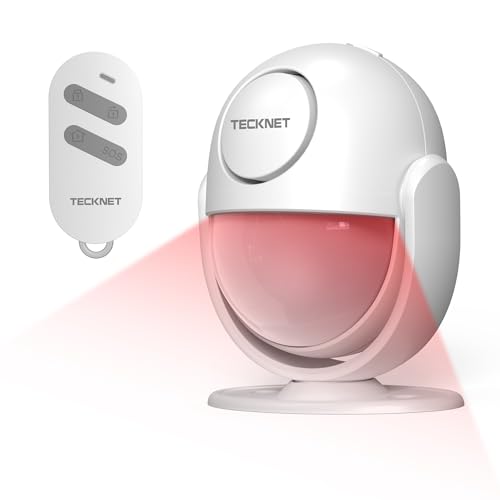
- 125dB siren with flashing strobe
- 16–26ft PIR detection and 120° coverage
- Remote control reaches up to 328ft
Best For: Garages, entryways, shops, and other indoor spaces needing a loud alert
Best Caregiver Alert
EverNary Wireless Motion Pager

- Motion sensing within 16.4 feet
- 58 ringtones and five volume levels
- Visual LED and wireless receiver alerts
Best For: Caregiver monitoring, room movement alerts, and entry notifications
Best Battery-Powered Value

- 125dB siren with 16–26ft PIR detection
- Includes three AA batteries and mounting accessories
- Alarm, chime, and remote SOS modes
Best For: Portable security in garages, sheds, shops, and other indoor spaces
Reliable Room Coverage – eufy Security Motion Sensor
The eufy Security Motion Sensor is a practical choice for indoor motion detectors when you want broad room coverage, adjustable sensitivity, and phone alerts. Its 100° field of view reaches up to 30 feet, while the included battery can last up to two years.
Best For: Homeowners who want app-connected room monitoring with pet-sensitive settings.
Pros:
- 100° coverage detects motion up to 30 feet away.
- Adjustable sensitivity can help reduce alerts from cats and dogs.
- Included battery provides up to two years of operation.
- Sends motion notifications through the eufy Security app.
Cons:
- Not waterproof, so it is intended for indoor use.
- App alerts require the eufy Security setup.
With wide coverage and long battery life, this sensor is a well-rounded option for rooms where you want straightforward monitoring and remote notifications.
Long-Range Smart Detection – YoLink Radar Motion Sensor
The YoLink Indoor Radar Motion Sensor is designed for indoor motion detectors buyers who prioritize radar-based accuracy and smart-home automation. It offers customizable detection settings, motion and no-motion alerts, and long-range LoRa communication with a compatible hub.
Best For: YoLink users who want configurable alerts and automations across larger properties.
Pros:
- Radar technology is designed to improve detection accuracy and reduce false alarms.
- LoRa wireless communication reaches up to 2,034 feet in open air.
- Included batteries can last up to 24 months.
- Supports sensitivity adjustments, alert holds, and no-motion detection.
Cons:
- Requires a YoLink Hub or SpeakerHub for app connectivity and remote alerts.
- Actual wireless range varies with walls, obstacles, and placement.
This sensor makes the most sense within an existing YoLink ecosystem, especially when you want motion events to trigger lights, sirens, or other connected devices.
Simple Pet-Friendly Alerts – Ring Motion Detector
The Ring Motion Detector is a straightforward option among indoor motion detectors, covering a room with a 90° field of view and a range of up to 9.1 meters. It sends instant motion-activated alerts and connects over Amazon Sidewalk without a base station.
Best For: Ring users seeking simple room monitoring with customizable pet-friendly settings.
Pros:
- One sensor covers a room up to 9.1 meters away.
- Pet-friendly settings can reduce alerts from pets under 50 pounds.
- No base station is required for connection.
- Supports optional 24/7 Pro Monitoring with a compatible Ring subscription.
Cons:
- Amazon Sidewalk is required, and coverage may vary.
- 24/7 professional monitoring requires a compatible subscription.
For households already using Ring or Amazon Sidewalk, this detector offers an uncomplicated way to receive room-level alerts while limiting some pet-related notifications.
Audible Entry Alerts – Wireless Motion Sensor Chime
This wireless motion sensor chime is a useful alternative among indoor motion detectors when an audible or visual alert matters more than app connectivity. It detects movement within 16 to 26 feet, sends signals to a receiver up to 500 feet away, and offers 32 chimes with adjustable volume.
Best For: Homes, shops, offices, and caregiving situations that need a noticeable entry or movement alert.
Pros:
- Offers 32 chimes, five volume levels, and silent mode.
- Receiver and sensor can communicate across up to 500 feet.
- Flashing LED provides a visual alert for hearing-impaired users.
- Can expand to up to 20 sensors and unlimited receivers.
Cons:
- Motion detection range is limited to 16–26 feet.
- Provides local chime or alarm alerts rather than app notifications.
- Requires two AAA batteries for the sensor.
Its plug-in receiver, loud alarm, and expandable design make it particularly practical for entrances, retail counters, garages, or monitoring movement in another room.
Best Long-Range Coverage – Wireless Driveway Motion Alarm
This wireless motion alarm is a practical option for indoor motion detectors setups that need alerts from a driveway, entryway, window, or hallway. Its transmitter-to-receiver range reaches up to 328 feet, while the receiver offers 38 chimes and a flashing LED indicator.
Best For: Homes or small businesses monitoring entrances, driveways, walking paths, or separate rooms.
Pros:
- Up to 328 feet of wireless range between sensor and receiver.
- Includes four sensors and one plug-in receiver.
- Offers 38 ringtone choices, LED alerts, and adjustable detection delay.
Cons:
- Sensor requires three AAA batteries, which are not included.
- Not waterproof and needs protection from rain.
- Motion detection range is listed at up to 23 feet.
Choose this model if long transmitter-to-receiver distance and multi-sensor coverage matter most. Its indoor-focused design and flexible chime settings make it useful for monitoring several access points.
Best Multi-Alert Kit – Indoor Motion Security System
For shoppers comparing indoor motion detectors, this kit combines four motion sensors with two alarm receivers for broader coverage around a home. It provides up to 300 feet of wireless transmission, selectable chimes, volume controls, and a silent LED-only mode.
Best For: Families wanting multiple monitored locations, quiet alerts, or flexible entryway and room notifications.
Pros:
- Includes four motion detectors and two alarm receivers.
- Offers up to 300 feet of wireless signal range and about 20 feet of motion detection.
- Provides 38 ringtones, three volume levels, and silent LED notification.
Cons:
- AAA batteries for the detectors are not included.
- Not waterproof and should be kept away from rain.
- Wind and obstructions can contribute to false alarms or reduced detection.
This is a versatile choice when one receiver is not enough or when silent notifications are useful. Careful placement away from wind and obstructions should help support more dependable operation.
Best Customizable Alert – 500-Foot Motion Chime
This COTINSE system stands out among indoor motion detectors for its long receiving range and extensive alert customization. The receiver supports 58 ringtones, five volume levels, a flashing LED, and expandable pairing with up to 20 motion sensors.
Best For: Homes, offices, stores, or schools needing a highly adjustable alert system over a large wireless distance.
Pros:
- Receiver-to-transmitter range reaches up to 500 feet.
- Offers 58 ringtones and five adjustable volume levels.
- One receiver can work with up to 20 motion sensors.
- Includes sensor batteries and uses a plug-in receiver.
Cons:
- Motion detection range is about 13 to 16.5 feet.
- The listed configuration includes one sensor and one receiver.
- The 110 dB alarm may be too loud for some indoor settings.
This model is a strong fit when customization and expandable coverage are priorities. Its shorter detection radius may require more deliberate sensor placement, but the long receiving range is useful across larger properties.
Most Powerful Siren – TECKNET 125dB Indoor Motion Alarm
For shoppers comparing indoor motion detectors, the TECKNET stands out with a 125dB siren, flashing strobe, and flexible battery or USB-C power. Its PIR sensor covers approximately 16–26 feet across a 120° field of view, while the included remote simplifies arming and mode changes.
Best For: Indoor entryways, garages, shops, storage rooms, and vehicle interiors where a loud local alarm is a priority.
Pros:
- 125dB alarm, flashing strobe, and three selectable volume levels.
- Alarm and doorbell-chime modes support different monitoring needs.
- Remote control works up to 328 feet in open areas and the sensor can be wall-mounted or placed on a flat surface.
Cons:
- USB-C powers the alarm but does not recharge the three AAA batteries.
- Designed primarily for indoor use and does not require Wi-Fi or an app.
The TECKNET is a practical choice when deterrence matters more than app connectivity. Its adjustable installation and remote controls make it versatile, while the loud siren may be excessive for quieter rooms.
Best Caregiver Alert – EverNary Wireless Motion Pager
Among indoor motion detectors, this EverNary kit is designed less as a deterrent and more as a remote movement alert. The motion sensor detects activity within 16.4 feet and sends sound and visual notifications to its plug-in receiver, helping caregivers monitor rooms without staying nearby.
Best For: Caregiver monitoring, bedroom or bed-area movement alerts, entry notifications, and households needing audible and visual signals.
Pros:
- Receiver offers 58 ringtones and five volume levels up to 110dB.
- Flashing LED provides a visual alert for hearing-impaired users or noisy environments.
- Wireless transmission reaches up to 260 feet in open areas, with adjustable mounting and battery or USB operation.
Cons:
- The sensor’s 16.4-foot detection range should be tested before permanent mounting.
- Walls and doors can reduce the stated transmission distance.
This is a flexible notification system for monitoring movement rather than sounding a security siren at the sensor. Its customizable receiver and visual indicator make it especially useful in caregiving situations.
Best Battery-Powered Value – Luckydeer 125dB Motion Alarm
This Luckydeer model is one of the more straightforward indoor motion detectors for sheds, garages, bedrooms, and other spaces without a wired alarm setup. It uses three included AA batteries, detects motion approximately 16–26 feet away, and includes a remote for alarm, chime, and SOS functions.
Best For: Portable indoor security, garages, sheds, boats, shops, and households wanting a battery-powered alarm with simple installation.
Pros:
- 125dB siren with PIR detection and intelligent signal analysis intended to reduce false alarms.
- Includes three AA batteries, mounting hardware, adhesive tape, and a remote control.
- Supports doorbell and alarm modes, plus a remote SOS button.
Cons:
- Remote range is up to 328 feet only in open areas.
- Supplied notes specify two volume levels, offering less adjustment than some alternatives.
The Luckydeer offers a convenient standalone setup for users who want a loud local warning without Wi-Fi or a hub. Its included accessories and one-year warranty add practicality for basic indoor monitoring.
How We Picked the Best Indoor Motion Detectors
We evaluated these Indoor Motion Detectors by looking at the features that matter most in everyday use: detection coverage, alert speed, installation requirements, wireless range, power source, sound level, and intended setting. We also considered whether each model is better suited to whole-home security, a single doorway, a driveway, lighting automation, or caregiver monitoring.
Because these products serve different purposes, the loudest alarm is not automatically the best choice. A compact sensor may be preferable for a bedroom, while a long-range detector or plug-in receiver may make more sense for a large home or caregiving setup.
Quick Comparison
| Best For | Look For | Standout Features |
|---|---|---|
| Smart home security | App alerts and system compatibility | Remote notifications and automation |
| Entry notification | Audible chime and simple setup | Immediate alerts without complex wiring |
| Large properties | Extended wireless range | Remote receivers and long-distance coverage |
| Caregiving | Plug-in alerts and dependable receivers | Room, bed, and movement monitoring |
| Lighting | Motion-triggered activation | Hands-free illumination |
Key Buying Factors for Indoor Motion Detectors
Detection Coverage and Placement
Check the stated viewing angle and detection distance before buying. A 90- or 100-degree sensor can work well in a hallway or doorway, but a larger room may require careful corner placement or multiple units. Mount the detector where people naturally pass, and avoid pointing it directly at windows, heaters, or moving fans.
Alert Type and Volume
Decide whether you need a phone notification, siren, chime, light, or caregiver receiver. Very loud alarms can be useful for security but disruptive in bedrooms. Adjustable volume or multiple alert modes provide more flexibility.
Connectivity, Range, and Power
Smart models may require an app, hub, or compatible alarm ecosystem, while standalone wireless alarms are often quicker to install. Compare the advertised transmission range with your home’s walls and layout. Also check whether the sensor uses replaceable batteries, rechargeable power, or a plug-in receiver.
Pets and False Alerts
If pets share the room, prioritize a pet-friendly mode and position the sensor above common pet pathways where possible. No detector eliminates false alerts completely, so placement and sensitivity settings remain important.
Who Should Buy Which Indoor Motion Detectors?
- Choose a smart security sensor if you want app-based intruder alerts or integration with an existing home alarm system.
- Choose a wireless chime or entry alarm for a shop, office, front door, or room where an audible arrival notification is the main goal.
- Choose a long-range alarm for a driveway, detached area, or larger property where the receiver may be far from the detector.
- Choose a motion-activated light sensor for closets, halls, stairs, and other spaces that need temporary illumination.
- Choose a caregiver-oriented system when monitoring movement, bedrooms, beds, or fall-risk areas is more important than general intrusion protection.
Before purchasing, confirm the detection range, receiver requirements, battery details, and installation location. The best option is the one that delivers the right alert in the room and situation you actually need to monitor.