The best indoor motion detectors for homes can do more than sense movement. Depending on the model, they can send app alerts, trigger a security system, sound a loud alarm, or announce activity with a door chime.
These 10 picks cover smart-home sensors, pet-friendly detection, wired professional-style hardware, and standalone alarms. Use the guide below to match detection range, connectivity, power, and alert style to your space.
Best 10 Indoor Motion Detectors for Homes Picks for 2026
Radar Precision Pick
YoLink Indoor Radar Motion Sensor RT

- Radar detection with adjustable sensitivity
- Up to 2,034-foot open-air LoRa range
- Up to two years of battery life
Best For: Hub-based YoLink homes needing customizable indoor alerts
Simple Room Coverage Pick

- 90-degree coverage up to 9.1 meters
- Pet-friendly settings for pets under 50 pounds
- No base station required; uses Amazon Sidewalk
Best For: Ring households wanting easy room alerts
Smart Automation Pick

- 120-degree detection up to 7 meters
- Adjustable 3-, 5-, or 7-meter range
- Up to two years from one CR2450 battery
Best For: Tapo users creating motion-triggered smart actions
Wired Security System Pick

- Wired PIR detection for permanent installations
- Stated 40-by-56-foot detection area
- Designed for alarm and lighting control
Best For: Existing compatible wired security systems
Best Entry Alert
Wireless Motion Sensor Door Chime

- 32 chimes with five volume levels and silent mode
- 500-foot receiver-to-sensor wireless range
- Expandable to 20 sensors and unlimited receivers
Best For: Entryways, garages, and room-to-room alerts
Best Loud Alarm
TECKNET Indoor Motion Sensor Alarm
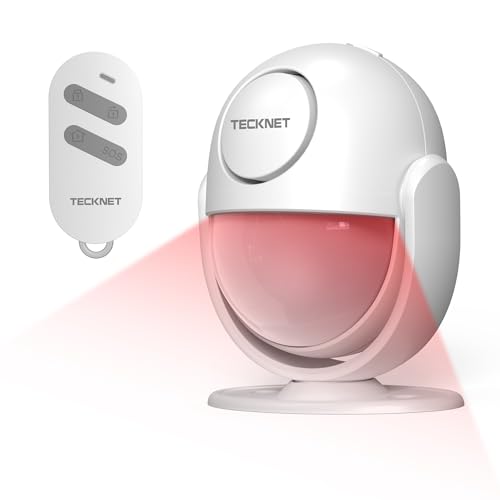
- 125dB siren with flashing strobe
- Alarm and doorbell chime modes
- Remote control reaches up to 328 feet in open areas
Best For: Garages and indoor spaces needing a strong local alarm
Long-Range Property Coverage

- Up to 1/2-mile wireless transmission range
- Includes two sensors and one receiver
- Expandable with 35- or 50-foot detection settings
Best For: Large homes and properties needing alerts across multiple areas
Multi-Zone Home Alerts

- Includes four detectors and two alarms
- Offers 38 chimes, three volume levels, and mute mode
- Provides up to 300 feet of wireless transmission
Best For: Monitoring multiple indoor entry points with audible or LED alerts
High-Volume Indoor Security
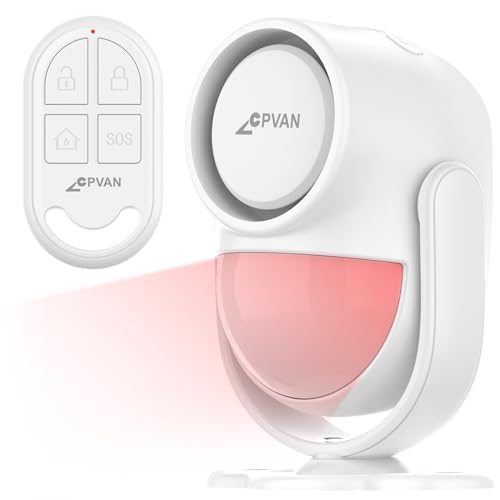
- 125dB siren for prominent motion alerts
- Detects movement up to 40 feet
- Remote control reaches up to 328 feet in open areas
Best For: Standalone indoor security in garages, sheds, vehicles, and storage areas
Radar Precision Pick – YoLink Indoor Radar Motion Sensor RT
For indoor motion detectors for homes, the YoLink YS7806 stands out with radar-based detection, adjustable sensitivity, and configurable motion or no-motion alerts. It is designed for smart-home automations, but a compatible YoLink Hub or SpeakerHub is required for app access and remote notifications.
Best For: Homeowners who want long-range wireless communication and customizable alerts in complex indoor spaces.
Pros:
- Radar-powered detection is designed to reduce false alarms.
- LoRa wireless communication reaches up to 2,034 feet in open air.
- Offers up to two years of battery life with included AA batteries.
- Supports adjustable sensitivity, alert hold, alarm suppression, and no-motion detection.
Cons:
- Requires a YoLink Hub or SpeakerHub, sold separately.
- Actual wireless range can vary with walls, obstacles, and placement.
This is a flexible option for users already invested in YoLink or planning a hub-based system. Its long-range protocol and detailed alert settings are useful, though the separate hub adds to the setup cost.
Simple Room Coverage Pick – Ring Motion Detector
The Ring Motion Detector is a straightforward choice among indoor motion detectors for homes, covering a room with a 90-degree field of view and a range of up to 9.1 meters. It sends motion alerts and includes settings intended to help reduce notifications caused by smaller pets.
Best For: Ring users seeking simple room monitoring with pet-friendly settings and no separate base station.
Pros:
- Monitors up to 9.1 meters with a 90-degree field of view.
- Pet-friendly settings support pets under 50 pounds.
- Connects over Amazon Sidewalk without a base station.
- Compatible Ring subscriptions can add 24/7 Pro Monitoring.
Cons:
- Amazon Sidewalk is required, and coverage may vary.
- 24/7 Pro Monitoring requires a compatible Ring subscription.
The Ring detector is appealing when convenience matters more than broad customization. Check Sidewalk availability in your area and account for any optional subscription costs before choosing it.
Smart Automation Pick – Tapo T100 Motion Sensor
The Tapo T100 is a compact option for indoor motion detectors for homes, offering detection across a 120-degree angle and up to 7 meters. It supports adjustable sensitivity, app notifications, and smart actions for compatible Tapo devices, but it requires a Tapo H100 hub and a secured 2.4 GHz Wi-Fi network.
Best For: Tapo households that want motion-triggered lighting and other smart-home actions.
Pros:
- Detects motion across a 120-degree angle and up to 7 meters.
- Detection range can be set to 3, 5, or 7 meters.
- Runs for up to two years on one included CR2450 battery under stated usage.
- Includes magnetic and 3M adhesive mounting options.
Cons:
- Requires a Tapo H100 hub and secured 2.4 GHz Wi-Fi network.
- Smart actions require the Tapo hub and compatible Tapo devices.
This sensor makes the most sense as part of a Tapo ecosystem. Its adjustable coverage and mounting flexibility suit varied rooms, while the required hub should be included in the overall budget.
Wired Security System Pick – Honeywell IS335 PIR Detector
The Honeywell IS335 is a wired PIR choice for indoor motion detectors for homes, with a stated detection area of 40 by 56 feet. It is intended for dependable detection in alarm or lighting-control applications and is compatible with security systems and smart-home hubs.
Best For: Users who prefer a wired detector for an existing compatible security or lighting-control installation.
Pros:
- Provides a stated 40-by-56-foot detection area.
- PIR technology is intended for dependable motion detection.
- Works with security systems and smart-home hubs.
- Wall-mount design supports a fixed installation.
Cons:
- Requires corded electrical power rather than batteries.
- Wired installation is less flexible than wireless sensor placement.
- Compatibility should be confirmed with the existing system before purchase.
The IS335 is best suited to a planned, permanent installation rather than a quick renter-friendly setup. Its wired design can fit established security infrastructure, provided the system and mounting location are compatible.
Best Entry Alert – Wireless Motion Sensor Door Chime
For shoppers comparing indoor motion detectors for homes, this wireless chime is a practical choice when you want a simple alert system without an app. It detects movement up to 26 feet away, sends a signal to the plug-in receiver from as far as 500 feet, and offers adjustable sound plus a visual LED alert.
Best For: Entryways, garages, small businesses, or monitoring movement between rooms.
Pros:
- Offers 32 chimes, five volume levels, and silent mode.
- Provides up to 500 feet of receiver-to-sensor wireless range.
- Can expand to as many as 20 sensors with unlimited receivers.
- Includes batteries and supports wall mounting.
Cons:
- The motion sensor itself covers a range of up to 26 feet.
- It uses AAA batteries rather than USB power.
- Its alert is designed as a chime or alarm, not a smartphone notification.
This AMHEY system suits buyers who prioritize flexible audible alerts and straightforward installation over smart-home integration. The LED indicator and silent setting also make it adaptable to different household needs.
Best Smart-Home Pick – WiFi Motion Sensor with App Alerts
This COTINSE model is a strong option for indoor motion detectors for homes when phone alerts and automations matter. It connects directly to 2.4GHz Wi-Fi without a hub, detects movement up to 26 feet away across a 128-degree angle, and works with Smart Life or Tuya for app-based alerts.
Best For: Smart-home users who want app notifications and motion-triggered lighting or other scenes.
Pros:
- Connects directly to 2.4GHz Wi-Fi without a gateway.
- Sends smartphone alerts through the Smart Life or Tuya app.
- Supports battery operation or 5V USB continuous power.
- Includes a 360-degree rotating base for wall or tabletop placement.
Cons:
- It requires a 2.4GHz Wi-Fi connection for smart features.
- It does not support Home Assistant.
- App and automation features require pairing through the app first.
Choose this sensor if you want a compact detector that can participate in connected-home routines. Its dual-power design is useful for either flexible placement or continuous monitoring near an outlet.
Best Loud Alarm – TECKNET Indoor Motion Sensor Alarm
For buyers seeking indoor motion detectors for homes with a prominent local warning, the TECKNET TK-HA001 combines PIR detection with a 125dB siren and flashing strobe. It covers approximately 16 to 26 feet within a 120-degree field of view and includes a remote control with a stated open-area range of up to 328 feet.
Best For: Garages, hallways, storage rooms, and other indoor areas where a loud alarm is preferred over app alerts.
Pros:
- Provides a 125dB maximum siren and flashing strobe light.
- Offers alarm and doorbell chime modes.
- Includes 80dB, 100dB, and 125dB volume settings.
- Works with AAA batteries or USB-C continuous power.
Cons:
- USB-C powers the unit but does not recharge the batteries.
- It has no Wi-Fi or smartphone app.
- Alarm mode sounds continuously for two minutes after triggering.
This TECKNET detector is best when immediate, high-volume on-site warning is the priority. Its remote lets you arm, disarm, change modes, or trigger SOS without approaching the sensor.
Long-Range Property Coverage – Half-Mile Motion Sensor Kit
For shoppers comparing indoor motion detectors for homes, this HTZSAFE kit stands out when you need coverage that can extend well beyond a single room. It includes two motion sensors and a plug-in receiver, with adjustable detection sensitivity, multiple alert sounds, and support for indoor or outdoor locations.
Best For: Large homes or properties needing long-range alerts across garages, gates, driveways, porches, or indoor areas.
Pros:
- Wireless transmission range of up to one-half mile, depending on terrain.
- Two adjustable detection settings covering approximately 35 or 50 feet.
- Expandable to up to 32 sensors and unlimited receivers.
- Offers four volume levels and 35 selectable melodies.
Cons:
- The three AA batteries required for each sensor are not included.
- Actual wireless range can vary with local terrain and conditions.
- The system is larger and more property-oriented than a simple single-room alarm.
This is a flexible choice if you want one alert system for multiple areas rather than a basic standalone indoor detector. Its expandable design and unusually long transmission range are the main reasons to consider it.
Multi-Zone Home Alerts – Wireless Chime Motion Alarm
This BESTOONE system is a practical option among indoor motion detectors for homes when you want several sensors and flexible notification choices. The package includes four motion detectors and two alarms, with LED alerts, selectable chimes, adjustable volume, and a silent mode.
Best For: Households monitoring several entry points, walkways, rooms, or care areas with customizable audible and visual alerts.
Pros:
- Includes four motion detectors and two alarm units.
- Wireless signal transmission reaches up to 300 feet.
- Provides 38 chime choices, three volume levels, and a mute mode.
- Can be used for doors, garages, windows, driveways, child or elderly care, and wildlife warnings.
Cons:
- AAA batteries are required and not included.
- The detectors are not waterproof and should be protected from rain.
- Placement away from wind and obstructions is important to help limit false alarms.
With multiple sensors and receivers included, this kit makes sense for broader indoor coverage without requiring a hub or app. Its silent LED mode is especially useful when you want notifications without a loud alert.
High-Volume Indoor Security – 125dB PIR Alarm
For buyers seeking indoor motion detectors for homes with a strong local alarm, the CPVAN CP2 Pro combines PIR sensing with a 125dB siren and remote control. It detects motion up to 40 feet, supports both alarm and chime modes, and can be mounted or placed on a shelf without Wi-Fi.
Best For: Indoor garages, sheds, storage areas, vehicles, and rooms where a loud standalone warning is more useful than app-based monitoring.
Pros:
- 125dB siren provides a prominent audible alert.
- PIR detection covers up to 40 feet, with best performance typically at 10–26 feet.
- Remote control works up to 328 feet in open areas.
- Includes batteries and supports adhesive, screw, or tabletop placement.
Cons:
- The unit is not waterproof and is intended for indoor use.
- PIR sensing cannot detect motion through walls, windows, or glass doors.
- It is a single alarm unit rather than a multi-sensor coverage kit.
This CPVAN model is best when deterrence and simplicity are priorities. Its loud siren, remote-controlled operation, and no-Wi-Fi setup make it convenient for focused indoor security in a garage, shed, vehicle, or storage space.
How We Picked the Best Indoor Motion Detectors for Homes
We compared these Indoor Motion Detectors for Homes by looking at detection range, alert methods, installation requirements, connectivity, power source, control options, and intended use. The selection includes app-connected sensors for smart-home systems, standalone sirens and chimes, wired PIR hardware, and longer-range products suited to entryways or nearby outdoor approaches.
Because “best” depends on the room and security goal, we considered practical trade-offs rather than ranking every device by one feature. A sensor that works well in a small hallway may not be the right choice for a large property or a home with pets.
Quick Comparison
- Best smart-home integration: YoLink, Ring, and Tapo options, depending on your existing ecosystem.
- Best for pet-aware monitoring: Ring’s pet-friendly mode.
- Best for loud local alerts: TECKNET and CPVAN 125dB alarms.
- Best for a simple announcement: Wireless motion-sensor door chimes.
- Best for wired installations: The Honeywell IS335 PIR detector.
- Best for extended range: The driveway alarm system with a long-range receiver.
Key Buying Factors for Indoor Motion Detectors for Homes
Detection Technology and Coverage
PIR sensors detect changes in infrared heat, while radar-based models may offer different sensing behavior and fewer issues with some environmental conditions. Check the stated coverage angle and distance, then consider furniture, walls, doorways, and likely walking paths. Adjustable sensitivity is useful when you need to reduce nuisance alerts.
Connectivity and Compatibility
Smart sensors may require a hub, bridge, or compatible security platform. Confirm whether the product connects directly to Wi-Fi, uses a proprietary low-power protocol, or needs a base station. Also check app support, notification controls, and whether integrations work with your existing smart-home setup.
Alert Type and Volume
App notifications are useful when you are away, while a built-in siren or chime provides immediate local awareness. Loud alarms can be effective in garages, workshops, and entry areas, but may be unsuitable near sleeping spaces or shared walls.
Power and Installation
Battery models are usually easier to install, but battery life and replacement access matter. Wired detectors can provide consistent power and integrate with alarm panels, though installation is more involved. Mount the sensor at the recommended height and avoid pointing it directly at heat sources or constantly moving objects.
Who Should Buy Which Indoor Motion Detectors for Homes?
Choose a smart sensor if you want remote alerts, automation, or integration with cameras and other security devices. Choose a standalone siren if you need a simple, independent warning without subscriptions or a hub. A chime is a better fit for entry awareness than intrusion deterrence. For larger properties, consider a long-range receiver system, while wired Honeywell hardware suits users building or upgrading a traditional alarm installation. If pets move through monitored rooms, prioritize adjustable sensitivity or a clearly specified pet-friendly mode.