When precision matters, choosing the right dial indicator can make a significant difference in your projects. In 2025, several top models stand out for their exceptional accuracy and durability. You’ll find options that cater to various applications, from engineering to woodworking. But what exactly should you look for in these instruments? Let’s explore the ten best precision dial indicators and the key factors that’ll guide your decision.
WEN 10703 1 in. Precision Dial Indicator with .001 in. Resolution

The WEN 10703 1 in. Precision Dial Indicator delivers exceptional accuracy with its impressive 0.001-inch resolution. You’ll appreciate the 2-inch display face, making it easy to read measurements at a glance. The 1.5-inch long plunger guarantees precise contact, while the 1/4-inch lug hole allows for easy mounting. Made from durable stainless steel, the rack and contact tip assure reliable readings. With a rotatable bezel and adjustable markers, you can quickly set reference points. This indicator complies with ASME and ANSI standards, and it comes with a two-year warranty, guaranteeing you’re covered for any potential issues.
Best For: The WEN 10703 1 in. Precision Dial Indicator is best for machinists and hobbyists who require high-precision measurements for their projects.
Pros:
- Exceptional accuracy with 0.001-inch resolution ensures reliable readings.
- Durable construction with stainless steel components enhances longevity and performance.
- User-friendly design including a rotatable bezel and adjustable markers for quick reference point setup.
Cons:
- Limited measurement range of 1 inch may not be suitable for larger projects.
- Manual operation may require more time compared to digital alternatives.
- Potential learning curve for beginners unfamiliar with dial indicators.
Dial Indicator with Magnetic Base Holder

For those seeking an affordable yet functional tool, the Qnkaa Dial Gauge Indicator with Magnetic Base Holder stands out. With a measuring range of 0-1 inches and a resolution of 0.001 inches, it’s perfect for basic applications. The strong magnetic base, featuring ON/OFF control, works well on vertical metal surfaces, though some users find it less powerful than premium options. While the instructions could be clearer, most find setup straightforward. The fine adjustment knob helps with precise positioning, but be aware that the dial mechanism may feel tight, requiring careful handling to zero out effectively.
Best For: Budget-conscious users needing a basic and functional dial indicator for occasional measurements.
Pros:
- Affordable entry-level tool suitable for basic applications.
- Strong magnetic base with ON/OFF control for easy attachment on vertical surfaces.
- Fine adjustment knob allows for precise positioning during measurements.
Cons:
- Magnetic strength may be insufficient compared to premium brands.
- Dial mechanism can be tight, making it challenging to zero out accurately.
- Instructions are unclear, and some components feel flimsy, affecting long-term durability.
Dial Indicator with Magnetic Base Set
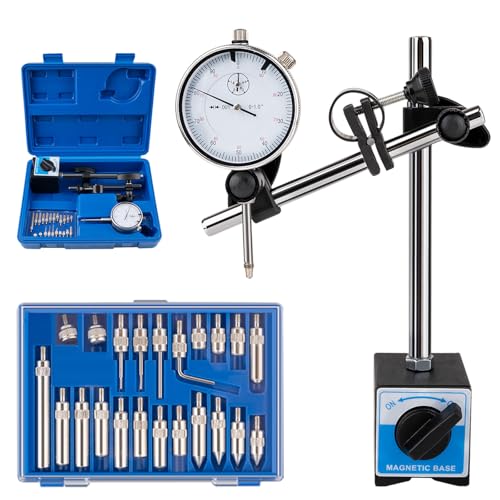
If you’re a hobbyist or a beginner looking to enhance your workshop’s precision capabilities, the Dial Indicator with Magnetic Base Set is a fantastic choice. This set offers a 0-1 measurement range with 0.001 precision, making it perfect for line cutting and welding tasks. Its magnetic base holds securely to ferrous metals, while the 360° rotatable arm and V-groove adapt to various workpieces. Built from hardened steel, it withstands heavy use and maintains accuracy over time. With 22 versatile indicator points and a clear dial, this set provides excellent value for budget-conscious users and is great for educational settings.
Best For: Hobbyists, beginners, and budget-conscious users looking to enhance their workshop precision capabilities.
Pros:
- High-quality hardened steel construction ensures durability and long-term precision.
- Versatile with 22 indicator points and a 360° rotatable arm for various workpiece adaptations.
- Excellent value for money, making it suitable for educational use and light workshop tasks.
Cons:
- Some components may feel less robust and require careful handling.
- Magnetic base may struggle with thin or irregularly shaped metals.
- Stiffness in the dial indicator that improves with use, but not suited for ultra-precise measurements.
NAKAO Dial Indicator with Magnetic Base and Point Precision Inspection Set

Crafted with versatility in mind, the NAKAO Dial Indicator with Magnetic Base and Point Precision Inspection Set suits both hobbyists and experienced woodworkers alike. With a 3/8-inch stem and a graduation of 0.001, it offers reliable measurements for various projects. The sturdy magnetic base adheres well, but adjusting it can be tricky due to its lack of semi-friction control. You’ll appreciate the included 22-piece indicator point set, meeting AGD specifications for added functionality. While generally good value, some users find it less precise for high-end applications. Overall, it’s a solid choice for those seeking a dependable tool without breaking the bank.
Best For: Hobbyists and experienced woodworkers looking for a reliable and affordable measuring tool.
Pros:
- Sturdy construction with an easy-to-read dial for convenience.
- Includes a versatile 22-piece indicator point set that meets AGD specifications.
- Good value for the price, comparable to more expensive models.
Cons:
- Difficult adjustment mechanisms can lead to frustration during use.
- May not provide the precision required for high-end applications.
- Mixed reviews regarding long-term reliability and measurement accuracy.
Fowler 52-520-110-0, Adg Dial Indicator With 0-1 Measuring Range

The Fowler 52-520-110-0 Adg Dial Indicator is an excellent choice for machinists and engineers seeking precision in their measurements. With a 2.25-inch diameter dial and 0.001 graduations, you’ll find readability superb, thanks to microfine graduations. The rigid supporting plate guarantees perfect alignment, while the durable construction, including a hardened stainless steel spindle rack, assures longevity. You’ll appreciate the easy 360° adjustment from the knurled bezel and the consistent measuring pressure provided by the 2oz. gauge. Plus, the full 1-year warranty shows Fowler’s commitment to quality. This tool will certainly enhance your measurement accuracy.
Best For: The Fowler 52-520-110-0 Adg Dial Indicator is best for machinists and engineers who require precise and reliable measurements in their work.
Pros:
- High readability with a 2.25-inch diameter dial and 0.001 graduations for accurate measurements.
- Durable construction featuring hardened stainless steel and brass components for long-lasting use.
- Easy adjustment with a knurled bezel allowing for smooth 360° modifications.
Cons:
- Limited measuring range of 0-1 inches may not suit all applications.
- Requires careful handling to maintain precision and avoid damage to the dial indicator.
- Pressure sensitivity may be an issue for users needing to measure with varying pressure levels.
Fowler 52-520-109-0, Adg Dial Indicator With 0-1 Measuring Range (Black)

For those seeking a reliable and user-friendly dial indicator, the Fowler 52-520-109-0 stands out with its impressive 0-1 inch measuring range and a dial face that enhances readability. Its 2.25-inch dial features microfine white graduations against a black background and a red hand for quick reference. Built with a carbide ball contact point and hardened stainless steel components, this indicator guarantees durability. The knurled bezel adjusts smoothly, while the center lug back allows for versatile positioning. Despite being lightweight, it delivers consistent performance, making it a great value for those who need dependable measurements in various conditions.
Best For: The Fowler 52-520-109-0 Adg Dial Indicator is best for budget-conscious users seeking a reliable measuring tool for daily applications in varied environments.
Pros:
- Durable construction with carbide ball contact point and hardened stainless steel components ensures longevity.
- Easy-to-read dial face with microfine graduations and a contrasting red hand enhances user experience.
- Versatile positioning with a center lug back and smooth bezel adjustment for convenient use.
Cons:
- Lacks a flat mounting option, which may limit installation versatility.
- Some users find the indicator to be lighter and potentially more fragile than expected.
- Primarily suitable for roughing applications, not recommended for high-precision tasks.
Neoteck Dial Indicator Gauge for High Precision Measurement

Engineers and woodworkers will appreciate the Neoteck Dial Indicator Gauge for its impressive 0.001 resolution, making it a top choice for high precision measurement. With a measuring range of 0-1, this full metal construction tool is built to endure heavy workshop use. Its internal mechanism features a brass insert and hardened stainless steel rack for durability. You’ll love the dual mounting options, allowing compatibility with magnetic bases or extended rods. Whether you’re aligning a lathe or leveling a 3D printer bed, follow the straightforward measurement procedure for accurate results every time. Get ready to elevate your precision work!
Best For: Engineers and woodworkers seeking high precision measurement tools for various applications.
Pros:
- High precision with 0.001 resolution for accurate measurements.
- Durable full metal construction designed to withstand heavy workshop use.
- Versatile mounting options compatible with magnetic bases and extended rods.
Cons:
- Limited measuring range of 0-1 may not meet all measurement needs.
- Initial setup required, which may be confusing for beginners.
- No digital display, which some users may prefer for easier reading.
HFS(R) 0-2 Precision Travel Dial Indicator

Precision is essential in any measurement task, and the HFS(R) 0-2 Precision Travel Dial Indicator delivers just that with its remarkable accuracy of +/- 0.001 for the first 2.5 revolutions. With a measuring range of 0 to 2 and a graduation interval of 0.001, it’s designed for precise readings. The durable aluminum body and jeweled bearing guarantee longevity, while the easy-to-read dial face features an anti-glare finish for peak visibility. Plus, it complies with AGD2 standards, guaranteeing reliability. Versatile mounting options make it simple to set up, making this indicator a must-have for any professional toolkit.
Best For: Professionals and hobbyists in machining, engineering, and woodworking who require precise measurements in their work.
Pros:
- Highly accurate with a measurement precision of +/- 0.001 for the first 2.5 revolutions.
- Durable construction with an aluminum body and jeweled bearing for longevity.
- Versatile mounting options and easy-to-read dial face with anti-glare finish enhance usability.
Cons:
- Limited measuring range of only 0 to 2, which may not suit all applications.
- Potentially higher cost compared to basic dial indicators.
- Requires careful handling to maintain accuracy over time.
KATSU Tools Dial Indicator with Magnetic Base and 22 Pieces Indicator Points Set
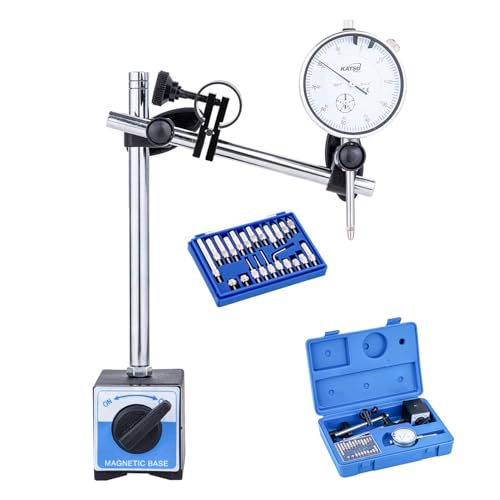
The KATSU Tools Dial Indicator with Magnetic Base and 22 Pieces Indicator Points Set is ideal for both automotive enthusiasts and professionals who need a reliable measuring tool. With a measuring range of 0-1.0 and an accuracy of 0.001, you’ll find it effective for setting backlash and making precise adjustments. The strong magnetic base, boasting 132lbs of holding power, guarantees stability during use. Users appreciate its quality and functionality, especially for the price. While it only measures in millimeters, it’s a great investment for both beginners and experienced users looking for versatility in their projects.
Best For: Automotive enthusiasts and professionals seeking a reliable and affordable measuring tool for precision adjustments.
Pros:
- High accuracy of 0.001 within a measuring range of 0-1.0, making it suitable for precise tasks.
- Strong magnetic base with 132lbs holding power ensures stability during measurements.
- Includes a 22-piece indicator points set for versatility in various applications.
Cons:
- Only measures in millimeters, which may not be ideal for users needing dual measurement capabilities (SAE and metric).
- Some users reported issues with product delivery, such as broken cases.
- Variability in magnetic strength noted by some users may affect usability.
HGC Precision Yellow Test Indicator (0-15-0)

For hobbyists and machinists seeking a reliable and economical tool, the HGC Precision Yellow Test Indicator (0-15-0) stands out with its impressive accuracy of 0.0005. With a range of 0.030 to 0.080 ball diameter, it’s perfect for machine setups and general production tasks. The yellow dial face features an anti-glare finish, ensuring easy readability. Its automatic contact point reversal and 270° swiveling enhance usability. While many users praise its reliability and smooth movement, be aware of mixed reviews regarding quality. At an affordable price, it’s a solid choice for everyday machining needs and hobby projects alike.
Best For: Hobbyists and machinists looking for an economical and reliable test indicator for machine setups and general production tasks.
Pros:
- Accurate with a precision of 0.0005, making it suitable for both high-tolerance and general applications.
- Features a yellow dial face with an anti-glare finish for easy readability and usability enhancements like automatic contact point reversal and 270° swiveling.
- Economical price point compared to high-end brands, providing great value for everyday use.
Cons:
- Mixed reviews on quality, with some units reported to be stiff or sticky, affecting performance.
- Occasional delivery issues, such as receiving damaged cases that impact usability.
- Not recommended for precision applications requiring high-end tools, as it may not meet the standards of more advanced indicators.
Factors to Consider When Choosing Precision Dial Indicators
When choosing a precision dial indicator, you should consider several key factors to guarantee it meets your needs. Look at the measurement range, resolution, and accuracy to make certain it fits your specific tasks. Additionally, take into account the build quality, magnetic base strength, and ease of use for a more efficient experience.
Measurement Range Options
Choosing the right measurement range for your precision dial indicator is essential, as it directly impacts the accuracy and effectiveness of your measurements. Typically, these indicators offer ranges of 0-1 inches or 0-2 inches, suitable for various applications. If your tasks require specialized measurements, consider options like the 0-15-0 range, which can cater to specific machining or testing needs. Aligning the measurement range with your specific tasks guarantees that the indicator captures required measurements accurately and avoids exceeding its limits. Remember, selecting an indicator with an insufficient range can lead to inaccurate results or even damage the tool. Always assess your measurement needs to choose the best precision dial indicator for your projects.
Resolution and Accuracy
Three key factors—resolution, accuracy, and calibration—play an essential role in selecting the right precision dial indicator. The resolution, typically measured in thousandths of an inch (0.001 in), allows you to make highly detailed measurements, critical for engineering and machining tasks. A higher resolution helps you detect smaller discrepancies, ensuring greater precision in your work.
Accuracy is another important aspect, often specified with a tolerance range of +/- 0.001 inches or better, providing reliable readings. To achieve ideal accuracy, consider the specific measurement range and resolution required for your application. Proper calibration in line with industry standards greatly affects both resolution and accuracy, ensuring your indicator delivers consistent, dependable performance over time.
Build Quality Materials
Build quality materials are vital in selecting a precision dial indicator that meets your needs. Look for indicators made from hardened stainless steel for the spindle rack and carbide for the contact point, ensuring durability and accuracy. An aluminum or brass body can offer a lightweight yet sturdy option, making it easier to handle in workshop environments. High-quality internal components, such as jeweled bearings, help minimize friction and promote smooth movement, leading to more precise readings. Additionally, a chrome-plated surface provides corrosion resistance, which is essential for consistent performance across various working conditions. Remember, the choice of materials greatly impacts performance, with higher-grade options often delivering better precision and reliability over time.
Magnetic Base Strength
When selecting a precision dial indicator, the strength of the magnetic base plays a significant role in ensuring accurate measurements. Typically measured in pounds of pull, a stronger base offers better stability and accuracy during use. For vertical metal surfaces, a magnetic base with a pulling force of 130-160 lbs is usually adequate, but it may struggle with thinner or irregular materials. You’ll want to take into account that some indicators provide a more robust grip than others, which impacts measurement reliability. Additionally, look for magnetic bases with ON/OFF control, allowing for easy adjustments without losing hold. Insufficient magnetic strength can lead to unstable readings, so choose a base that consistently adheres to your work surface for ideal results.
Ease of Use
Choosing a precision dial indicator can be straightforward if you focus on ease of use. Look for models with clear, easy-to-read faces featuring microfine graduations or contrasting colors that enhance visibility. Fine adjustment knobs are essential for precise positioning, helping you minimize user error during setup. Additionally, consider indicators with versatile mounting options, like flat or magnetic bases, which allow you to use them across various workpieces. A smooth and consistent movement mechanism is vital for maintaining accuracy during repeated measurements. Finally, opt for models that come with straightforward instructions and user-friendly features, making the setup process simpler and improving your overall experience. Prioritizing these aspects will enhance your measurement tasks considerably.
Versatility for Applications
Versatility is key when selecting a precision dial indicator, as it can greatly impact your measurement tasks across various applications. Most precision dial indicators have a measuring range of 0-1 inches and a resolution of 0.001 inches, making them ideal for engineering, automotive, and woodworking projects. Look for models with versatile mounting options, like magnetic bases or lug backs, which allow for secure attachment and easy adjustments. Including various indicator points in your set enhances adaptability, letting you handle tasks such as aligning CNC machines or checking wheel alignment. Fine-tuning features like adjustable knobs and rotatable arms offer improved control, ensuring accuracy in your setups. Choose durable indicators with hardened steel components for reliability in demanding environments.
Calibration and Adjustments
Calibration and adjustments play an essential role in ensuring your precision dial indicator delivers accurate and reliable measurements. To achieve this, you’ll need a standard reference to adjust the zero point before each use. Regular adjustments are key, especially for indicators that see high-frequency usage, as wear and tear can affect performance. Look for models with a knurled bezel or fine adjustment knobs; these features make it easy to set the zero position for consistent readings. It’s also crucial to periodically verify your indicator’s accuracy against known standards or gauge blocks. Always check the manufacturer’s specifications for calibration procedures, since different models may have unique requirements that impact their best performance.
Warranty and Support
After ensuring your precision dial indicator is properly calibrated and adjusted, you’ll want to contemplate the warranty and support options available. A strong warranty, typically lasting one to two years, reflects the manufacturer’s confidence in the product’s durability. Look for warranties that cover repairs and replacements, as they offer peace of mind against defects or malfunctions. Additionally, consider the support options; responsive customer service and technical assistance can make resolving issues much smoother. Detailed resources like user manuals and troubleshooting guides can greatly enhance your experience. Companies that prioritize customer satisfaction often have dedicated support teams ready to help, which should factor into your purchasing decision. Quality support can be invaluable for effective use and maintenance.