Choosing the right deer feeder can make feeding more consistent while reducing wasted feed, battery changes, and unwanted animal access. The best setup depends on your property size, feed type, power availability, and how much control you want over feeding times.
We compared 10 wildlife feeders for deer across capacity, timer options, construction, installation style, and ease of maintenance so you can choose a practical match for your hunting property or land-management goals.
Best 10 Wildlife Feeders for Deer Picks for 2026
Heavy-Duty Capacity

- 270-pound hopper with 50-foot feed radius
- Up to six programmable feed times daily
- Varmint guard and weather-ready metal components
Best For: Large hunting areas and extended feeding intervals
Vehicle-Mounted Convenience
Galvanized 50lb Tailgate Feeder

- Mounts to a truck, UTV, or ATV
- 12-volt motor with in-cab adapter
- Galvanized steel body helps resist corrosion
Best For: Mobile corn spreading from recreational vehicles
Smart Scheduling
Moultrie Pro Hunter III 250lb Feeder

- Bluetooth and optional remote app control
- Ten daily feed events up to 60 seconds each
- 250-pound hopper with solar-panel port
Best For: Connected, long-term feeding at established sites
Compact Portability

- Collapsible 5-gallon, 20–30-pound capacity
- Four programmable feed times daily
- Lightweight, weather-resistant plastic body
Best For: Small sites, temporary setups, and easy transport
Smart Remote Feeder Kit

- App-controlled scheduling from up to 300 feet
- Full-circle broadcast with up to four daily events
- Converts compatible containers into smart feeders
Best For: Custom feeder setups and remote scheduling
Power-Free Gravity Feeder

- Large 250-pound hopper capacity
- No batteries or electronics required
- Adjustable funnels accept corn and protein pellets
Best For: Long-term, low-maintenance feeding
Compact Varmint-Guard Kit
American Hunter ECON Feeder Kit

- Metal spin plate for consistent distribution
- Built-in guard helps limit varmint feed loss
- Fits twist-lock and flat-mounted hoppers
Best For: Basic feeder builds and replacement applications
Best Portable Pick
Moultrie 30-Lb Hanging Deer Feeder
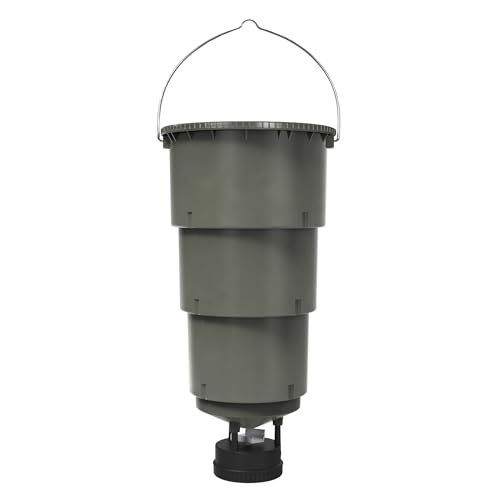
- Collapsible 30-lb hanging hopper
- App scheduling with up to four daily events
- Optional Edge 3 cellular connectivity
Best For: Portable setups and Moultrie ecosystem users
Best Upgrade Kit
Wildgame Innovations Trophy Hunter 6V Kit

- Six programmable daily feed times
- Adjustable motor speed and 360-degree spread
- Weather-resistant galvanized metal construction
Best For: Upgrading an existing deer feeder
Best DIY Value
6V Digital Deer Feeder Motor Kit

- Supports up to eight daily feed times
- Includes bracket, funnel, spinner plate, and hardware
- Solar-panel connection option for extended runtime
Best For: Custom bucket-feeder projects
Heavy-Duty Capacity – Quick-Set Pro 270lb Feeder
For hunters comparing wildlife feeders for deer, the WILDGAME Innovations Quick-Set Pro offers substantial capacity, programmable feeding, and a varmint guard in a freestanding tripod design. Its 270-pound hopper and 50-foot feed radius suit locations where dependable, repeated feeding is important.
Best For: Hunters who need a large-capacity feeder with flexible daily scheduling and durable outdoor construction.
Pros:
- Holds up to 270 pounds of corn or pellets.
- Digital timer supports up to six feed times daily, lasting 1 to 30 seconds.
- Rigid varmint guard helps protect feed and the power control unit.
- Powder-coated legs, galvanized spinner plate, and a portable box design support outdoor use.
Cons:
- At 38 pounds, it is heavier than compact hanging feeders.
- Battery power requires ongoing battery maintenance.
The Quick-Set Pro is a practical choice when capacity and scheduling flexibility matter more than a minimal footprint. Its included varmint protection and relatively simple setup add useful convenience for seasonal hunting locations.
Vehicle-Mounted Convenience – Galvanized 50lb Tailgate Feeder
Among wildlife feeders for deer, this galvanized tailgate feeder is designed for convenient use from a truck, UTV, or ATV. It holds 50 pounds of corn and uses a 12-volt motor with an in-cab cigarette-lighter adapter to make spreading feed quick and controlled.
Best For: Property managers and hunters who want to distribute corn from a vehicle rather than install a freestanding feeder.
Pros:
- Attaches in multiple configurations to trucks and recreational vehicles.
- Galvanized steel construction resists corrosion.
- 12-volt motor and included adapter allow operation from inside the cab.
- Spinner plate is designed to reduce feed waste.
Cons:
- Its 50-pound capacity is smaller than the tripod feeders in this roundup.
- Requires a compatible vehicle or hitch-mount setup.
This model makes the most sense for mobile feeding routes and quick corn distribution. It trades hopper capacity and autonomous scheduling for vehicle-based control and straightforward operation.
Smart Scheduling – Moultrie Pro Hunter III 250lb Feeder
For a connected approach to wildlife feeders for deer, the Moultrie Pro Hunter III combines a 250-pound hopper with Bluetooth programming and optional remote control through a paired Edge 3 camera. It also offers ten daily feed events, adjustable spin-plate speed, and a solar-panel port for longer deployments.
Best For: Hunters who want detailed scheduling, app-based control, and a high-capacity feeder for an established feeding site.
Pros:
- Bluetooth control works from up to 300 feet, with expanded remote control when paired with an Edge 3 camera.
- Supports up to ten programmable feed events daily, each lasting up to 60 seconds.
- 250-pound polymer hopper has a six-foot fill height.
- Solar-panel port, locking lid, and 360-degree coverage support extended outdoor use.
Cons:
- Rechargeable battery and solar panel are sold separately.
- Some remote features require pairing with a Moultrie Edge 3 camera.
- At 72 inches high, it may be less convenient to transport than compact feeders.
The Pro Hunter III is the most feature-focused option here for users who value precise feed timing and reduced site visits. Its app features and solar readiness are particularly useful for maintaining a remote feeder over a long season.
Compact Portability – 5-Gallon Hanging Deer Feeder
This compact hanging feeder offers a lightweight alternative for shoppers comparing wildlife feeders for deer in smaller or temporary setups. Its collapsible 5-gallon container holds approximately 20 to 30 pounds of corn and uses four AA batteries to run up to four scheduled feed times per day.
Best For: Hunters who need a portable, space-saving feeder for a hanging feeding station.
Pros:
- Collapsible design saves storage and transportation space.
- Holds approximately 20 to 30 pounds of corn.
- Accurate RTC timekeeping supports consistent schedules.
- Four programmable feed times and lightweight plastic construction simplify seasonal use.
Cons:
- Capacity is much lower than the larger tripod feeders.
- Four AA batteries are required and not included.
- Hanging mounting requires a suitable support location.
This feeder is a sensible pick when portability and simple storage matter most. It is less suited to high-volume feeding, but its collapsible body and automatic scheduling make it convenient for smaller sites.
Smart Remote Feeder Kit – Moultrie All-in-One II
For hunters comparing wildlife feeders for deer, the Moultrie All-in-One II is a flexible automated option that adds app-based scheduling to a custom drum, bucket, or other flat-bottom container. It broadcasts feed in a full circle and supports up to four daily feed events.
Best For: Hunters who want programmable feeding with Bluetooth control and the option for cellular remote access when paired with an Edge 3 Series camera.
Pros:
- Adjust feed times and duration from up to 300 feet through Bluetooth and the Moultrie app.
- Supports up to four feed events per day, with one- to 20-second durations.
- Quick-Lock adapter works with compatible drums, buckets, and Moultrie hoppers.
- Runs on four or eight AA batteries, with a slide-out tray for simpler changes.
Cons:
- Requires a separate container or hopper for a complete feeder setup.
- Full remote access from anywhere requires pairing with an Edge 3 Series camera.
This kit is a strong choice when scheduling flexibility and ecosystem compatibility matter more than having a complete freestanding feeder. Its container-friendly design also makes it useful for custom builds.
Power-Free Gravity Feeder – Moultrie 250-Lb Tripod
For a low-maintenance approach to wildlife feeders for deer, the Moultrie Gravity Deer Feeder uses gravity rather than batteries or electronics. Its 250-pound hopper, adjustable triple-funnel system, and tripod base are designed for extended feeding in outdoor locations.
Best For: Land managers and hunters who want a large-capacity, no-power feeder for corn, protein pellets, or mixed grains.
Pros:
- 250-pound hopper capacity helps reduce refill frequency.
- Battery-free gravity operation avoids electronic or battery maintenance.
- Three adjustable funnels accommodate corn, protein pellets, and mixed grains.
- UV-resistant construction and a reinforced tripod help it handle outdoor use.
Cons:
- Gravity feeding does not provide programmable timing or app control.
- At 37 pounds, it is less convenient to relocate than a compact feeder kit.
This is the practical pick for a straightforward feeding station where capacity and simplicity are priorities. The Quick-Lock adapter also leaves room for future conversion to other compatible Moultrie feeder kits.
Compact Varmint-Guard Kit – American Hunter ECON Feeder Kit
The American Hunter ECON is a compact automated feeder kit for building, upgrading, or replacing a deer feeder system. For shoppers comparing wildlife feeders for deer, its metal spin plate, built-in varmint guard, and flexible hopper mounting make it a practical basic setup.
Best For: Hunters who need a straightforward AA-powered feeder kit that can fit twist-lock or flat-mounted hoppers.
Pros:
- Metal spin plate is designed for consistent feed distribution.
- Built-in varmint guard helps reduce feed loss from nuisance animals.
- Compatible with twist-lock and flat-mounted feeder hoppers.
- Solar-panel-ready plug and accessory rail support future customization.
Cons:
- The supplied notes do not specify app control, feed-event scheduling, or hopper capacity.
- A separate hopper may be needed because this is described as a feeder kit.
Choose the ECON when compatibility and a durable spin plate are more important than advanced controls. Its solar-ready design and accessory rail provide useful upgrade paths for a custom or replacement build.
Best Portable Pick – Moultrie 30-Lb Hanging Deer Feeder
If you want wildlife feeders for deer that pack easily into remote setups, this Moultrie hanging feeder combines a collapsible 30-pound hopper with app-based scheduling. It broadcasts feed in a 360-degree pattern and supports up to four daily feeding events.
Best For: Hunters who need a portable hanging feeder with Bluetooth control and optional Moultrie camera connectivity.
Pros:
- Collapses into a compact bundle for pack-in transport and storage.
- Bluetooth app control works from up to 300 feet; pairing with an Edge 3 camera enables remote control through cellular connectivity without a subscription.
- Offers four daily feed events, adjustable from one to 20 seconds, with 360-degree coverage.
- Uses four AA batteries normally or eight for extended runtime, with a removable battery tray.
Cons:
- Its 30-pound capacity is smaller than many larger stationary feeder setups.
- Remote cellular control requires pairing with an Edge 3 Series camera.
- Feed and batteries are not included in the listed components.
This is a strong choice when mobility and convenient scheduling matter most. Its hanging design and fold-down hopper simplify deployment, while the Moultrie ecosystem adds flexibility for compatible camera users.
Best Upgrade Kit – Wildgame Innovations Trophy Hunter 6V Kit
For DIY wildlife feeders for deer, the Trophy Hunter kit upgrades a compatible feeder with programmable timing and adjustable motor control. Its digital timer supports up to six feeding events, while the weather-resistant metal housing is built for repeated outdoor use.
Best For: Hunters upgrading an existing feeder who want straightforward digital scheduling and adjustable feed distribution.
Pros:
- Programs up to six daily feed times with durations from one to 30 seconds.
- Provides 360-degree distribution up to 30 feet.
- High-torque motor offers low, medium, and high speed settings.
- Large LCD, silicone buttons, battery charge indicator, galvanized steel case, and spinner plate support practical field use.
Cons:
- It is an upgrade kit rather than a complete hopper and feeder setup.
- Requires a 6V battery, which is not listed as included.
- Deck mounting and the included 2-inch drop funnel may require compatibility checks with the existing feeder.
This kit makes sense when you already have a feeder container and want more control over timing and motor performance. The digital display and durable metal components add useful functionality without replacing the entire setup.
Best DIY Value – 6V Digital Deer Feeder Motor Kit
This 6V kit is suited to DIY wildlife feeders for deer, letting you convert a feed bucket into a programmable system. It supports up to eight daily feed times, adjustable run durations, and three motor-speed settings, with mounting hardware and a drop funnel included.
Best For: DIY builders who want to assemble a feeder from a bucket and need extensive timing control.
Pros:
- Programs up to eight feeding times per day with one- to 30-second durations.
- Adjustable low, medium, and high motor speeds help tailor feed distribution.
- Includes an adjustable mounting bracket, metal funnel, spinner plate, and mounting hardware.
- Has a test button and an outlet for connecting an external solar panel to extend battery life.
Cons:
- It requires a 6V battery, which is not included.
- Installation requires drilling a hole and mounting the components to a feed bucket.
- It is a component kit, not a complete feeder with a hopper.
This is the most flexible option for hands-on setups, especially if eight daily feed events are useful. Buyers should be comfortable with basic installation and should confirm their bucket and power arrangement before purchasing.
How We Picked the Best Wildlife Feeders for Deer
We focused on the features that matter most in real outdoor use: hopper or container capacity, timer flexibility, power requirements, feed-dispensing reliability, weather resistance, installation difficulty, and protection from varmints. The selection includes complete tripod feeders, hanging feeders, gravity systems, conversion kits, and replacement motor-and-timer assemblies.
Bluetooth-enabled models received attention for remote scheduling and monitoring, while gravity and hanging designs were considered for simplicity and low-power operation. We also looked for options that can handle common deer feed, including corn and protein pellets.
Quick Comparison
| Feeder type | Best for | Main advantage |
|---|---|---|
| Large tripod feeder | Longer intervals between refills | High capacity and broad coverage |
| Hanging feeder | Small plots and compact setups | Easy installation and portability |
| Gravity feeder | Low-maintenance feeding | No timer or motor required |
| Smart Bluetooth feeder | Remote management | App-based scheduling and control |
| Feeder kit | Existing barrels or custom builds | Flexible, often lower-cost installation |
Key Buying Factors for Wildlife Feeders for Deer
Capacity and Placement
Choose capacity based on deer activity, refill access, and how frequently you can visit the property. Larger tripod hoppers suit remote locations, while 20- to 50-pound hanging or tailgate feeders work well for smaller areas and shorter feeding cycles.
Timer and Feeding Control
Digital timers let you set feeding schedules and control daily output. Multiple programmable feed times are useful when you want consistent morning and evening activity. Bluetooth models add convenience by allowing adjustments from a phone, although they still require dependable battery power and app connectivity.
Construction and Animal Resistance
Look for galvanized or weather-resistant components, secure lids, sturdy mounting hardware, and a protected spin plate or motor. Varmint guards can help limit access by raccoons, squirrels, and other nuisance animals, but placement and regular inspection remain important.
Power and Maintenance
Battery-powered timers and motors are convenient, but cold weather, moisture, and frequent operation can shorten runtime. Gravity feeders avoid motor maintenance, while replacement kits are useful when an existing feeder needs a new timer or dispensing mechanism.
Who Should Buy Which Wildlife Feeders for Deer?
- For large properties: Choose a high-capacity tripod feeder to reduce refill trips.
- For remote scheduling: Select a Bluetooth-enabled Moultrie-style feeder or kit.
- For simple, low-power operation: A gravity feeder is the easiest choice.
- For small plots: Consider a hanging feeder with a compact container and programmable timer.
- For custom installations: A digital feeder kit can convert a suitable barrel or replace worn components.
- For harsh outdoor use: Prioritize galvanized or weather-resistant construction and protected electronics.
Before buying, confirm the feeder’s capacity, battery type, mounting requirements, feed compatibility, and local wildlife-feeding regulations. A well-matched feeder should be easy to fill, schedule, inspect, and protect throughout the season.