Renters need indoor security that installs quickly, travels easily, and avoids drilling or hardwiring. The best indoor motion detectors for renters range from app-connected sensors to straightforward alarms and entry chimes.
We compared these 10 options by setup requirements, alert methods, detection coverage, power needs, smart-home compatibility, and practical apartment use cases.
Best 10 Indoor Motion Detectors for Renters Picks for 2026
Long-Range Pick

- Up to 2,034 feet of stated LoRa range
- Tool-free magnetic or adhesive mounting
- Requires a YoLink hub for full functionality
Best For: Large homes, multi-floor coverage, and automation
Simple Smart Alert Pick

- 90-degree coverage with a 9.1-meter range
- Pet-friendly settings for pets under 50 pounds
- No base station required; Amazon Sidewalk is needed
Best For: Ring users wanting simple room alerts
Long-Battery Smart Pick
TP-Link Tapo T100 Motion Sensor

- Up to two years of stated battery life
- 120-degree detection up to 23 feet
- Requires a Tapo H100 hub and 2.4 GHz Wi-Fi
Best For: Tapo users prioritizing battery life and automation
Standalone Siren Pick
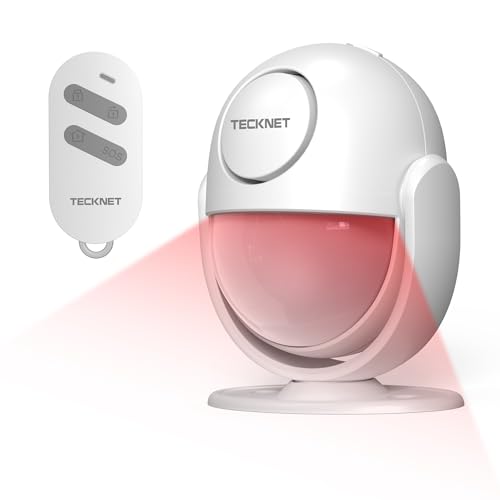
- 125dB siren and flashing strobe
- No Wi-Fi or app required
- Battery or USB-C power with remote control
Best For: Local audible protection without smart-home equipment
Best Smart-Home Pick

- App alerts through Smart Life or Tuya Smart
- Alexa and Tuya automation support
- Multiple renter-friendly mounting options
Best For: Renters wanting remote alerts and smart-home routines
Best Audible Alert
Wireless Motion Sensor Door Chime

- 32 chimes and five volume levels
- Flashing LED visual notification
- Up to 500-foot receiver range
Best For: Renters wanting a local door or room alert
Best Multi-Room Value

- Two hub-free sensors for broader coverage
- App alerts, history, and battery status
- About six months of stated battery life
Best For: Renters monitoring multiple rooms with one app
Best Budget Door-Alert Pick
Adjustable Wireless Motion Chime

- Adhesive or screw mounting
- 35 tones with up to 110 dB volume
- Supports up to 20 sensors per receiver
Best For: Renters wanting flexible, audible entry alerts
Best Smart Automation Pick
Pet-Immune PIR Motion Detector

- Combines alarms and motion lighting
- Adjustable sensitivity and delay
- Wireless wall or ceiling installation
Best For: Renters automating lights and indoor alerts
Best Loud Alert Pick
Wireless Motion Sensor Door Chime

- Audio and RGB visual alerts
- 60 melodies plus alarm tone
- Includes two motion transmitters
Best For: Renters needing unmistakable entry notifications
Long-Range Pick – YoLink Indoor Motion Sensor
For renters comparing indoor motion detectors for renters, the YoLink YS7804 stands out for its exceptionally long wireless range and tool-free installation. It requires a YoLink hub for full functionality, but its LoRa-based connection avoids adding another Wi-Fi device to your network.
Best For: Renters who need coverage across multiple floors or larger properties and want app alerts plus smart-home automation.
Pros:
- Up to 2,034 feet of stated range with obstruction penetration.
- Tool-free mounting with a built-in magnet, metal disc, and 3M tape.
- Supports text, email, and phone push notifications.
- Can automate lights and pair with YoLink alarms or other devices.
Cons:
- A YoLink hub is required for full functionality and app access.
- SMS alerts have stated monthly and per-device limits.
The YoLink is a strong option when range matters more than a simple standalone setup. Its removable mounting approach suits rentals, while the required hub adds cost and setup complexity.
Simple Smart Alert Pick – Ring Motion Detector
The Ring Motion Detector is a practical choice among indoor motion detectors for renters when you want room coverage and phone alerts without installing a base station. It connects over Amazon Sidewalk, so Sidewalk availability and coverage should be considered before buying.
Best For: Renters who want a straightforward room sensor with pet-friendly settings and optional professional monitoring.
Pros:
- Monitors a room with a 90-degree field of view and 9.1-meter range.
- Pet-friendly settings can reduce alerts from pets under 50 pounds.
- No base station is required.
- Compatible Ring subscriptions can add 24/7 Pro Monitoring.
Cons:
- Amazon Sidewalk is required for use, and coverage may vary.
- Professional monitoring requires a compatible Ring subscription.
This sensor keeps the hardware setup simple and offers useful pet-related customization. It is best for renters already comfortable with the Ring ecosystem and Amazon Sidewalk connectivity.
Long-Battery Smart Pick – TP-Link Tapo T100 Motion Sensor
The TP-Link Tapo T100 is a flexible option for renters shopping for indoor motion detectors for renters, with adjustable sensitivity, a movable detection angle, and adhesive or magnetic mounting. It does require a Tapo H100 hub and a secured 2.4 GHz Wi-Fi connection.
Best For: Renters building a Tapo smart-home setup who want long battery life and motion-triggered actions.
Pros:
- Detects motion across a 120-degree angle up to 23 feet.
- Offers 3-, 5-, and 7-meter detection settings plus adjustable positioning.
- One CR2450 battery can last up to two years under stated usage.
- Supports app notifications and smart actions for compatible Tapo devices.
Cons:
- Tapo H100 hub and a secured 2.4 GHz Wi-Fi network are required.
- Smart actions depend on compatible Tapo devices.
The Tapo T100 balances renter-friendly mounting with useful customization and low battery maintenance. The required hub makes it less suitable as a single-sensor purchase, but it fits well into an expanding Tapo system.
Standalone Siren Pick – TECKNET Indoor Motion Alarm
For renters who prefer indoor motion detectors for renters without apps or network equipment, the TECKNET motion alarm offers a self-contained siren and strobe. It supports adhesive, screw, or tabletop placement and can run from AAA batteries or USB-C power.
Best For: Renters who want an audible local alarm for entryways, hallways, garages, or other indoor areas without Wi-Fi.
Pros:
- 125dB maximum siren with a flashing strobe light.
- Alarm and doorbell-chime modes with three volume levels.
- Remote control works up to 328 feet in open areas.
- Offers approximately 16–26 feet of detection and 120-degree coverage.
Cons:
- No app or Wi-Fi connectivity for remote notifications.
- USB-C powers the alarm but does not recharge the batteries.
- Alarm mode sounds for two minutes before returning to standby.
The TECKNET is the simplest choice when you want immediate, on-site sound rather than connected alerts. Its flexible placement and remote control are rental-friendly, though it cannot provide app-based monitoring.
Best Smart-Home Pick – Compact WiFi Motion Sensor
For renters seeking indoor motion detectors for renters, this compact battery-powered PIR sensor offers app alerts without a hub. It works with Smart Life and Tuya Smart over 2.4GHz WiFi, and its adhesive, screw, flat-lay, and lanyard mounting options make it relatively easy to place without permanent changes.
Best For: Renters who want smartphone notifications and simple smart-home automations in rooms such as bedrooms, hallways, or bathrooms.
Pros:
- Pushes motion alerts to the Smart Life or Tuya Smart app.
- Supports Alexa voice routines and Tuya-compatible devices.
- Offers a 128° viewing angle and detection distance up to 7 meters.
- Includes adhesive backing, screws, and a battery, with stated battery life of about four months.
Cons:
- Works with 2.4GHz WiFi, not 5GHz WiFi.
- One sensor is included, so broader coverage requires additional units.
This is a practical choice when remote alerts and automation matter more than a loud built-in siren. Check your WiFi band and expected battery-maintenance needs before buying.
Best Audible Alert – Wireless Motion Sensor Door Chime
This wireless motion sensor door chime is a straightforward option among indoor motion detectors for renters. Instead of relying on an app or hub, the battery-powered sensor sends movement alerts to a plug-in receiver, making it useful for entryways, rooms, or spaces where an audible or visual notification is preferred.
Best For: Renters who need an immediate indoor chime for doors, visitors, household monitoring, or hearing-accessible visual alerts.
Pros:
- Provides 32 chimes, five volume levels, silent mode, and volume up to 110 dB.
- LED flashes provide a visual alert alongside the sound.
- Offers up to a 500-foot receiver-to-sensor working range.
- Can expand to as many as 20 sensors and unlimited receivers.
Cons:
- Requires a plug-in receiver and two AAA batteries for the sensor.
- Does not provide the smartphone app notifications described by the WiFi alternatives.
- Mounting is described primarily with screws, which may be less convenient for some renters.
Choose this model when dependable local alerts are the priority and you do not need remote monitoring. Its adjustable sounds and flashing indicator add flexibility for different rooms and hearing needs.
Best Multi-Room Value – 2-Pack WiFi PIR Sensors
For renters comparing indoor motion detectors for renters across more than one room, this two-pack provides app-connected coverage without a hub. The sensors use 2.4GHz WiFi and the Tuya or Smart Life apps to deliver alerts, review motion history, check battery status, and connect with compatible smart-home devices.
Best For: Renters who want two wireless sensors for multiple rooms, remote monitoring, and Tuya-based automation.
Pros:
- Includes two sensors with no hub required and one-key 2.4GHz WiFi setup.
- Sends smartphone alerts and records motion history in the app.
- Provides a 128° detection angle and a stated 6- to 40-foot detection distance.
- Offers approximately six months of battery life and low-battery app warnings.
Cons:
- Requires 2.4GHz WiFi rather than 5GHz WiFi.
- Smart-home automation depends on compatible Tuya or Smart Life devices.
- Detection sensitivity may be high, so placement could require adjustment.
The two-pack is a strong fit for renters who want broader coverage without installing a wired system. Its app-based records and battery warnings make ongoing monitoring easier, while the included 3M stickers simplify placement.
Best Budget Door-Alert Pick – Adjustable Wireless Motion Chime
For renters comparing indoor motion detectors for renters, this wireless AMHEY system offers a practical, drill-optional way to monitor entrances, rooms, garages, or corridors. The sensor detects movement from roughly 13 to 26 feet away, while the receiver can connect across up to 500 feet.
Best For: Renters who want customizable audio alerts without complicated installation.
Pros:
- Adhesive or screw mounting supports temporary or more permanent setup.
- Offers 35 tones, five volume levels from muted to 110 dB, and adjustable detection angles.
- A single receiver supports up to 20 motion sensors for zone-based alerts.
Cons:
- It is primarily an audio-alert system rather than a fully connected smart-home security device.
- Its stated detection distance is shorter than the receiver’s wireless transmission range.
The included two AAA batteries and plug-and-play receiver make this a straightforward choice for renters who mainly need an audible entry notification and flexible placement.
Best Smart Automation Pick – Pet-Immune PIR Motion Detector
This USecure unit is a versatile option among indoor motion detectors for renters, combining PIR movement sensing with configurable alarms and motion-activated lighting. Its wireless wall- or ceiling-mount design is intended for indoor spaces such as hallways, closets, garages, and stairwells.
Best For: Renters who want motion-triggered lighting and adjustable security behavior in one device.
Pros:
- Lets you configure motion to trigger an alarm, lights, or both.
- Adjustable sensitivity, light-level threshold, and delay provide room-by-room control.
- Battery operation and wireless mounting avoid complicated rewiring.
- Supports Google Home according to the product title.
Cons:
- The listed maximum detection range is 12 meters, with no wider receiver range specified.
- Only one included battery is listed, and the battery type is an A battery.
Choose this model when convenience and energy-conscious lighting matter as much as intrusion alerts. Its adjustable settings give renters more control than a basic motion chime, although the supplied details do not specify a separate receiver or broader multi-sensor setup.
Best Loud Alert Pick – Wireless Motion Sensor Door Chime
For renters seeking indoor motion detectors for renters with prominent notifications, the TECKNET door chime pairs infrared motion detection with both sound and an RGB visual indicator. It detects movement up to 20 feet away across a 110-degree angle and connects wirelessly to the receiver from up to 1,000 feet.
Best For: Renters who need highly noticeable audio and visual alerts for doors, visitors, or caregiving.
Pros:
- Includes 60 melodies plus an alarm tone, five volume levels, and silent mode.
- Combines a flashing RGB indicator with sound, including volume up to 120 dB.
- Two motion transmitters and mounting hardware are included.
- No wiring is required, and the product includes a 36-month warranty with registration-based lifetime support.
Cons:
- The alarm repeats every 10 seconds when triggered, which may be excessive in some apartments.
- Its 20-foot detection range is more limited than the wireless transmission range.
- At up to 120 dB, the loudest setting may not suit noise-sensitive neighbors.
This is a strong fit when missed alerts are the main concern. The visual signal, extensive chime selection, and two included sensors make it especially useful for entrances or assistance monitoring, but renters should use the volume controls thoughtfully in shared buildings.
How We Picked the Best Indoor Motion Detectors for Renters
We focused on products that can be installed without permanent changes to walls or doors and removed when you move. The lineup includes app-based Wi-Fi sensors, hub-dependent systems, standalone alarms, and wireless door chimes so you can match the device to your security needs and technical comfort level.
We also considered detection range, adjustable sensitivity, pet-friendly operation, battery life, alert volume, remote controls, temperature monitoring, and compatibility with voice assistants. A strong renter-focused detector should provide useful warnings without requiring a complete professionally installed security system.
Quick Comparison
| Type | Best for | What to check |
|---|---|---|
| App-connected PIR sensor | Remote notifications and activity records | Wi-Fi, app, or hub requirements |
| Hub-based sensor | Expanding a smart-home security setup | Required hub and compatible ecosystem |
| Standalone alarm | Immediate audible warnings | Alarm volume, remote range, and battery type |
| Door chime | Entry awareness for rooms or businesses | Chime selection, volume, and detection delay |
Key Buying Factors for Indoor Motion Detectors for Renters
Installation and Portability
Choose adhesive, magnetic, freestanding, or screw-free mounting when possible. Confirm that the included mounting method will not damage painted walls or violate your lease. Battery-powered models are generally easier to reposition than wired units.
Alerts and Connectivity
App notifications are useful when you are away, but they depend on a reliable internet connection and sometimes a separate hub. Standalone sirens work during a phone outage but may be less discreet. Some models offer both local alarms and mobile alerts.
Coverage and False Alarms
Check the sensor’s viewing angle and placement guidance. Aim it across an entry path rather than directly at a window, heater, or moving curtain. Pet-immune or adjustable sensitivity modes can reduce alerts caused by cats and small dogs, though no pet mode is perfect.
Privacy, Power, and Compatibility
Prefer products with clear app permissions and understandable data policies. Review battery-life claims, low-battery warnings, and replacement costs. If you use Google Home or another platform, verify compatibility before buying; “smart” does not always mean universal integration.
Who Should Buy Which Indoor Motion Detectors for Renters?
Choose an app-connected Wi-Fi PIR sensor if remote notifications and activity records matter most. A hub-based option is better if you already use a compatible smart-home ecosystem or plan to add more sensors. Select a loud standalone alarm when immediate attention is more important than phone access, especially for a room, hallway, or entryway.
Wireless door chimes are a practical choice for renters who want simple arrival alerts without a subscription. Pet owners should prioritize adjustable or pet-aware detection, while shoppers who want extra environmental information can consider a model with temperature monitoring. Before ordering, confirm the mounting surface, network requirements, battery type, and return policy.