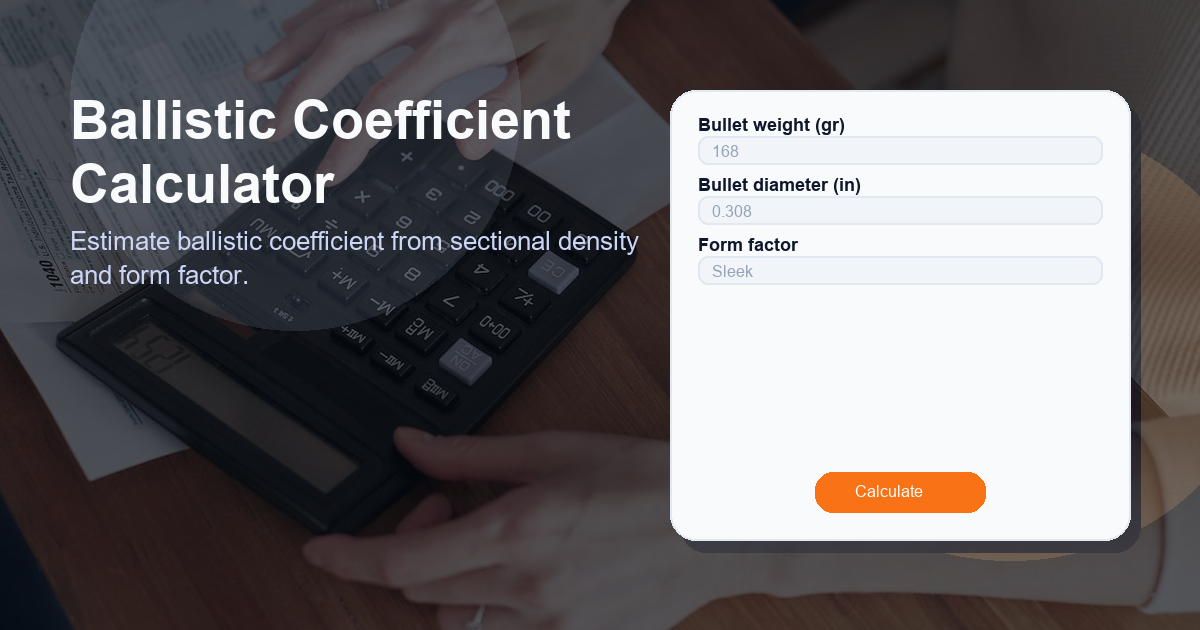
Ballistic Coefficient Calculator
What this Ballistic Coefficient Calculator does
The Ballistic Coefficient Calculator estimates the ballistic coefficient (BC) of a bullet using two fundamental inputs: the sectional density (derived from bullet weight and diameter) and the bullet’s form factor. This simple calculator converts the bullet weight from grains to pounds, factors in the bullet diameter in inches, and adjusts the result by the provided form factor to generate a single-number approximation of ballistic performance.
This tool is designed for shooters, reloaders, ballistics enthusiasts, and engineers who need a quick, analytical estimate of BC without resorting to complex measurement procedures. The output—labeled Ballistic Coefficient—is useful for trajectory prediction, comparative evaluation of bullets, and as an input to ballistics solvers.
How to use the Ballistic Coefficient Calculator
Using the Ballistic Coefficient Calculator is straightforward. Provide three inputs and read the result:
- Bullet weight (gr) — Enter the bullet mass in grains (gr). Common bullet weights are often listed on ammunition packaging or manufacturer specifications.
- Bullet diameter (in) — Enter the bullet diameter in inches (in). Typical diameters include 0.224, 0.308, 0.257, etc.
- Form factor — Enter the bullet’s form factor. The form factor describes how the actual drag of the bullet compares to a standard reference projectile; values are typically greater than 0.5 and often range between 0.8 and 1.5 for many bullets.
After entering these values, the calculator computes and displays the Ballistic Coefficient. If either the bullet diameter or form factor is zero or negative, the calculator returns 0 to avoid invalid calculations.
Example inputs and interpretation:
- Bullet weight: 150 gr
- Bullet diameter: 0.308 in
- Form factor: 1.02
With these values the calculator yields a BC that helps you approximate the bullet’s aerodynamic performance compared to reference projectiles.
How the Ballistic Coefficient Calculator formula works
The formula used by this calculator is implemented as:
(bullet_diameter_in > 0 && form_factor > 0) ? ((bullet_weight_gr / 7000) / Math.pow(bullet_diameter_in, 2)) / form_factor : 0
In clearer mathematical terms:
BC = ((weight in grains / 7000) / diameter²) / form factor
Breaking that down:
- weight in grains / 7000 converts the bullet mass from grains to pounds (1 lb = 7000 gr).
- diameter² uses the bullet’s cross-sectional area scaling — smaller diameters increase sectional density for the same weight, which typically improves BC.
- dividing by the form factor adjusts the sectional-density-based estimate to reflect the bullet’s actual aerodynamic shape (a lower form factor means a sleeker shape and a higher BC for the same sectional density).
The calculator enforces a basic input validation: if either diameter or form factor are nonpositive, the formula does not run and a result of 0 is returned to indicate invalid input.
Use cases for the Ballistic Coefficient Calculator
The Ballistic Coefficient Calculator is a practical tool in many contexts:
- Trajectory prediction — Use BC as an input to external ballistics solvers to model drop, wind drift, and time of flight.
- Ammo selection and comparison — Compare BCs to choose the best projectile for long-range shooting or hunting.
- Reloading and bullet design — Evaluate the aerodynamic implications of weight and diameter changes during bullet selection or design iterations.
- Ballistics education — Demonstrate how sectional density and form factor impact aerodynamic performance.
- Modeling and simulation — Provide a quick BC estimate for initial simulation runs before using more refined, experimentally derived BC curves.
Keep in mind this calculator provides an approximate BC based on geometry and form factor. It is especially useful for first-order assessments and comparisons when measured BC data are unavailable.
Other factors to consider when calculating x
While the calculator provides a solid starting point, the real-world ballistic coefficient depends on many additional factors beyond sectional density and a simple form factor. Consider the following:
- Velocity dependence — BC is not constant across speeds; bullets exhibit different drag regimes (subsonic, transonic, supersonic) and BC can vary with velocity.
- Bullet shape details — Ogive profile, boat tail, meplat size, and surface finish all affect drag and thus true BC.
- Stability and spin — Insufficient spin or yaw can increase drag and reduce effective BC.
- Atmospheric conditions — Air density, temperature, humidity, and altitude change drag and trajectory even for the same BC.
- Manufacturing tolerances — Variations in concentricity, weight distribution, and base blow-by can alter aerodynamic behavior.
- Reference models — Different BC definitions and measurement methods (G1, G7, G8, etc.) produce differing BC values; ensure your BC is compatible with the ballistics model you use.
For accurate trajectory work at long ranges, measured or publisher-provided BC values (often velocity-specific and based on standardized drag models) are preferred. Use this calculator for rapid estimates, comparative analysis, and as a teaching tool, but validate with empirical or manufacturer data when precision matters.
FAQ
What units should I use for weight and diameter?
Enter weight in grains (gr) and diameter in inches (in). The calculator converts grains to pounds internally (1 lb = 7000 gr) before applying the diameter and form factor.
Why does the calculator return zero sometimes?
The calculator returns 0 if the bullet diameter or form factor inputs are zero or negative. This prevents invalid mathematical operations (division by zero) and indicates incorrect input values.
How accurate is the BC calculated here compared to manufacturer BCs?
This BC is an estimate based on sectional density and form factor. Manufacturer BCs are often measured or derived using specific drag models (G1, G7) and can be velocity-dependent. Use this calculator for approximations and comparisons, but rely on measured BCs for precise trajectory work.
Can I use metric units with this calculator?
No. This calculator expects grains and inches. To use metric inputs you must convert grams to grains and millimeters to inches beforehand (1 g ≈ 15.4324 gr, 1 mm ≈ 0.0393701 in).
Does the form factor have a standard reference?
Form factor is a relative number that compares a bullet’s drag to a reference projectile. Different references (e.g., G1 vs G7) can change interpretations. When possible, use a form factor calibrated to the same drag model (G1, G7) as your ballistics solver for consistency.