Optimal Twist Rate Calculator
What this Optimal Twist Rate Calculator calculator does
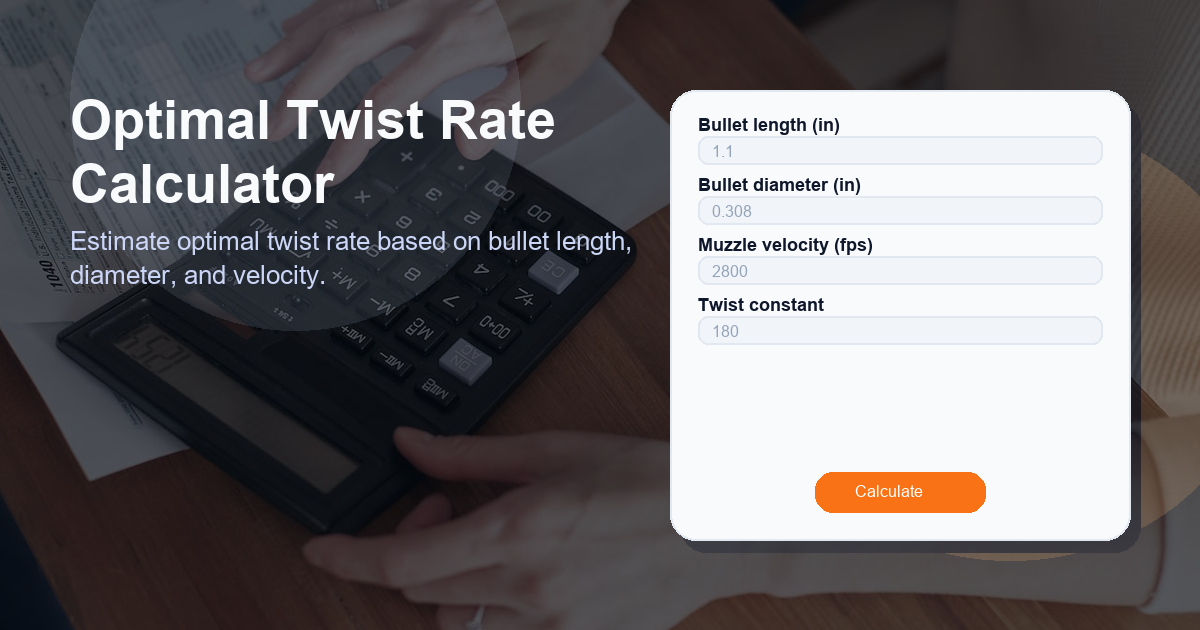
The Optimal Twist Rate Calculator estimates the recommended rifling twist rate (expressed as inches per turn) for stabilizing a bullet using three primary inputs: bullet length (in), bullet diameter (in), and muzzle velocity (fps). A fourth input, the twist constant, lets you adapt the method to different empirical models (for example, Greenhill-style constants). This tool returns a single value labeled Optimal Twist Rate, which represents the computed inches-per-turn twist that best stabilizes the projectile according to the chosen formula.
How to use the Optimal Twist Rate Calculator calculator
Using the Optimal Twist Rate Calculator is straightforward. Follow these steps to get a reliable estimate:
- Enter bullet length (in): Measure the bullet from base to tip in inches. The formula requires a positive length; if you enter zero or a negative number the calculator will return 0.
- Enter bullet diameter (in): Use the standard caliber expressed in inches (for example, .308 is 0.308 in).
- Enter muzzle velocity (fps): Provide the velocity at the muzzle in feet per second. If you only have chronograph readings, use the measured value.
- Choose a twist constant: Typical empirical constants (often called the Greenhill constant) are around 150 or 180. Use a value appropriate for your modelling preference or leave the default if specified.
- Read the result: The calculator outputs the Optimal Twist Rate, expressed as inches per turn (for example, “1 in 9.5”).
Example: with bullet_length_in = 1.50, bullet_diameter_in = 0.308, muzzle_velocity_fps = 2800, and twist_constant = 150, the calculator gives approximately 1 in 9.49.
How the Optimal Twist Rate Calculator formula works
The calculator uses the following conditional formula (JavaScript-style) to compute the result:
bullet_length_in > 0 ? (twist_constant * Math.pow(bullet_diameter_in, 2)) / bullet_length_in * Math.sqrt(muzzle_velocity_fps / 2800) : 0Broken down in plain language:
- If bullet_length_in is not positive, the output is 0 (invalid input guard).
- Otherwise, calculate (twist_constant * bullet_diameter_in²) / bullet_length_in. This is a length-based scaling similar to classical Greenhill-type formulas where twist scales with the square of diameter and inversely with length.
- Multiply the result by sqrt(muzzle_velocity_fps / 2800) to introduce a velocity correction factor. Using 2800 fps as a reference, higher velocities change the required twist according to the square-root law in this model.
Units and interpretation:
- Input units: inches for length and diameter, feet per second for velocity.
- Result units: inches per turn (e.g., “1 in 9.5”).
- Sensitivity: Because diameter is squared, small changes in caliber have a relatively larger effect than equivalent fractional changes in bullet length. Velocity affects the result more gently via a square-root factor.
Use cases for the Optimal Twist Rate Calculator
This calculator is useful for shooters, reloaders, gunsmiths, and ballistic engineers in scenarios such as:
- Barrel selection: Choosing a rifling twist when building or buying a barrel to match a particular bullet profile and intended muzzle velocity.
- Bullet selection: Determining whether a given bullet will stabilize adequately in an existing rifle with a known twist.
- Load development: Comparing how changes in muzzle velocity (different powders, seating depths, or charges) affect the calculated optimal twist.
- Design verification: Quick sanity checks while designing projectiles or testing new bullet shapes and lengths.
The Optimal Twist Rate Calculator is particularly helpful as a first-pass tool to narrow options before conducting field testing and chronograph validation.
Other factors to consider when calculating twist rate
While the calculator gives a clear numerical recommendation, several real-world factors influence whether that twist rate yields consistently accurate and stable bullets:
- Bullet construction and mass distribution: Hollow-point, boattail, polymer-tip, or varying jacket thicknesses change the mass distribution and gyroscopic stability beyond what length and diameter alone capture.
- Atmospheric conditions: Air density, altitude, temperature, and humidity all affect aerodynamic stability. The formula assumes a standard reference environment.
- Projectile shape: Long, high-section-density projectiles (e.g., long-range match bullets) may require faster twist than calculated by a simple empirical model.
- Barrel harmonics and precision: Even an “optimal” twist will not guarantee group size if barrel quality, harmonics, or bedding are poor.
- Empirical testing: Always validate the calculated twist with live-fire testing and a chronograph. The formula provides a theoretical recommendation, not a definitive guarantee.
In summary, treat the Optimal Twist Rate Calculator as a practical, evidence-based starting point. Combine its output with manufacturer guidance, published stability indices (such as the Miller Stability Formula or gyroscopic stability calculations), and real-world testing for best results.
FAQ
Q: What exactly is the unit of the Optimal Twist Rate?
A: The calculator returns the twist as inches per turn (for example, “1 in 9” means one full rifling twist every 9 inches). This is the conventional unit used in firearm barrel specifications.
Q: Which twist constant should I use?
A: Common choices are 150 or 180 depending on which empirical model you prefer. Greenhill’s original rule often used 150 for velocities around typical service rifle speeds; 180 is sometimes used for subsonic or heavier bullet approximations. If unsure, try both and compare with published guidance for your bullet type.
Q: How does muzzle velocity affect the calculated twist?
A: In this formula, muzzle velocity modifies the result by sqrt(muzzle_velocity_fps / 2800). That means velocity influences the recommended twist more gently than length or diameter. Higher muzzle velocity scales the output by the square root of the ratio versus the reference 2800 fps.
Q: Can I use this calculator for muzzle velocities far above or below 2800 fps?
A: The formula will produce a numerical result, but accuracy may drop for extreme velocities. For very low (subsonic) or very high velocities, rely on additional stability models and empirical testing to confirm the correct twist.
Q: Is this calculator a replacement for gyroscopic stability formulas?
A: No. The Optimal Twist Rate Calculator is a practical, empirical tool for estimating twist based on common variables. For comprehensive stability analysis, use gyroscopic stability formulas (e.g., Miller or full physical models) along with live-fire testing.