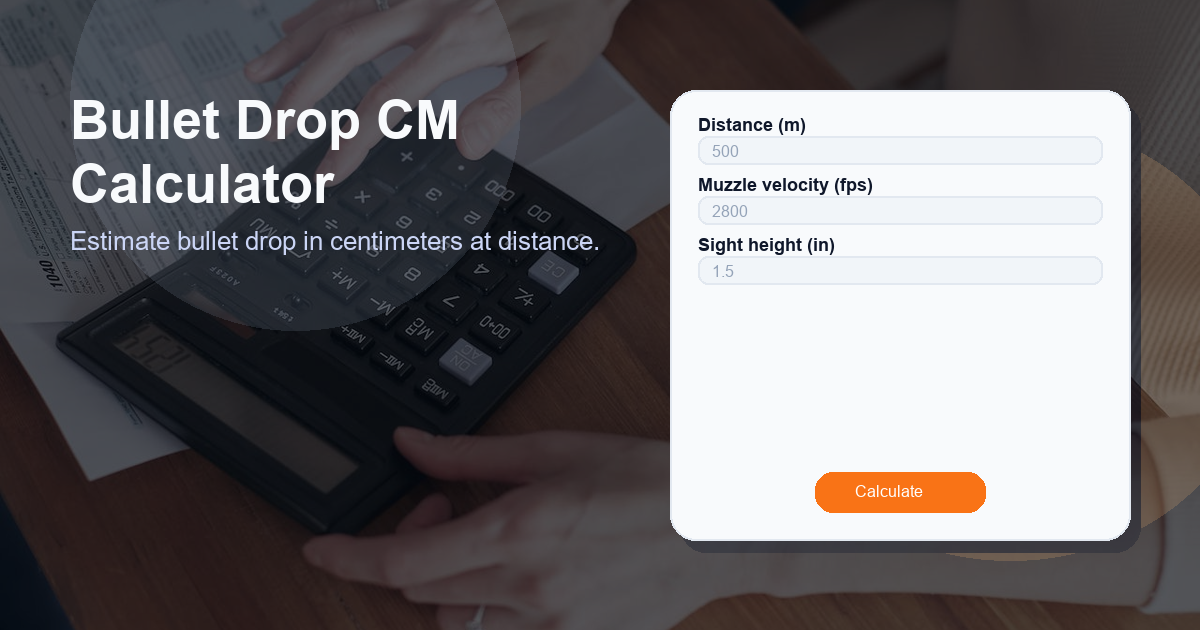
Description: Estimate bullet drop in centimeters at distance.
What this Bullet Drop CM Calculator calculator does
The Bullet Drop CM Calculator is a simple, physics-based tool that estimates the vertical drop of a projectile (bullet) in centimeters at a specified range. It uses basic kinematics — assuming constant gravitational acceleration and straight-line horizontal motion — to return the expected vertical displacement of the bullet relative to the muzzle line of travel, then adjusts for the shooter’s sight height. The calculator accepts three inputs and returns a single result labeled Drop.
Inputs:
- Distance (m): Target distance in meters.
- Muzzle velocity (fps): Bullet muzzle velocity in feet per second (fps).
- Sight height (in): Height of the sight or optic above the bore in inches.
Output: Drop — vertical drop in centimeters.
How to use the Bullet Drop CM Calculator calculator
Using the Bullet Drop CM Calculator is straightforward. Follow these steps for a quick estimate:
- Enter the distance to your target in meters (m).
- Enter the muzzle velocity of the cartridge in feet per second (fps). This is often listed on ammunition boxes or ballistic tables.
- Enter the sight height — the vertical distance in inches between the bore axis and the sight/optic center.
- Press calculate. The result labeled Drop will show the estimated drop in centimeters (cm).
Example: For a 100 m shot with a muzzle velocity of 2800 fps and a sight height of 1.5 in, the calculator provides an approximate Drop of ~2.92 cm. This quick estimate can help with range adjustments and holdover decisions when precise ballistic tables or software are not available.
How the Bullet Drop CM Calculator formula works
The calculator uses the following expression (implemented as JavaScript-style logic) to compute drop:
Formula:
muzzle_velocity_fps > 0 ? ((0.5 * 32.174 * Math.pow(distance_m * 3.28084 / muzzle_velocity_fps, 2) * 12) - sight_height_in) * 2.54 : 0
Breaking that formula down into understandable steps:
- Distance conversion: distance_m * 3.28084 converts meters to feet because muzzle velocity is in fps.
- Time of flight (seconds): t = distance_ft / muzzle_velocity_fps. This assumes the bullet travels at constant muzzle velocity horizontally, so t is the time it takes to cover the horizontal distance.
- Vertical drop in feet: y_ft = 0.5 * g * t^2, where gravitational acceleration g is 32.174 ft/s^2. This is standard physics for free-fall under gravity.
- Convert feet to inches: y_in = y_ft * 12.
- Account for sight height: The bullet’s path is referenced to the bore axis; subtract sight_height_in to get the bullet’s vertical position relative to the sight line: y_rel_in = y_in – sight_height_in.
- Convert to centimeters: y_rel_cm = y_rel_in * 2.54. This is the displayed Drop.
- Safety check: If muzzle velocity is zero or negative, the formula returns 0 to avoid invalid calculations.
Important note: This method models only the gravitational component of drop and converts units appropriately. It does not model aerodynamic drag, wind, Coriolis effects, or bullet deceleration. It also assumes the bullet travels perfectly level with the bore axis at muzzle velocity in the horizontal direction — an approximation useful for quick estimates and educational purposes.
Use cases for the Bullet Drop CM Calculator
The Bullet Drop CM Calculator is useful in multiple scenarios where a fast, first-order estimate of drop is valuable:
- Range safety and planning: Estimate how much vertical correction or holdover you might need before entering the shooting range or setting up targets.
- Ballistic education: Demonstrate how gravity affects projectile paths in classrooms, training sessions, or online content.
- Rough field adjustments: Provide quick reference numbers when full ballistic calculators or doppler data are unavailable.
- Comparison and sanity checks: Compare this gravity-only estimate against full ballistic solver outputs to gauge the role of drag and other effects.
- Hunting and marksmanship basics: Understand tendencies of bullet drop at typical engagement distances to improve aiming technique.
Other factors to consider when calculating x
While the Bullet Drop CM Calculator gives a quick gravitational drop estimate, many real-world factors can change the actual bullet path. Consider these when planning shots or interpreting results:
- Aerodynamic drag: Drag slows the bullet and increases time of flight, usually producing larger drop than gravity-only estimates. Drag depends on ballistic coefficient (BC), velocity, and air density.
- Ballistic coefficient (BC): Higher BC bullets retain velocity better and will usually drop less at a given range than low-BC bullets.
- Air density and altitude: Higher altitude and warmer temperatures reduce air density, reducing drag and resulting in less drop than at sea level.
- Wind: Wind introduces horizontal and sometimes vertical effects (e.g., wind shear or updrafts) that this calculator does not model.
- Bullet stability and yaw: Poor stabilization or yawing can increase drag and change the trajectory.
- Zeroing and sight offset: The user’s zero distance and scope alignment also change how much holdover or adjustment is needed; the simple sight-height subtraction here does not equal a full zeroing solution.
- Coriolis and spin drift: At very long ranges, Earth’s rotation and gyroscopic drift can be noticeable but are beyond this tool’s scope.
FAQ
Q: What units must I enter for each input?
A: Enter distance in meters (m), muzzle velocity in feet per second (fps), and sight height in inches (in). The calculator converts units internally and returns Drop in centimeters (cm).
Q: Is this calculator accurate for all bullets and ranges?
A: No. This calculator models only gravitational drop (g = 32.174 ft/s²) and assumes the bullet travels at constant muzzle velocity horizontally. It ignores aerodynamic drag, ballistic coefficient, wind, and other real-world factors. Use it for quick estimates or teaching; for precision shooting, use a full ballistic solver with BC, air density, and measured velocity.
Q: Why is sight height subtracted in the formula?
A: The formula computes the vertical distance the bullet falls from the bore axis over time. The line of sight (optic) is typically above the bore by a measured sight height. Subtracting sight height aligns the computed fall with the sighting reference so the output reflects how far below the sight the bullet will be at the target.
Q: Why does the formula use 32.174?
A: 32.174 ft/s² is the standard gravitational acceleration constant in feet per second squared. The calculator uses that value because the muzzle velocity input is in feet per second. Unit conversions produce the final result in centimeters.
Q: Can I use this to zero my rifle?
A: Not reliably. Zeroing involves both sight height and the angle at which the barrel is aimed relative to the sight to intentionally intersect bullet path and line of sight at a chosen range. Use this tool for estimated drop values, then verify with live-fire zeroing and proper ballistic tables or software for precise sight adjustments.