Bullet Expansion Calculator
Bullet Expansion Calculator — Estimate expanded diameter from impact velocity and bullet type quickly and consistently. This article explains what the calculator does, how to use it, the formula behind it, practical use cases, and additional factors that influence real-world expansion. Use this guide to get reliable, repeatable estimates and understand the assumptions behind them.
What this Bullet Expansion Calculator calculator does
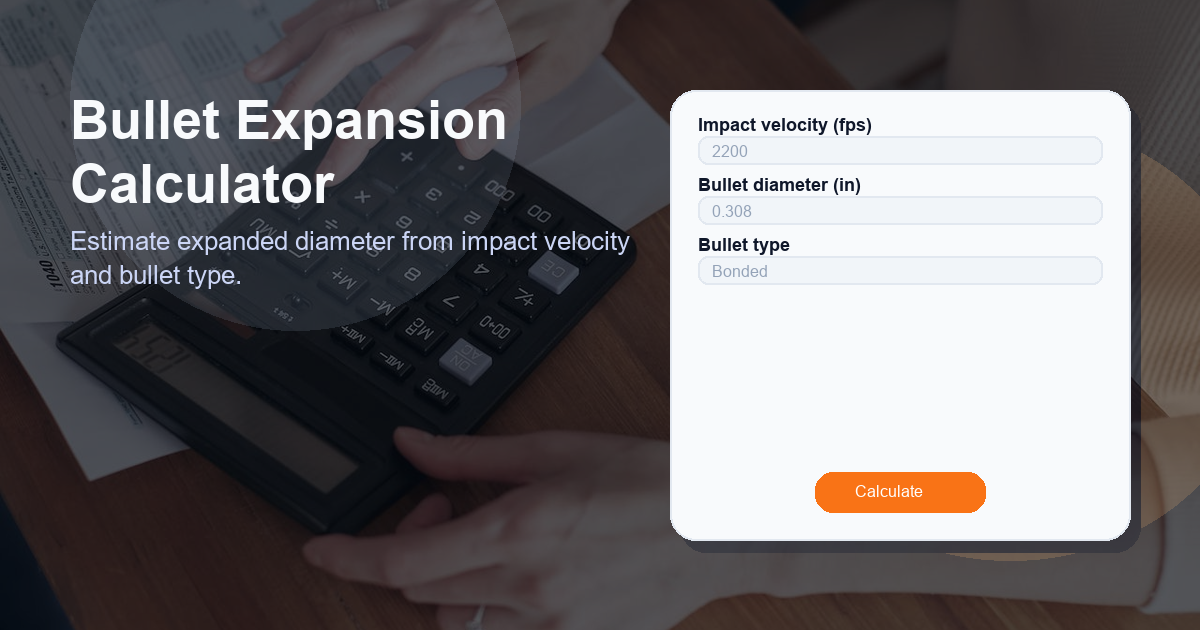
The Bullet Expansion Calculator estimates the Expanded Diameter of a bullet after impact using three simple inputs:
- Impact velocity (fps) — velocity at the moment the bullet strikes the target, measured in feet per second.
- Bullet diameter (in) — the original caliber of the bullet in inches.
- Bullet type — a dimensionless multiplier that represents how readily a bullet design expands (e.g., full metal jacket, soft-point, hollow point).
The calculator uses a straightforward, linearized model to provide a quick estimate of post-impact diameter. It is intended for conceptual planning, comparison, and educational use rather than as a substitute for live testing or certified ballistic models.
How to use the Bullet Expansion Calculator calculator
Using the Bullet Expansion Calculator is simple. Follow these steps:
- Measure or obtain the Impact velocity (fps) for the shot scenario. This should be the velocity when the bullet reaches the target, not muzzle velocity unless firing over a very short distance.
- Enter the bullet’s original Bullet diameter (in) in inches (for example, 0.308 for a .308 caliber bullet).
- Select or input the Bullet type multiplier that best matches the bullet construction and expected expansion behavior.
- Apply the formula (shown below) to compute the Expanded Diameter.
Formula (as used by the calculator):
caliber_in * (1 + (impact_velocity_fps - 1200) / 4000) * bullet_type
Example calculation:
- Impact velocity = 2500 fps
- Bullet diameter = 0.308 in (.308 caliber)
- Bullet type multiplier = 1.25 (example for a moderately expanding hollow point)
Step-by-step plug-in:
0.308 * (1 + (2500 - 1200) / 4000) * 1.25
= 0.308 * (1 + 1300 / 4000) * 1.25
= 0.308 * (1 + 0.325) * 1.25
= 0.308 * 1.325 * 1.25
≈ 0.308 * 1.65625
≈ 0.510 in
Expanded Diameter: approximately 0.510 inches (in this illustrative example).
How the Bullet Expansion Calculator formula works
The formula used by the Bullet Expansion Calculator is:
caliber_in * (1 + (impact_velocity_fps - 1200) / 4000) * bullet_type
Key elements and rationale:
- caliber_in: the baseline diameter. Expansion scales relative to this original size.
- (impact_velocity_fps – 1200) / 4000: a normalized velocity term. The formula treats 1200 fps as a baseline below which expansion is minimal. The divisor 4000 scales how much additional velocity contributes to the expansion factor. This linear term approximates the tendency for higher impact energy to increase expansion.
- bullet_type: a multiplicative factor that captures design-dependent expansion behavior. Different bullet constructions (e.g., FMJ, soft point, polymer-tipped hollow point) expand at different rates. The bullet_type multiplier adjusts the computed size accordingly.
This approach trades absolute physical modeling for simplicity and transparency. It is intentionally linear and conservative to make it usable with minimal inputs while conveying relative differences across loads and bullet designs.
Use cases for the Bullet Expansion Calculator
The Bullet Expansion Calculator is useful in a variety of practical and educational contexts:
- Hunters — compare likely expanded diameters across loads to help select a cartridge and bullet combination for ethical terminal performance.
- Reloaders and handloaders — estimate how changes to velocity may influence expansion when tuning loads.
- Ballistics students and instructors — demonstrate the relationships between velocity, bullet design, and expansion using a simple numeric model.
- Forensic and investigative preliminaries — generate quick, approximate expansion figures when reconstructing shooting scenarios (note: always corroborate with empirical test data before drawing conclusions).
- Ammunition designers (concept stage) — perform early-stage comparisons across design options before physical prototyping.
Other factors to consider when calculating x
While the Bullet Expansion Calculator provides a useful estimate, many real-world variables affect actual expansion. When calculating x (the expanded diameter), consider the following:
- Bullet construction: jacket thickness, nose cavity depth, bonding between jacket and core, and pre-forming all strongly influence expansion beyond a single multiplicative factor.
- Target medium: expansion in ballistic gelatin differs from expansion in animal tissue, bone, or layered clothing. Barriers (leather, denim, auto glass) can reduce or alter expansion.
- Bullet yaw and stability: bullets that yaw or tumble can present different forces on the nose and may expand more or less than predicted by simple models.
- Fragmentation: some bullets fragment instead of expanding, which changes terminal diameter in ways this calculator does not model.
- Temperature and environmental conditions: temperature can affect propellant burn and terminal velocity; very cold or hot conditions may alter expansion slightly.
- Barrel and rifling effects: barrel twist rate and bore condition affect bullet stability and can change how a bullet expands at impact.
In short, use the calculator as a consistent estimate and comparative tool, but validate important decisions with controlled testing and manufacturer data.
FAQ
Q: How accurate is the Bullet Expansion Calculator?
A: The calculator provides a simplified estimate based on a linearized model. It is useful for comparison and planning but is not as accurate as empirical testing in ballistic gelatin or manufacturer-specific terminal ballistics data. Treat results as indicative rather than definitive.
Q: What value should I use for the Bullet type multiplier?
A: The bullet_type multiplier represents a design-driven expansion multiplier. As an example only: use 1.00 for non-expanding or FMJ, 1.10–1.30 for mild-expanding designs, and 1.30–1.60+ for highly engineered hollow points. These ranges are illustrative; consult manufacturer guidance or test data for precise values.
Q: Does the calculator account for fragmentation or bone strikes?
A: No. This model assumes a continuous expansion process and does not model fragmentation, break-up, or complex interactions like bone impact. Such events can drastically change terminal behavior and require dedicated testing to evaluate.
Q: Can I use muzzle velocity instead of impact velocity?
A: You can use muzzle velocity for very short-range scenarios where velocity loss is minimal, but for accurate estimates at range, use the impact velocity (after accounting for distance, drag, and ballistic coefficient).
Q: Is this calculator safe to use for selecting self-defense or hunting loads?
A: The calculator can support initial comparisons, but selecting ammunition for hunting or defense should rely on proven tests, manufacturer claims, and local regulations. Always prioritize reliable empirical data and ethical considerations when choosing a load.
Note: The Bullet Expansion Calculator is a modeling tool. Always corroborate critical applications with physical testing and expert guidance.