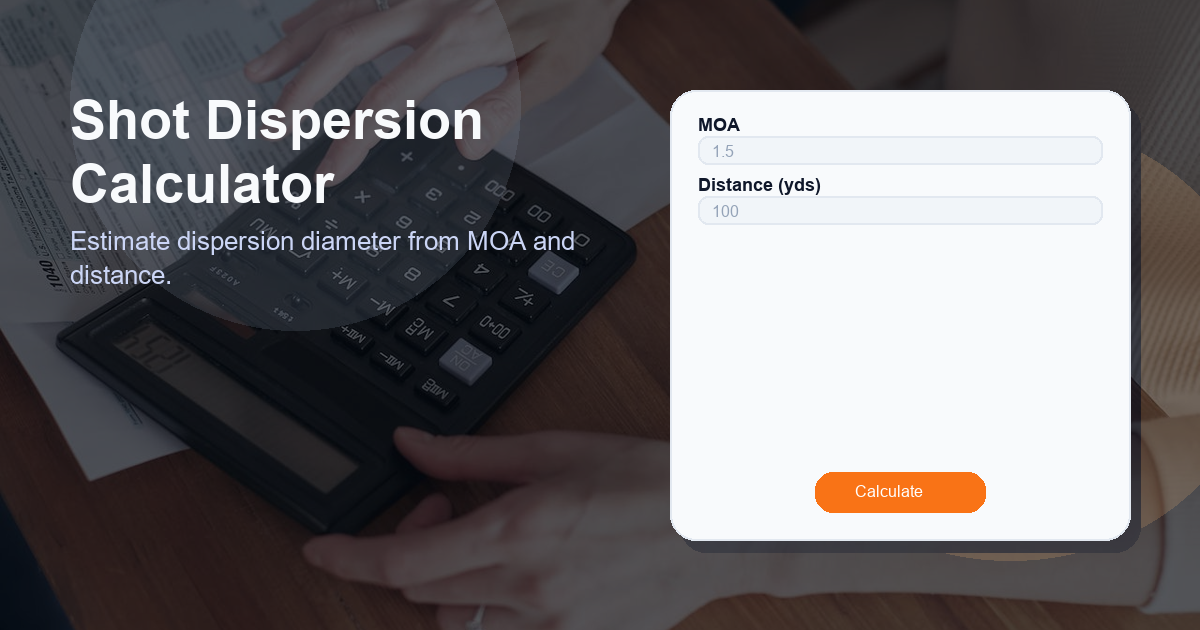
The Shot Dispersion Calculator is a simple tool to estimate the diameter of a shot group (dispersion) based on sighting precision expressed in MOA and the target distance in yards. Use this calculator to quickly convert angular accuracy into a practical linear spread so you can compare rifles, ammunition, or sighting adjustments at specific distances.
What this Shot Dispersion Calculator calculator does
The Shot Dispersion Calculator converts an angular accuracy value in MOA (Minute of Angle) into a linear diameter (the expected group Dispersion) at a given distance measured in yards. It answers the common question: “If my rifle or scope is said to be X MOA, how large will my group be at Y yards?”
Inputs:
- MOA — the angular measurement of accuracy (numeric).
- Distance (yds) — the range to the target in yards.
Formula used:
Dispersion = moa * 1.047 * distance_yds / 100
This produces the Dispersion as a linear value (inches) representing the approximate diameter of the shot group at the specified distance.
How to use the Shot Dispersion Calculator calculator
Using the Shot Dispersion Calculator is straightforward. Follow these steps:
- Enter MOA — Input the angular accuracy number in MOA (for example, 1, 0.5, 0.75). This can be the manufacturer’s claimed accuracy, an observed average, or a scope adjustment value.
- Enter Distance (yds) — Enter the target distance in yards (for example, 100, 200, 500).
- Calculate Dispersion — The calculator applies the formula moa * 1.047 * distance_yds / 100 and returns the Dispersion (inches), which is the estimated diameter of the group at that distance.
Example:
- MOA = 1.0, Distance = 100 yds.
- Dispersion = 1.0 * 1.047 * 100 / 100 = 1.047 inches.
- Result label: Dispersion: 1.047 in
Another example for clarity:
- MOA = 0.5, Distance = 300 yds.
- Dispersion = 0.5 * 1.047 * 300 / 100 = 1.5705 inches.
- Result label: Dispersion: 1.571 in (rounded).
Note: The value 1.047 in the formula is the approximate number of inches in one MOA at 100 yards (1 MOA ≈ 1.047 inches at 100 yards). Multiplying by distance/100 scales that to the chosen yardage.
How the Shot Dispersion Calculator formula works
The underlying calculation converts an angular measurement (MOA) into a linear measurement at a given distance. The formula is:
Dispersion = moa * 1.047 * distance_yds / 100
Why this works:
- MOA is an angular unit: 1 MOA equals 1/60 of a degree. At 100 yards, 1 MOA covers approximately 1.047 inches.
- By multiplying MOA by 1.047 you get the inches of spread at 100 yards for that MOA value.
- Multiplying by distance_yds / 100 scales the result to any other yardage.
Step-by-step breakdown:
- Start with MOA (for example, 0.8 MOA).
- Multiply by 1.047 to convert to inches at 100 yards: 0.8 × 1.047 = 0.8376 in at 100 yds.
- Scale to your distance, e.g., at 250 yds: 0.8376 × (250 / 100) = 2.094 in.
Result labeling: The calculator reports this value as Dispersion, which you can interpret as the approximate group diameter if the angular precision holds across the group. Keep in mind this is an estimate — real-world group sizes will vary due to many factors described below.
Use cases for the Shot Dispersion Calculator
The Shot Dispersion Calculator is useful in a variety of shooting-related scenarios. Common use cases include:
- Comparing gear: Compare advertised MOA values for different rifles or scopes and see the practical impact at various ranges.
- Load development: Estimate how changes in ammunition or components will change group size at specific distances.
- Zeroing and scope setup: Understand how scope adjustments translate into group movement and expected spread at target range.
- Training and goal setting: Set realistic accuracy goals (e.g., “I need 1 MOA or better to reliably place shots in a 2-inch target at 200 yards”).
- Ballistics planning: Incorporate dispersion estimates when planning for precision shooting, match strategy, or hunting scenarios.
Because the calculator returns an easily visualized linear diameter (inches), it helps shooters make quick decisions without doing trigonometry manually.
Other factors to consider when calculating dispersion
The Shot Dispersion Calculator provides a theoretical baseline, but actual group size is influenced by many additional factors. Consider these when interpreting results:
- Shooter error: Human factors (trigger control, stance, follow-through) often dominate group size, especially at longer ranges.
- Ammunition variability: Differences in bullet weight, powder charge, and consistency affect dispersion.
- Barrel and rifle condition: Barrel harmonics, fouling, throat erosion, and bedding can change point-of-impact and group size.
- Environmental conditions: Wind, temperature, humidity, and altitude all influence bullet flight and increase dispersion variability.
- Measurement method: “Group size” can be measured center-to-center, edge-to-edge, or by best-fit circles — be consistent when comparing values.
- Definition of MOA: Manufacturers sometimes round or use informal definitions. Verify whether MOA is measured at 100 yards and whether it refers to average or best-group values.
- Shot count: A three-shot group will often appear smaller or larger than a 10-shot group; dispersion statistics change with sample size.
- Units and conversions: The formula outputs inches. If you need metric units (mm or cm), convert the final Dispersion value accordingly (1 inch = 25.4 mm).
- Systematic offsets: Windage and elevation offsets shift the center of the group but do not necessarily change dispersion; random errors increase dispersion.
Use the Shot Dispersion Calculator as a quick estimate and pair it with range testing to validate real-world performance.
FAQ
Q: What units does the Shot Dispersion Calculator use for Dispersion?
A: The calculator returns Dispersion in inches. The formula uses 1.047 inches per MOA at 100 yards and scales by the distance in yards divided by 100.
Q: Can I use the calculator with distances in meters?
A: The inputs are in yards. To use meters, convert the distance to yards first (1 meter ≈ 1.09361 yards) or convert the final Dispersion from inches to millimeters (multiply inches × 25.4) after calculation.
Q: Does this give an exact group size I will achieve on the range?
A: No. The calculator gives an estimate based on angular accuracy (MOA). Actual group size depends on shooter skill, ammunition, environmental conditions, and rifle condition.
Q: How should I interpret a manufacturer’s MOA claim?
A: Manufacturer MOA specs are often idealized. Use the calculator to understand the theoretical dispersion, but verify with live-fire testing to see actual performance under your conditions.
Q: What’s the difference between MOA and mils for dispersion?
A: MOA and mil (milliradian) are different angular units. This calculator uses MOA. To use mil-based values, convert mils to inches per 100 yards (1 mil ≈ 3.438 inches at 100 yards) and adapt the formula accordingly.
Use this Shot Dispersion Calculator as a quick, reliable way to translate MOA into practical group diameter at your chosen distance. Always confirm calculations with real-world testing to account for the many variables that affect shot dispersion.