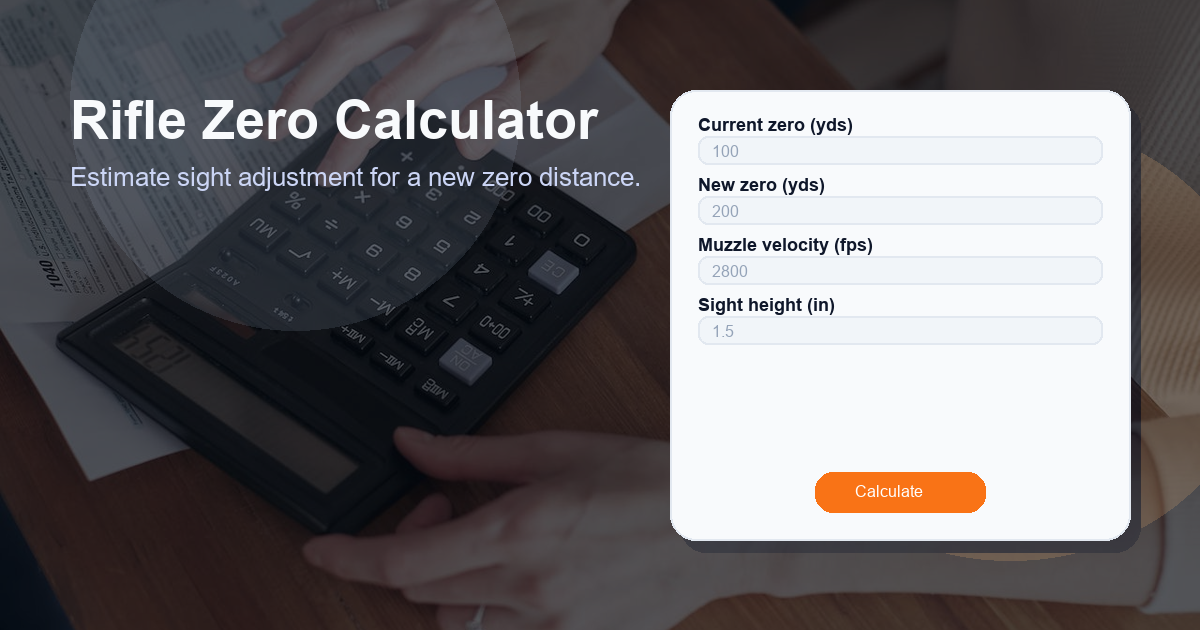
Description: Estimate sight adjustment for a new zero distance with this easy-to-use Rifle Zero Calculator. Enter your current zero, desired new zero, muzzle velocity and sight height to get a quick estimate of the vertical shift (in inches) you can expect when changing zero distances.
What this Rifle Zero Calculator calculator does
The Rifle Zero Calculator provides a simple, physics-based estimate of the vertical difference between your current sight zero and a new zero distance. It calculates a single value called the Zero Shift (in inches) that represents how far the bullet will be above or below your sight line at the new distance given the inputs you provide.
Key features:
- Quick estimate: Fast computation using muzzle velocity, sight height, and distances.
- Units-aware: Inputs are in yards (current and new zero), feet per second (muzzle velocity), and inches (sight height).
- Result label: The output is labeled Zero Shift and returned in inches.
- Safe fallback: If muzzle velocity is zero or invalid, the calculator returns 0 to avoid division errors.
How to use the Rifle Zero Calculator calculator
Using this Rifle Zero Calculator is straightforward. Follow these steps:
- Enter Current zero (yds) — the distance at which your rifle is currently zeroed (for example, 25 yards).
- Enter New zero (yds) — the distance you want to re-zero the rifle to (for example, 100 yards).
- Enter Muzzle velocity (fps) — the muzzle velocity of your load in feet per second (for example, 2800 fps).
- Enter Sight height (in) — the vertical distance from the center of the bore to the center of the sight (typically 1–2 inches for most rifle scopes).
- Read the Zero Shift — the calculator provides the vertical shift in inches. Positive values indicate the bullet will be below the sight line by that many inches at the new zero; negative values indicate the bullet will be above the sight line.
Example calculation (illustrative):
- Current zero: 25 yds
- New zero: 100 yds
- Muzzle velocity: 2800 fps
- Sight height: 1.5 in
Estimated Zero Shift ≈ 0.58 in (bullet expected about 0.58 inches below the sight line at 100 yds given those inputs). This is an approximation and should be verified on the range before precision shooting.
How the Rifle Zero Calculator formula works
The core formula used by the calculator is a simplified kinematic approximation that assumes a straight-line horizontal component of velocity and constant gravitational acceleration. The exact JavaScript-style expression used by the tool is:
muzzle_velocity_fps > 0 ? ((0.5 * 32.174 * (Math.pow(new_zero_yds * 3 / muzzle_velocity_fps, 2) - Math.pow(current_zero_yds * 3 / muzzle_velocity_fps, 2)) * 12) - sight_height_in) : 0
Breakdown of terms and units:
- new_zero_yds * 3: converts yards to feet (1 yd = 3 ft).
- / muzzle_velocity_fps: divides distance (ft) by velocity (ft/s) to get a simple time-of-flight estimate in seconds.
- Math.pow(…, 2): squares the time to use the vertical displacement formula from constant acceleration physics (s = 0.5 * g * t^2).
- 0.5 * 32.174: uses gravitational acceleration in ft/s^2 (approx. 32.174 ft/s^2) and applies the 0.5 factor from s = 0.5*g*t^2.
- * 12: converts the displacement from feet into inches.
- – sight_height_in: subtracts the sight height to produce the vertical difference between the bullet and the sight line (the Zero Shift in inches).
- The ternary expression returns 0 if muzzle_velocity_fps is zero or negative to avoid dividing by zero.
Interpretation: The formula calculates the difference in vertical drop between the two distances and then offsets that by your sight height. The result—labeled as Zero Shift—is an estimate of how many inches the bullet will impact above or below the optical axis at the new zero.
Use cases for the Rifle Zero Calculator
The Rifle Zero Calculator is useful for a variety of shooters and situations:
- Transitioning zero distance: If you usually zero at close ranges (e.g., 25 yds) but want to move to a longer zero (e.g., 100 yds), this calculator gives a quick estimate of vertical shift.
- Load comparison: Compare how different muzzle velocities change your zero shift without firing multiple groups.
- Field expediency: For hunters or tactical shooters who need an initial estimate to dial in before final range confirmation.
- Training and education: Demonstrates how time-of-flight and gravity interact to create bullet drop as distance increases.
- Scope setup planning: Helps plan how many clicks or reticle adjustments might be required to move between zeros (you’ll still want to convert inches to MOA or MIL clicks at the target distance).
Other factors to consider when calculating x
While the Rifle Zero Calculator provides a useful approximation, several additional real-world factors affect where a bullet actually impacts. Consider the following before relying solely on the calculator for precision work:
- Ballistic drag and coefficient (BC): The calculator ignores aerodynamic drag. Real bullets decelerate, increasing time of flight and drop compared to the simple model.
- Air density, altitude and temperature: Environmental conditions change drag and velocity; higher altitude and warmer temperatures generally reduce drag.
- Wind and crosswind: Horizontal drift is not accounted for here—use a full ballistic solution or wind calls for precise long-range shooting.
- Barrel harmonics and twist rate: These affect point of impact and stability, especially with different bullet weights.
- Scope mounting and parallax: Scope alignment, cant, and parallax error can change effective sight height and POI.
- Escape velocity and transonic effects: For extended ranges where the bullet slows into the transonic zone, drop behavior can change unpredictably relative to a simple model.
- Rifle and ammo consistency: Muzzle velocity variance from shot to shot changes the actual impact more than a static model captures; chronographing your load improves accuracy of the estimate.
FAQ
Q: What is the unit of the Zero Shift output?
A: The Zero Shift output is in inches. It estimates vertical displacement relative to the sight line at the new zero distance.
Q: Does the calculator account for bullet drag and ballistic coefficient?
A: No. This calculator uses a simplified kinematic model and does not account for aerodynamic drag, ballistic coefficient, or environmental effects. Use a ballistics solver for more accurate predictions.
Q: If Zero Shift is positive, how should I adjust my scope?
A: A positive Zero Shift means the bullet will be below the sight line by that many inches at the new distance. To correct, you would typically adjust your point of aim or move the reticle so the impact is brought up (note: exact scope clicks required depend on distance and your scope’s click value; convert inches at the target distance to MOA or MIL).
Q: What should I enter for sight height?
A: Enter the vertical distance from the bore centerline to the optical center of your sight in inches. Typical values for rifle scopes range from about 1.2 to 2.0 inches depending on mounts and rings.
Q: Is this safe to rely on in the field?
A: Use this Rifle Zero Calculator for an initial estimate only. Always confirm your zero by shooting groups at the desired distance under actual field conditions before relying on it for hunting or precision shots.