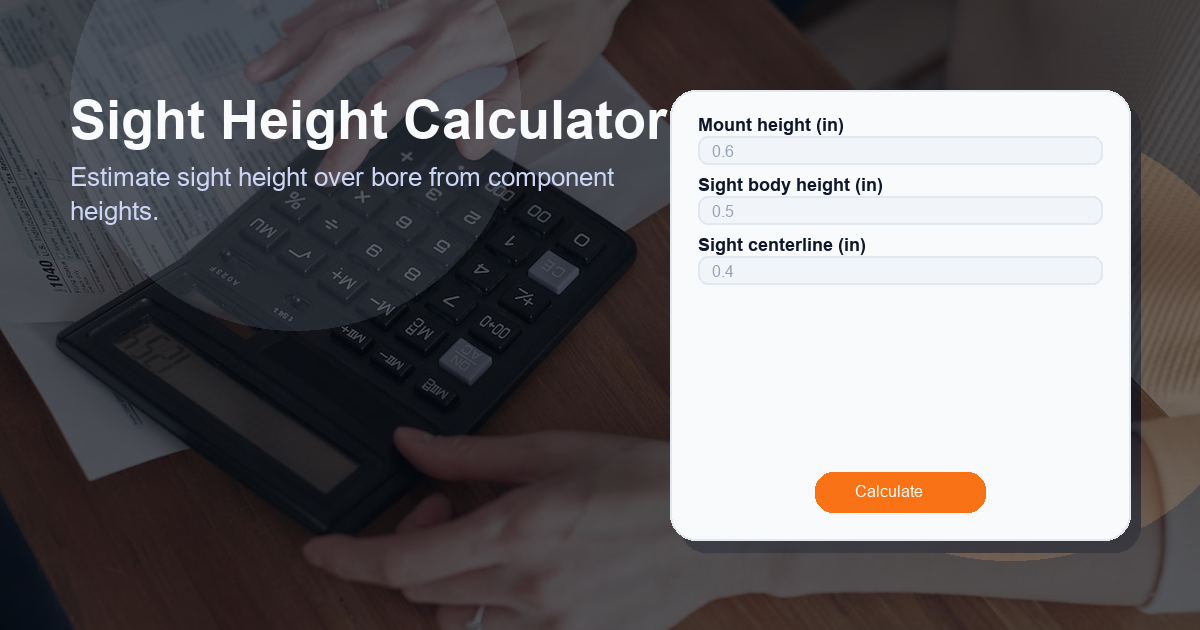
Description: Estimate Sight Height over bore from component heights. This Sight Height Calculator helps shooters, gunsmiths, and designers quickly determine the vertical distance between the bore (barrel centerline) and the aiming surface by adding component heights. Use this tool to ensure proper sight alignment, co-witnessing, and clearance for optics, suppressors, and muzzle devices.
What this Sight Height Calculator calculator does
The Sight Height Calculator computes the total vertical distance from the bore centerline (or muzzle centerline) to the sight’s aiming plane by summing three components:
- Mount height (in) — the thickness or rise contributed by the mount or base that sits on the receiver or slide.
- Sight body height (in) — the height of the sight hardware itself above the mount (this is the physical height of the sight body).
- Sight centerline (in) — the distance from the sight’s physical reference to the actual aiming centerline (for example, the center of an optic’s lens or the notch/top of an iron sight).
Formula used: sight height = mount_height_in + sight_body_height_in + sight_centerline_in
Result label: Sight Height (displayed in inches)
How to use the Sight Height Calculator calculator
Using the Sight Height Calculator is simple and reliable when you follow these steps. Make sure all measurements are in inches to match the calculator’s units.
- Measure the Mount Height (in): Measure the vertical distance the mount raises the sight above the reference surface (receiver top, slide, or rail). Use a caliper or scale for precision.
- Measure the Sight Body Height (in): Measure from the top of the mount to the bottom of the sight body if the sight sits on the mount, or follow the manufacturer’s spec for sight body height.
- Measure the Sight Centerline (in): Find the distance from the bottom (or mounting reference) of the sight to the sight’s aiming centerline—this could be the optical center of a red dot lens or the top of a blade notch.
- Enter the values: Add the three measured values into the calculator fields (Mount height, Sight body height, Sight centerline). The formula will compute the total automatically:
Sight Height = mount_height_in + sight_body_height_in + sight_centerline_in
Example: If Mount height = 0.90 in, Sight body height = 0.25 in, and Sight centerline = 0.40 in, then:
Sight Height = 0.90 + 0.25 + 0.40 = 1.55 in
How the Sight Height Calculator formula works
The formula is straightforward because it uses a direct sum of vertical contributions. Each component contributes linearly to the total sight height. The calculator assumes:
- All measurements share the same reference plane: typically the barrel/bore centerline or the mounting surface.
- Heights are additive: there are no offsets or angular corrections applied—this is pure vertical stacking of parts.
Why summation works:
- Mounts raise the entire sight system by their thickness.
- Sight bodies sit on those mounts and add additional vertical offset.
- The sight centerline is the final offset within the sight assembly to the aiming plane.
When combined, these three vertical distances give the full eye-to-bore or sight-to-bore vertical offset. For practical shooting and setup, this single number—labeled Sight Height—is what you use to determine eye relief, iron sight co-witnessing, optic ring height selection, and whether the sight clears accessories like suppressors.
Use cases for the Sight Height Calculator
The Sight Height Calculator is useful across many scenarios. Typical uses include:
- Optic selection and ring height planning: Choose correct ring or mount heights to achieve desired optic centerline relative to the bore.
- Red dot co-witness checks: Ensure an optic lines up with iron sights at the correct height for absolute or lower 1/3 co-witness.
- Suppressor and muzzle device clearance: Verify that the sight does not interfere mechanically with a suppressor or flash hider mounted on the muzzle.
- Custom fabrication and CAD modeling: Use the sight height as a parameter when modeling upper receiver assemblies or sight mounting solutions.
- Ergonomics and cheek weld planning: Match sight height to stock geometry for comfortable eye alignment without shifting head position excessively.
Other factors to consider when calculating sight height
While the simple additive Sight Height Calculator gives an accurate nominal vertical offset, real-world setups require additional considerations:
- Tolerances and manufacturing variance: Components often have small tolerances. Measure actual parts rather than relying only on nominal specs.
- Mounting repeatability: Quick-detach mounts, dovetails, and clamps may shift when reinstalled. Expect small changes in sight height after remounting.
- Barrel contour and sight reference: The bore centerline may not be perfectly aligned with external barrel dimensions. Use the true bore centerline when precision matters.
- Thermal expansion and environmental changes: Heat from firing can change dimensions slightly; extreme temps can affect fit and alignment.
- Optic internal adjustment range: Ensure your optic has enough elevation/windage travel to zero at chosen sight height. High mounts may require more elevation dial-in.
- Eye relief and cheek weld: A higher sight changes head posture. Confirm you can maintain a proper cheek weld and sight picture.
- Legal or competition rules: Some competitions limit allowable sight height or mounting methods. Check regulations if relevant.
- Metric vs imperial: This calculator uses inches. If you measure in millimeters, convert before entering values (1 in = 25.4 mm) or perform the reverse conversion on the result.
FAQ
Q: What exactly is “Sight Height”?
A: Sight Height is the vertical distance from the bore (barrel) centerline to the aiming surface of the sight (optical center, notch, or dot). It determines how the sight aligns with the barrel and affects zeroing and co-witness relationships.
Q: Do I need to measure everything precisely?
A: For casual shooting you can rely on manufacturer specs, but for precision work you should measure each component with calipers or micrometers. Small errors add together and can affect zero at longer ranges.
Q: Can this calculator handle scopes and red dots equally?
A: Yes. The calculator is generic: input the mount height, the sight body height, and the sight centerline (optical center for scopes/red dots, top of blade for irons). Results apply equally.
Q: What if I mount an optic on offset mounts or risers?
A: Enter the effective mount height contributed by the riser or offset into the Mount height field. If multiple pieces stack, sum their heights before entering to get an accurate total.
Q: How do I account for co-witness positions?
A: Calculate the Sight Height for both the optic and your iron sights. Compare the two heights to determine whether they will absolute co-witness, partial co-witness, or require different mounting hardware to align.
Final tip: Use the Sight Height Calculator as an initial planning tool, then verify by test mounting and live zeroing to confirm performance and clearance in the real setup.