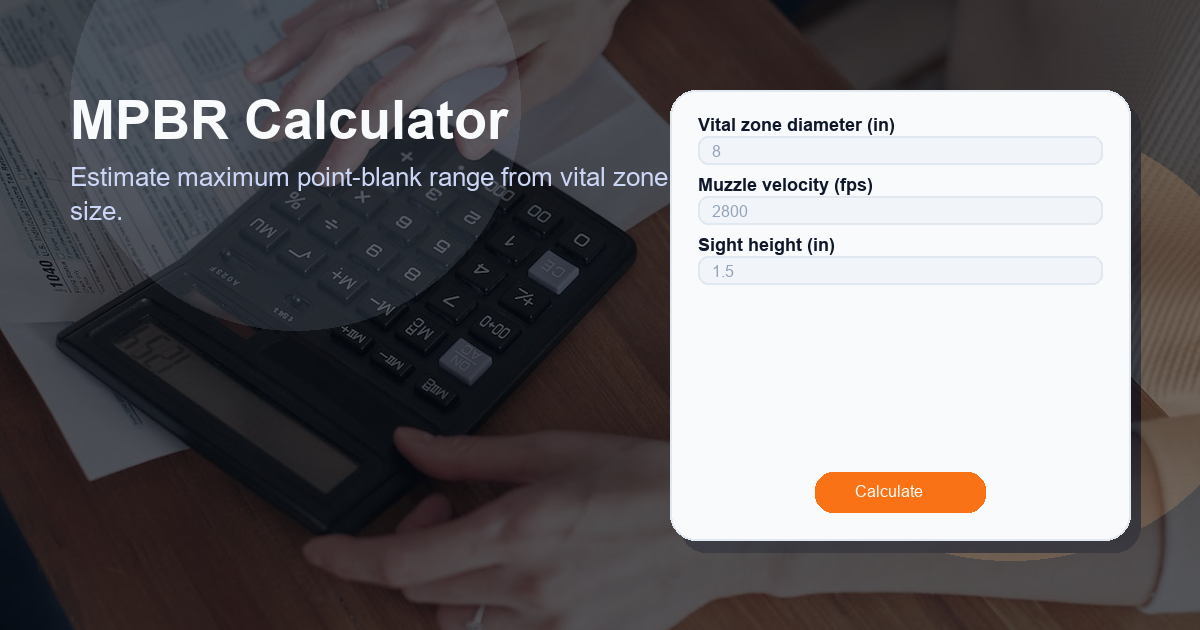
Use this MPBR Calculator to quickly estimate the maximum point-blank range for a given vital zone size, muzzle velocity, and sight height. The calculator computes the distance at which a bullet will remain inside a specified vital zone without adjusting aim for vertical drop. This tool is optimized for hunting and sighting-in planning and returns a practical MPBR value in yards.
What this MPBR Calculator does
The MPBR Calculator estimates how far you can aim at center of mass and expect the bullet to remain within the target’s vital zone without holding over or dialing elevation. Specifically, it:
- Accepts three inputs: vital zone diameter (inches), muzzle velocity (feet per second), and sight height (inches).
- Applies a physics-based formula using gravitational acceleration to approximate the allowable vertical drop relative to the vital zone.
- Outputs MPBR as a single distance value labeled MPBR (in yards).
How to use the MPBR Calculator
To use the calculator below:
- Enter the vital zone diameter in inches. This is the vertical size (height) of the area you want the bullet to stay in—common values: 6″ for small game, 8–10″ for medium game, 12+” for broadside deer shots depending on angle.
- Enter muzzle velocity in feet per second (fps). Use factory ammo data or chronograph results for best accuracy.
- Enter sight height in inches (center of bore to sight/ring height). Typical rifle sight heights are 1–2 inches for scopes, or slightly more for iron sights.
- Click Calculate MPBR to see the result. The displayed value is the estimated MPBR in yards.
How the MPBR Calculator formula works
The formula used by this MPBR Calculator is a simplified ballistic derivation that balances vertical drop against the allowed half-vital-zone tolerance plus sight height. Key points:
- Gravity: The calculator uses standard gravitational acceleration (32.174 ft/s²) converted to inches/sec² to match the input units.
- Half-vital-zone allowance: The model uses half the vital zone diameter vertically, because the bullet can drop either up to half the zone above or below the aim point and still remain inside.
- Time to drop: We compute the time it takes for gravity to cause the allowable drop using sqrt((half_vital + sight_height) / (0.5 * g)), which rearranges basic kinematics for vertical displacement under uniform acceleration.
- Horizontal distance: Multiply that time by the muzzle velocity (ft/s) to get horizontal distance in feet. The result is divided by 3 to convert feet to yards, so the MPBR is presented in yards.
In code form (as used above):
muzzle_velocity_fps > 0 ? Math.sqrt((vital_zone_in / 2 + sight_height_in) / (0.5 * 32.174 * 12)) * muzzle_velocity_fps / 3 : 0
Use cases for the MPBR Calculator
The MPBR Calculator is useful across several practical scenarios:
- Hunting setup: Determine the range at which you can confidently hold center mass without adjusting for bullet drop.
- Zeroing decisions: Compare MPBR for different zero distances or sight heights to decide an optimal zero for your hunting conditions.
- Ammo selection: Compare different loads and muzzle velocities to see which provides a longer MPBR for the target vital zone.
- Quick field planning: Use a simple MPBR value to set realistic engagement limits when scouting or planning shoots.
Other factors to consider when calculating MPBR
The MPBR produced by this calculator is an approximation. For precise shooting or extreme distances consider these additional factors:
- Ballistic coefficient (BC) and drag: The calculator assumes a simple flat-trajectory approximation; real bullets lose velocity due to air resistance, altering drop rate and MPBR.
- Wind and crosswind: Lateral drift is not modeled here but can push shots outside the vital zone at range.
- Atmospheric conditions: Air density, temperature, humidity, and altitude affect velocity and drag.
- Projectile behavior: Bullet stability, yaw, and fragmentation can change terminal performance inside the vital zone.
- Sight and rest accuracy: Shooter error, rest consistency, and mounting errors will reduce practical MPBR compared to the theoretical value.
- Target angle and movement: Broadside vs quartering shots change effective vertical target dimension and the safe MPBR.
For mission-critical planning, use a full external ballistics calculator that includes BC, atmospheric inputs, and drag models, or verify with live-fire chronograph and range testing.
FAQ
What does MPBR stand for?
MPBR means Maximum Point-Blank Range. It is the farthest range at which you can aim at a chosen point (usually center mass) and expect the bullet to remain within the defined vital zone without holdover.
What units does the MPBR Calculator output use?
The displayed MPBR is shown in yards. Inputs are in inches (vital zone and sight height) and feet per second for muzzle velocity.
How accurate is the MPBR value?
The calculator provides a reasonable estimate based on basic kinematics and standard gravity. It does not model drag, ballistic coefficient, wind, temperature, altitude, or other advanced effects. For exact work, use a full ballistics solution or field verification.
Why divide by 3 in the formula?
The formula first computes horizontal distance in feet (time × muzzle velocity in ft/s). Dividing by 3 converts feet to yards (1 yard = 3 feet), so the final MPBR value is presented in yards.
Can I use this calculator for all firearms and calibers?
Yes, but treat results as estimates. Use actual chronograph velocity for the most accurate results, and remember this model is simplified. Heavy, high-BC bullets or very slow projectiles may need full ballistic modeling.
Disclaimer: This calculator provides estimates for informational purposes only. It is not a substitute for professional ballistic advice, range testing, or adherence to laws and safe shooting practices.