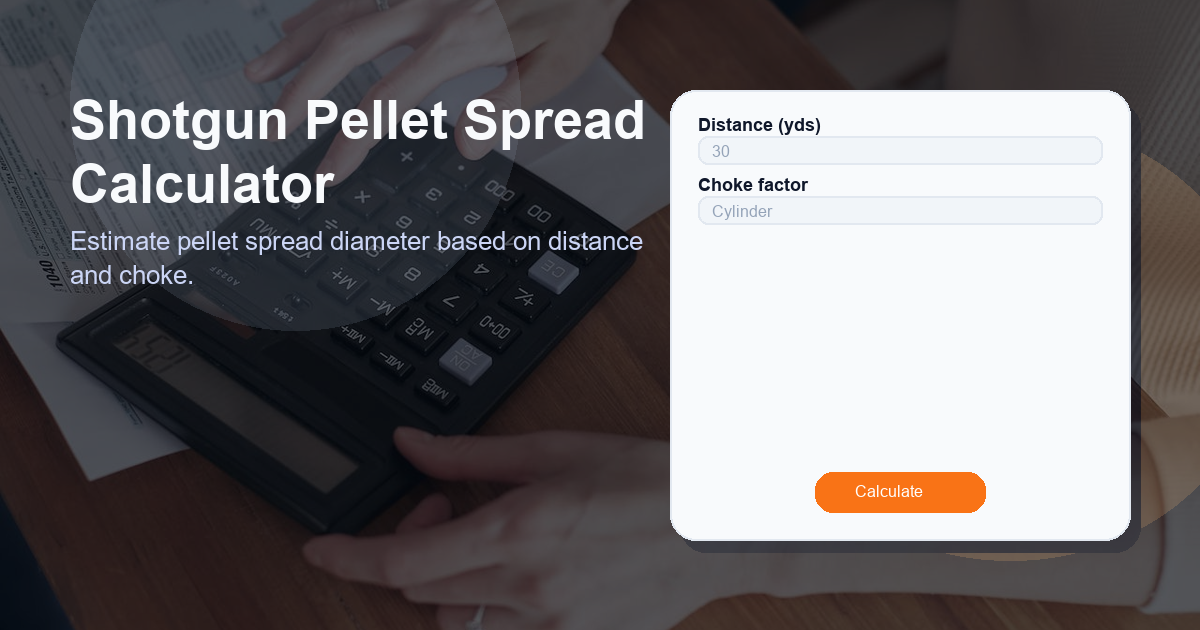
Shotgun Pellet Spread Calculator
Description: Estimate pellet spread diameter based on distance and choke. Use the Shotgun Pellet Spread Calculator to quickly approximate how wide a pattern of pellets will be at a given range.
What this Shotgun Pellet Spread Calculator does
The Shotgun Pellet Spread Calculator is a simple, practical tool that provides an estimate of the pellet pattern diameter at a specified range. It uses two inputs—Distance (yds) and a Choke factor—and applies a straightforward formula to return a single numeric output labeled Spread Diameter.
This calculator is intended for quick planning and comparative purposes, not as a replacement for live pattern testing. It helps shooters, hunters, and instructors get a ballpark figure for how dense and wide a shot pattern will be at common hunting and sporting distances.
How to use the Shotgun Pellet Spread Calculator
Using this calculator is quick and intuitive. Follow these steps:
- Enter Distance (yds): Type the target distance in yards. This is the range from the muzzle to the target.
- Choose or enter the Choke factor: The choke factor is a numeric value representing how tightly the choke concentrates pellets. Typical choke factor values are based on testing or manufacturer guidance; lower values tighten the pattern, higher values spread it more.
- Read the Spread Diameter: The calculator multiplies the two inputs by 0.9 and displays the estimated spread diameter as the result labeled Spread Diameter.
Example (manual):
- Distance = 30 yds
- Choke factor = 1.0
- Spread Diameter = 30 * 0.9 * 1.0 = 27 (displayed as Spread Diameter)
Tip: If you maintain consistent choke-factor reference values across tests, the calculator becomes useful to compare how changing distance affects pattern diameter.
How the Shotgun Pellet Spread Calculator formula works
The calculator uses a single linear formula:
Spread Diameter = distance_yds * 0.9 * choke_factor
Breaking that down:
- distance_yds – the range in yards from the muzzle to the target.
- 0.9 – a scaling constant built into this model. It represents the empirical relationship between yards and expected spread in the chosen output units (this constant can be adjusted in more advanced models based on local testing).
- choke_factor – a multiplicative value representing the tightening or loosening effect of the choke on pattern spread.
This formula is deliberately simple and linear so it’s easy to understand and calculate mentally if needed. The model assumes a roughly proportional relationship between range and spread with choke acting as a direct multiplier. In practice, pellet dynamics are more complex, but this formula gives a usable first-order approximation.
Use cases for the Shotgun Pellet Spread Calculator
The Shotgun Pellet Spread Calculator is useful in a variety of scenarios. Common use cases include:
- Hunting planning: Estimate lethal spread at field distances to decide whether to take a shot and which choke to use.
- Clays and sporting: Compare how different chokes change the pattern at standard yardages for trap, skeet, or sporting clays.
- Training and drills: Set expectations for pattern size during drills and help new shooters visualize shot dispersion with different choke settings.
- Load development and testing: Use as a quick check before live patterning to narrow down choke/load combinations worth full-pattern testing.
- Range safety assessment: Help determine safe backstop requirements based on expected pellet spread at specific distances.
Because the calculator is simple and fast, it’s excellent for field use or as a decision aid before conducting more detailed testing or on-the-fly adjustments between rounds and choke changes.
Other factors to consider when calculating spread diameter
While the calculator gives a quick estimate using the formula above, several real-world factors affect pellet spread and should be considered alongside the calculator result:
- Ammunition type: Pellet size, shot material (lead vs. steel), and load pressure change pattern behavior significantly.
- Barrel length and design: Different barrel lengths and vent rib designs can alter how pellets exit the muzzle.
- Chamber and choke construction: The physical choke design (cyl, improved cylinder, modified, full) has typical pattern effects, but manufacturing tolerances and wear cause variation.
- Pattern testing: The most reliable way to determine real spread is live patterning at range. Use the calculator as a guide but validate with shot cards.
- Environmental conditions: Wind, temperature, and humidity can all influence pellet flight, especially at longer ranges.
- Shot turbulence and pellet deformation: Pellets deform on firing and interact with each other, causing non-linear distribution that this linear formula cannot fully capture.
Because of these complexities, treat the calculator as a quick, conservative estimate. Whenever precision matters—competition, lethal hunting decisions, or load development—perform live testing and adjust choke factors based on real pattern results.
Frequently Asked Questions
Q: What units does the Shotgun Pellet Spread Calculator return for Spread Diameter?
A: The calculator uses Distance (yds) as input and returns a numeric Spread Diameter. In common practice the displayed value is interpreted in linear measurement appropriate to field tests (many users treat the output as inches for quick estimates). Always confirm units with your testing protocol.
Q: How do I choose a choke factor?
A: Choke factor is an empirical multiplier representing the choke’s effect. Start with manufacturer guidance or patterning data: tighter chokes use values around 0.8–1.0 (smaller spread), while more open chokes may be >1.0. The best approach is to pattern your shotgun and derive a choke factor from measured spread at a known distance.
Q: Is this calculator accurate for all shot sizes and loads?
A: No. The calculator provides a first-order estimate. Shot size, shot material, and load pressure significantly affect real-world spread. Use the calculator for planning and comparison, not as a replacement for live pattern testing.
Q: Can I use this formula for very long distances?
A: The linear model (distance * 0.9 * choke_factor) becomes less reliable at very long ranges because pellet drop, wind drift, and fragmentation increase non-linearity. For long-range estimates, rely on field testing and more sophisticated ballistic modeling.
Q: How should I validate the calculator for my gun?
A: Pattern your shotgun at several common distances using your chosen loads and choke settings. Measure actual spread diameters on pattern sheets, then derive a choke factor that aligns the calculator’s output with observed results. Update your choke factor for reliable planning.
Summary: The Shotgun Pellet Spread Calculator is a concise tool to estimate pellet pattern diameter using Distance (yds) and a Choke factor via the formula distance_yds * 0.9 * choke_factor. Use it for planning, comparison, and quick field decisions—but always confirm with live patterning before making critical shot or safety choices.