Bullet Stability Calculator
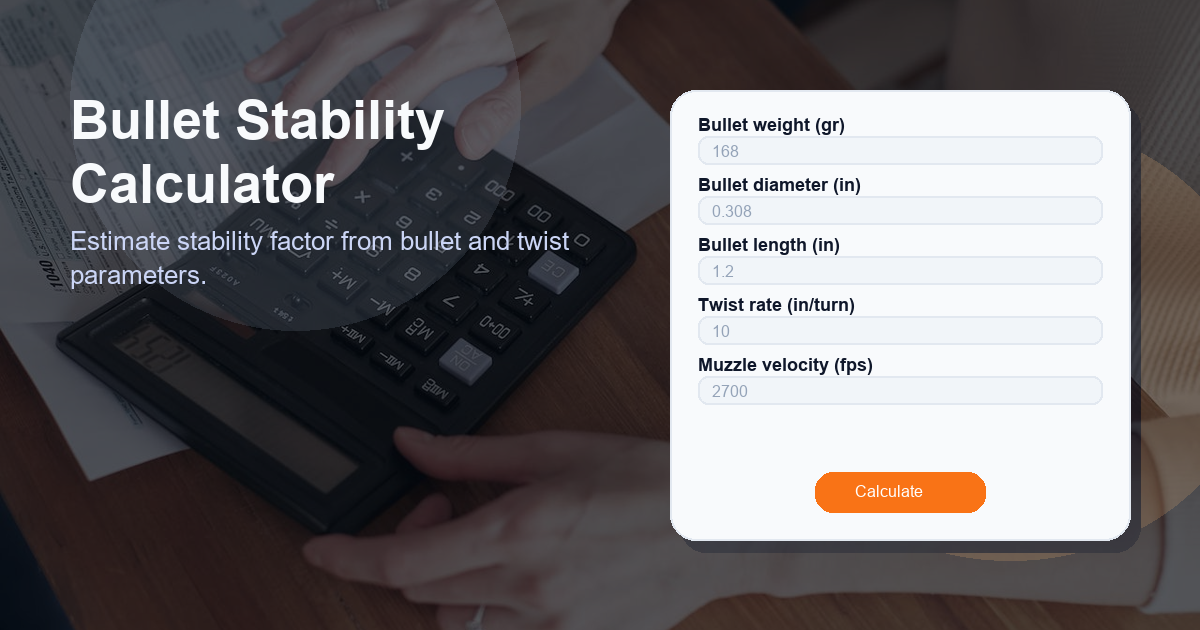
Description: Estimate stability factor from bullet and twist parameters. Use this Bullet Stability Calculator to quickly determine whether a particular bullet, with a given barrel twist and muzzle velocity, will be gyroscopically stable in flight. Enter the five inputs below and click Calculate to get the Stability Factor.
Result: —
What this Bullet Stability Calculator calculator does
This Bullet Stability Calculator gives a numerical estimate of the bullet’s gyroscopic stability during flight, expressed as a Stability Factor. The tool:
- Accepts five key inputs: bullet weight (gr), diameter (in), length (in), barrel twist rate (in/turn), and muzzle velocity (fps).
- Applies a physics-derived formula to produce a single scalar value indicating stability.
- Provides immediate feedback for load development, barrel selection, or bullet choice when optimizing accuracy.
The output is intended as an engineering estimate. Real-world behavior can be influenced by many external factors, but this calculator is a fast and practical first check to determine if the bullet is likely to be stable, marginal, or over-stabilized.
How to use the Bullet Stability Calculator calculator
Using the calculator is straightforward. Follow these simple steps:
- Measure or obtain your inputs:
- Bullet weight in grains (gr).
- Bullet diameter in inches (in), e.g., 0.308 for .308-caliber bullets.
- Bullet length in inches (in) — measured from the base to the tip along the axis.
- Twist rate in inches per turn (in/turn), usually stamped on the barrel (example: 1:10″ is 10 in/turn).
- Muzzle velocity in feet per second (fps), measured with a chronograph or provided by the load data.
- Enter each value into the corresponding field above.
- Click “Calculate Stability Factor.” The calculator will display the resulting Stability Factor with three decimals.
- Interpret the result: As a rule of thumb, a Stability Factor:
- < 1.0 — likely unstable (risk of tumbling).
- ≈ 1.0–1.4 — marginally stable; may be acceptable but not optimal.
- ≈ 1.4–2.0 — generally stable and good for accuracy.
- > 2.0 — potentially over-stabilized for some designs; usually still accurate but can affect long-range bullet behavior.
How the Bullet Stability Calculator formula works
The calculator uses a compact empirical expression to estimate gyroscopic stability. The exact formula implemented is:
stability = bullet_length_in > 0 && bullet_diameter_in > 0 ? (30 * bullet_weight_gr) / (Math.pow(bullet_diameter_in, 3) * bullet_length_in) * Math.pow(twist_rate_in / 10, 2) * (muzzle_velocity_fps / 2800) : 0
Breaking that down:
- Mass term: 30 × weight (gr) — increases stability as mass increases.
- Geometric denominator: diameter^3 × length — larger diameter or longer bullets reduce the computed stability for a given twist and mass. Diameter is cubed to reflect the strong influence of caliber on rotational inertia and aerodynamic properties.
- Twist scaling: (twist_rate_in / 10)^2 — twist is squared, indicating that faster twist (smaller in/turn value) dramatically increases gyroscopic stability. The formula normalizes to a reference twist of 10 in/turn.
- Velocity term: muzzle_velocity_fps / 2800 — a linear scaling that normalizes to 2800 fps. Higher velocity gives greater gyroscopic stability because the bullet spins faster for a fixed twist rate.
- Guard clause: If either bullet length or diameter is zero or invalid, the formula returns 0 to avoid division by zero.
Note that this formulation is a simplified, empirically-tuned estimator rather than a full aerodynamic stability derivation. It is designed to be practical and quick for shooters and load developers to screen setups.
Use cases for the Bullet Stability Calculator
This calculator is useful in a variety of scenarios. Typical use cases include:
- Barrel selection: Determine whether a particular twist rate is appropriate for the bullets you intend to shoot.
- Bullet choice: Compare different bullets (weight and length) to see which are likely to be stable in an existing rifle.
- Load development: Assess how changes in muzzle velocity (different powders or seating depths) may influence stability.
- Long-range optimization: Use the Stability Factor as one of several metrics when tuning for consistent, precise trajectories at extended ranges.
- Training and education: Help new reloaders and shooters understand the relationship between twist, bullet shape, and gyroscopic stability.
Other factors to consider when calculating stability factor
While the Bullet Stability Calculator delivers a useful estimate, remember these additional factors that influence actual performance:
- Atmospheric conditions: Air density, temperature, and humidity affect aerodynamic forces and may change real-world stability compared to the calculator’s estimate.
- Bullet construction and center of gravity: The internal mass distribution (solid vs. jacketed vs. boattail, etc.) affects spin inertia and aerodynamic centers.
- Manufacturing tolerances: Variations in bullet dimensions, concentricity, and barrel bore uniformity can alter practical stability.
- Transonic effects: At transonic speeds, aerodynamic behavior changes significantly and can cause bullets to behave differently than predicted by simple gyroscopic criteria.
- Barrel harmonics and harmony: Even with ideal gyroscopic stability, barrel harmonics, seating depth, and other mechanical variables affect group size and point of impact.
Use the Stability Factor as an initial screening tool, then confirm with chronograph measurements and accuracy testing at the range.
FAQ
What is a good Stability Factor value?
A Stability Factor around 1.4 to 2.0 is commonly considered optimal for many bullets and shooting scenarios. Below 1.0 indicates likely instability; above 2.0 can mean over-stabilization depending on bullet design.
Does muzzle velocity affect stability?
Yes. Higher muzzle velocity increases spin rate for a given twist and tends to increase stability. The formula scales linearly with velocity relative to 2800 fps.
Can I use this calculator for any caliber?
Yes, provided you supply the bullet diameter and length in inches and weight in grains. The formula is a generalized estimator and can be applied across calibers, but interpret results with practical testing.
What if my bullet length or diameter is zero?
To prevent invalid calculations and division by zero, the calculator returns 0 if bullet length or diameter is not a positive number. Enter realistic positive values for correct results.
Is this formula exact for all bullets?
No. This is an empirical, simplified estimator. It is excellent for quick checks and comparisons, but detailed stability analysis may require more advanced aerodynamic models and empirical testing on the range.