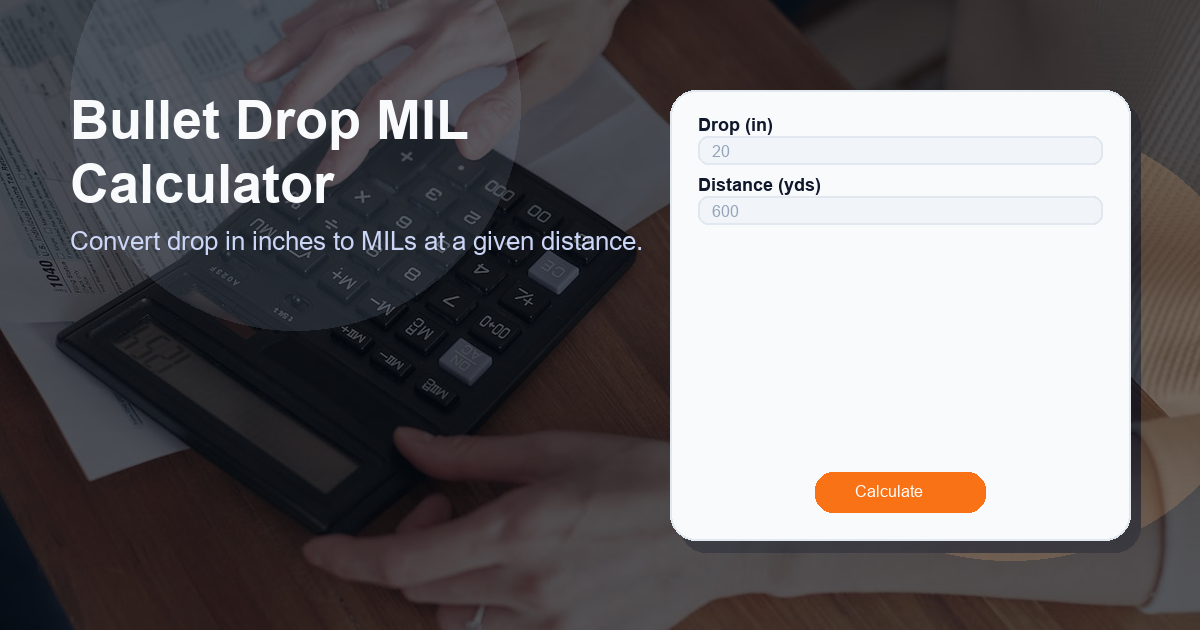
Description: Convert drop in inches to MILs at a given distance. Use the Bullet Drop MIL Calculator to quickly translate a measured or estimated vertical drop (in inches) into milliradians (MIL), which many shooters and optics users rely on for accurate holdovers and elevation adjustments.
What this Bullet Drop MIL Calculator calculator does
The Bullet Drop MIL Calculator converts a physical measurement of bullet drop in **inches** at a known distance in **yards** into the equivalent **milliradian (MIL)** value. This transformation is crucial for shooters who use MIL-based reticles or turrets to make elevation corrections quickly in the field.
This calculator specifically accepts two inputs:
- Drop (in) — the vertical drop measured in inches.
- Distance (yds) — the range at which the drop occurred, measured in yards.
The output is labeled as: Drop (MIL). The tool includes a guard for invalid distances (distance must be greater than zero).
How to use the Bullet Drop MIL Calculator calculator
Using the Bullet Drop MIL Calculator is simple and fast. Follow these steps:
- Measure or estimate the drop in inches. This may come from a chronographed ballistic chart, a range test group, or an observed impact point below the aim point.
- Record the distance to the target in yards. Accuracy of the distance measurement improves MIL accuracy.
- Enter the two values into the calculator: Drop (in) and Distance (yds).
- Read the result labeled Drop (MIL). This number tells you how many MILs of elevation correction you need to compensate for the observed drop.
Example: If your bullet impacts 10 inches low at 200 yards, input Drop (in) = 10 and Distance (yds) = 200. The calculator will give the MIL value to use as a holdover or turret adjustment.
How the Bullet Drop MIL Calculator formula works
The calculator uses the following formula to convert inches of drop into MILs:
distance_yds > 0 ? (drop_in / (distance_yds * 36)) * 1000 : 0
Breaking the formula down:
- distance_yds * 36 converts yards to inches (1 yard = 36 inches). This provides the total linear distance in the same units as the drop measurement.
- drop_in / (distance_yds * 36) computes the angular drop as a proportion of the total range (a unitless value representing radians approximately, because MILs are milliradians).
- … * 1000 converts the unitless fraction to milliradians (MILs), since 1 MIL = 1/1000 of the distance.
- The conditional distance_yds > 0 ? … : 0 prevents division by zero and returns 0 when the distance is zero or invalid.
Why this approach works: 1 milliradian (1 MIL) equals 1/1000 of the distance. If a bullet drops 1 inch at 100 yards, the angular drop in MILs equals (1 inch / (100 yards * 36 inches/yard)) * 1000. Converting inches and scaling to the MIL definition yields the correct MIL value for sighting and adjustment.
Practical numerical example:
- Drop: 10 in
- Distance: 200 yds
- Distance in inches = 200 * 36 = 7200 in
- Fraction = 10 / 7200 = 0.0013889
- MILs = 0.0013889 * 1000 = 1.3889 MIL
So you would dial or hold about 1.39 MIL of elevation to correct a 10-inch low impact at 200 yards.
Use cases for the Bullet Drop MIL Calculator
The Bullet Drop MIL Calculator is useful across a variety of shooting and optics scenarios. Common use cases include:
- Zeroing a rifle: When confirming your zero at a particular range, measure any residual drop and convert it to MILs to determine precise turret adjustments.
- Ballistic reticle holds: Use the MIL value for holdovers when your reticle provides MIL subtensions—convert measured drop into a reticle-friendly value quickly.
- Long-range shooting: For engagements at extended ranges, translating drop in inches into MILs helps compute elevation without complex ballistic tables on the spot.
- Hunting: For quick field corrections when a drop is observed at a known range, the calculator offers a fast conversion to apply to your scope.
- Competition shooting: Rapid correction during relay or stage changes—convert impacts into MIL adjustments between shots or stages.
Other factors to consider when calculating bullet drop
While the Bullet Drop MIL Calculator accurately converts a measured drop at a given distance to MILs, real-world ballistics and shot placement require attention to additional variables. Consider these factors:
- Ballistic coefficient and muzzle velocity: Different projectiles and velocities change the rate of drop as distance increases. The calculator converts observed drop; predicting future drop still needs ballistic models.
- Air density and altitude: Higher altitude and lower air density reduce drag and vertical drop. Temperature, humidity, and barometric pressure all influence ballistic trajectory.
- Wind and lateral drift: Wind does not change vertical drop directly but impacts point of impact; you may need separate MIL corrections for windage.
- Scope and reticle calibration: Ensure your optic’s MIL subtensions are accurate for your magnification setting. Some reticles are true MILs only at a particular magnification.
- Parallax and shooter-induced error: Parallax settings, inconsistent cheek weld, and trigger control create measurement variability that affects drop calculation.
- Distance measurement error: Laser rangefinder precision matters. An incorrect yardage significantly alters the MIL result because the formula scales with distance.
- Zero and sight height: Your rifle’s zero distance and the sight height between bore and optic can change how drop is observed at certain ranges; include zero offset if doing precise calculations.
Use the calculator as a conversion tool in conjunction with ballistic charts, drop tables, or ballistic apps for best results. It gives the angular correction, but accurate shooting relies on combining that correction with the above factors.
FAQ
Q: What is a MIL and why use it?
A: A MIL (milliradian) is an angular measurement equal to 1/1000 of the distance. Shooters use MILs because they provide simple, linear scaling: 1 MIL at 100 yards ≈ 3.6 inches. MIL-based reticles and turrets let you apply corrections consistently across ranges.
Q: How accurate is the calculator’s result?
A: The formula accurately converts inches and yards into MILs mathematically. Accuracy in practice depends on the precision of your drop measurement and range estimate, and on external factors like air density and ballistics discussed above.
Q: Can I use this for MOA conversions?
A: This calculator outputs MILs, not MOA. To convert MILs to MOA, use the conversion factor: 1 MIL ≈ 3.438 MOA. If you need MOA output, convert the MIL result accordingly.
Q: What if my distance is zero or unknown?
A: The formula includes a check: if distance_yds is zero or invalid, it returns 0 to avoid division by zero. For meaningful results, obtain an accurate range measurement before using the calculator.
Q: How should I apply the MIL number to my scope?
A: Use the resulting Drop (MIL) as a holdover on MIL-marked reticles or as turret clicks (1 MIL = number of clicks depending on your turret’s click value). Confirm the turret’s click value and reticle subtensions to ensure proper application.
Note: The Bullet Drop MIL Calculator is a conversion tool: it turns vertical displacement in inches at a known yardage into a MIL value for practical adjustments. Combine its output with ballistics, environmental awareness, and consistent shooting fundamentals for best results.