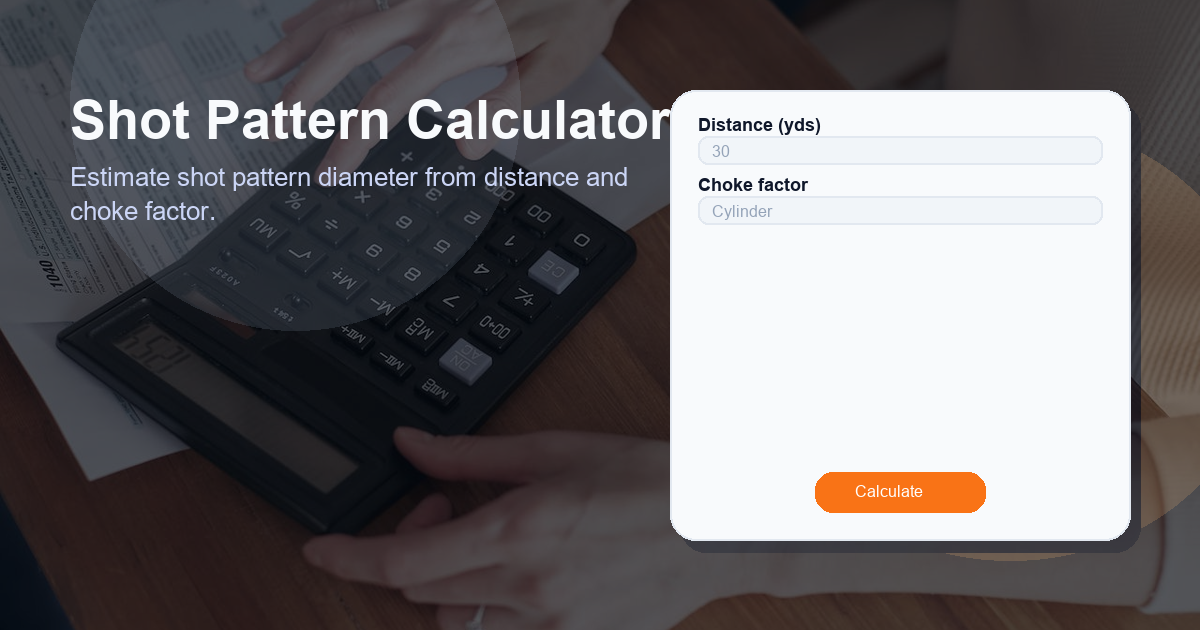
Shot Pattern Calculator
Description: Estimate shot pattern diameter from distance and choke factor using a simple, reliable formula. This Shot Pattern Calculator helps shooters, hunters, and range technicians predict the approximate spread of a shot pattern so they can make informed decisions about choke selection and effective range.
What this Shot Pattern Calculator calculator does
The Shot Pattern Calculator provides a quick, conservative estimate of the expected pattern diameter based on two inputs: Distance (yds) and Choke factor. It applies a straightforward mathematical relationship to convert shot distance into a predicted pattern size, labeled as Pattern Diameter. This is useful for planning shots, selecting choke tubes, and comparing theoretical expectations with real-world patterning results.
Key output: Pattern Diameter — the calculated spread based on the inputs and the built-in formula.
How to use the Shot Pattern Calculator calculator
Using this Shot Pattern Calculator is intentional and simple. Follow these steps for a useful estimate:
- Enter Distance (yds) — the shooting distance measured in yards. Use whole numbers or decimals (for example, 20 or 25.5).
- Enter Choke factor — a numeric multiplier representing how tight or open the choke is. Use values less than 1 for tighter chokes (narrower patterns), around 1 for neutral, and greater than 1 for more open chokes (wider patterns).
- Compute — apply the formula to get the Pattern Diameter.
Example:
- Distance (yds): 30
- Choke factor: 1.2
- Formula: distance_yds * 0.9 * choke_factor
- Calculation: 30 * 0.9 * 1.2 = 32.4
- Result label: Pattern Diameter: 32.4
Note: Use the example values as a guide. The calculator yields a numeric estimate labeled Pattern Diameter; for precision in real-world applications, always confirm with live patterning tests.
How the Shot Pattern Calculator formula works
The formula used by this Shot Pattern Calculator is:
Pattern Diameter = distance_yds * 0.9 * choke_factor
Breaking down the components:
- distance_yds — The range in yards from the muzzle to the target or patterning board. As distance increases, the pattern typically expands.
- 0.9 (scale factor) — A built-in scaling constant that adjusts the raw distance to better reflect empirical spread behavior. This factor compresses the raw distance slightly to account for general patterning tendencies observed in typical shot loads.
- choke_factor — A multiplier representing the constriction effect of the choke. A choke that tightens the shot will have a factor below 1, while a more open choke will have a factor above 1. Using different choke factors allows the model to simulate tighter or wider spreads without changing the distance input.
Why the formula is useful:
- It is simple and fast, making it convenient for planning and comparisons.
- It isolates two primary controllable inputs — distance and choke — which are the most commonly adjusted variables when patterning a shotgun.
- It provides a baseline estimate that can be refined with real-world testing.
Use cases for the Shot Pattern Calculator
This Shot Pattern Calculator serves multiple practical applications for different users:
- Hunters: Estimate effective field ranges for game by predicting pattern size at typical engagement distances.
- Sport shooters: Compare choke options and see how they alter expected spread for clay shooting or competitive events.
- Range technicians: Plan patterning sessions and set up targets at distances that will reveal meaningful changes in spread.
- Firearms trainers and law enforcement: Use the calculator for classroom demonstrations to illustrate how choke and range influence pattern density.
- New shooters: Learn the relationship between choke selection and effective range before investing time and ammunition in live patterning.
Because it’s low-cost (computationally) and fast, this calculator is ideal for quick scenario testing and pre-range planning where you want an immediate, defensible estimate of pattern diameter.
Other factors to consider when calculating x
While the Shot Pattern Calculator focuses on distance and choke factor, many other variables influence the final pattern. When calculating x (the pattern diameter), consider the following:
- Shot size and material: Larger shot and dense shot (e.g., steel vs lead) behave differently and can change spread and pellet energy.
- Shot payload: The number of pellets in the shell affects pattern density even if diameter is similar.
- Velocity and choke interaction: Higher velocities can increase spread; some chokes interact differently with different speeds.
- Barrel length and choke design: Barrel length and the shape of the choke (cylinder, improved cylinder, modified, full) alter patterning characteristics beyond a single multiplier.
- Wads and hulls: Shell construction, wad type, and shot cup influence how quickly the shot column disperses after exit.
- Environmental factors: Wind, temperature, humidity, and air density can subtly shift pattern shape and distribution.
- Shooter consistency: Mount, aim, and recoil management affect where the pattern lands and how uniform it appears on a target.
- Measurement variability: How you measure pattern diameter (edge-to-edge, 50% pellet density circle, etc.) changes the reported number. Standardize your measurement method.
Practical tip: use this calculator as a starting point and then perform live pattern tests at several distances and choke settings to derive a refined choke_factor value for your specific gun and ammo combination.
FAQ
What exactly is the “choke factor” in this Shot Pattern Calculator?
Answer: The choke factor is a numeric multiplier that models how tight or open the choke makes the shot spread. Values <1 indicate a tighter pattern, ≈1 indicates neutral, and >1 indicates a wider pattern. It is a simplified representation and should be calibrated with real patterning data for best accuracy.
How accurate is the Shot Pattern Calculator?
Answer: The calculator provides an estimate based on the two primary inputs. Accuracy depends on how well the chosen choke factor reflects your actual choke, load, and firearm. It’s a useful planning tool but not a replacement for live firing and measuring, which will give you precise results for your specific setup.
Can I use this calculator for all shotgun gauges and loads?
Answer: Yes, you can use it as a rough estimate for any gauge, but you should expect variation. Different gauges, shot sizes, and loads will affect pattern behavior; calibrate the choke factor based on measured pattern results from your specific combination.
How do I measure the pattern diameter in the field?
Answer: Place a patterning board at the desired distance, fire a test load, and mark pellet impacts. Measure the circle that contains your chosen density threshold (for example, where 50% of pellets fall). Consistently use the same measurement method to compare results.
Should I rely on the Shot Pattern Calculator instead of live testing?
Answer: No. Use the calculator for planning and quick comparisons, but always verify with live patterning under real conditions before making final decisions about choke selection or lethal engagement ranges.
Final note: The Shot Pattern Calculator is a useful tool for estimating pattern diameter quickly. Combine its output with practical patterning and field experience to achieve the best operational results.