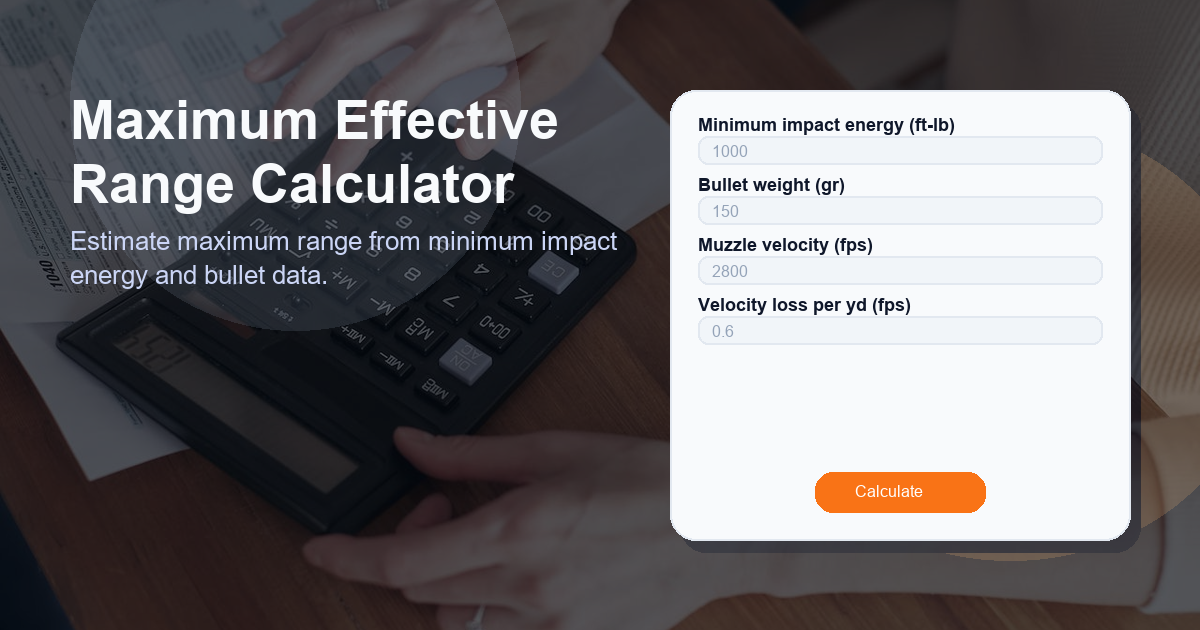
Maximum Effective Range Calculator
Description: Estimate maximum range from minimum impact energy and bullet data using the Maximum Effective Range Calculator. Enter the required inputs to get the Max Effective Range (in yards) based on muzzle velocity, bullet weight, and velocity loss per yard.
What this Maximum Effective Range Calculator calculator does
The Maximum Effective Range Calculator estimates how far a bullet can travel and still retain a specified minimum impact energy. It uses basic kinetic energy relationships and a simple linear velocity loss model to convert muzzle conditions into a maximum distance. The calculator returns a single value labeled Max Effective Range (yards).
Key features:
- Input-driven: uses your muzzle velocity, bullet weight, required terminal energy, and velocity-loss-per-yard.
- Quick estimate: provides a conservative, easy-to-understand range number suitable for planning and comparison.
- Units-aware: expects typical ballistic units: energy in ft-lb, weight in grains (gr), velocity in fps, and distance in yards.
How to use the Maximum Effective Range Calculator calculator
Using the Maximum Effective Range Calculator is straightforward. Provide the following inputs:
- Minimum impact energy (ft-lb) – the lowest energy you consider effective (e.g., for ethical hunting or terminal performance).
- Bullet weight (gr) – bullet mass in grains.
- Muzzle velocity (fps) – the velocity of the bullet leaving the muzzle.
- Velocity loss per yd (fps) – average velocity decay per yard of flight (positive number).
Example step-by-step:
- Set Minimum impact energy to 100 ft-lb.
- Set Bullet weight to 150 gr.
- Set Muzzle velocity to 2800 fps.
- Set Velocity loss per yd to 1.5 fps/yd.
- Press calculate; the result shows Max Effective Range in yards.
Output label:
- Max Effective Range — the calculated maximum distance (yards) at which the bullet still meets or exceeds the minimum impact energy.
How the Maximum Effective Range Calculator formula works
The calculator is based on the kinetic energy formula and a linear approximation for velocity loss over distance. The kinetic energy of a projectile in foot-pounds is:
E (ft-lb) = (weight_grains * velocity_fps^2) / 450240
Rearrange this to compute the velocity required at impact to achieve the specified minimum energy:
v_required = sqrt( min_energy_ftlb * 450240 / bullet_weight_gr )
Assuming a constant average velocity loss per yard (a simplification), the distance until velocity drops from muzzle_velocity_fps to v_required is:
distance_yards = (muzzle_velocity_fps – v_required) / velocity_loss_per_yd
Putting the logic into the exact formula used by the calculator (JavaScript-style):
velocity_loss_per_yd > 0 && bullet_weight_gr > 0 ? Math.max((muzzle_velocity_fps - Math.sqrt(min_energy_ftlb * 450240 / bullet_weight_gr)) / velocity_loss_per_yd, 0) : 0Notes on the formula:
- Validation: If velocity_loss_per_yd is not positive or bullet_weight_gr is not positive, the formula returns 0 because the calculation would be invalid or meaningless.
- Non-negative result: Math.max(…, 0) ensures the calculator never returns a negative distance; if muzzle velocity is already below the required impact velocity, the Max Effective Range is 0.
- Units: All inputs must use the correct units: energy in ft-lb, weight in grains, velocities in fps, distance computed in yards.
Example numeric calculation (illustrative):
- min_energy_ftlb = 100
- bullet_weight_gr = 150
- muzzle_velocity_fps = 2800
- velocity_loss_per_yd = 1.5
Compute v_required = sqrt(100 * 450240 / 150) ≈ 548 fps. Then distance ≈ (2800 − 548) / 1.5 ≈ 1501 yards. The displayed label would be: Max Effective Range: 1501 yd (rounded).
Use cases for the Maximum Effective Range Calculator
The Maximum Effective Range Calculator is useful for a variety of practical and planning tasks. Common use cases include:
- Hunting planning: Determine the maximum ethical shot distance based on the minimum terminal energy you require.
- Load development: Compare different bullet weights and muzzle velocities to see how they affect effective range.
- Ballistic comparison: Quickly compare cartridges or loads to decide what fits your operational needs.
- Training and safety: Use conservative energy thresholds to define safe shooting distances for target and pest control situations.
- Field estimation: Provide a simple estimate when a full ballistic solver or Doppler data is not available.
Because this tool prioritizes simplicity and clarity, it’s a great first-pass estimator before moving on to more sophisticated ballistics calculators that account for drag and environmental conditions.
Other factors to consider when calculating maximum effective range
While the Maximum Effective Range Calculator gives a useful baseline, real-world ballistics are complex. Consider these additional factors that can significantly alter effective range:
- Ballistic Coefficient (BC): The BC affects how quickly a bullet loses velocity due to air resistance. A high-BC bullet will travel farther than a low-BC bullet for the same muzzle velocity.
- Atmospheric conditions: Temperature, altitude, humidity, and barometric pressure change drag and therefore velocity loss per yard.
- Wind: Crosswind and headwind can alter both the horizontal and vertical point of impact and indirectly affect terminal energy at the target.
- Transonic effects: Bullets passing into the transonic range can become unstable and lose energy differently than a linear model predicts.
- Bullet design and construction: Expansion, fragmentation, and sectional density influence terminal performance beyond raw kinetic energy.
- Barrel and rifle specifics: Barrel length, rifling, and harmonics affect muzzle velocity and shot-to-shot variation.
- Angle of shot: Shooting up or down range changes the energy required and effective range due to gravity and atmospheric layering.
For critical applications, use this calculator as an initial estimate and then apply a full ballistic solver or empirical test data to refine the maximum effective range.
FAQ
Q: What does the result “Max Effective Range” represent?
A: The Max Effective Range is an estimate of how many yards a bullet can travel while still retaining at least the specified minimum impact energy (ft-lb). It assumes a constant velocity loss per yard and basic kinetic energy physics.
Q: Can I use this calculator for any caliber or bullet type?
A: Yes, as long as you provide the correct inputs (bullet weight in grains, muzzle velocity in fps, and a realistic velocity-loss-per-yard). The calculator does not care about caliber directly, but bullet ballistic coefficient and construction will affect the real-world result.
Q: Why must velocity loss per yard be positive?
A: Velocity loss per yard models how much speed the bullet loses for every yard of flight. A non-positive number would be physically meaningless (no loss or velocity gain). The formula requires a positive decay to compute a valid distance.
Q: Is this calculator accurate for long-range ballistics planning?
A: It provides a quick, conservative estimate but is not a full ballistic solution. For accurate long-range planning, use a detailed ballistic calculator that accounts for drag (BC), wind, altitude, temperature, and transonic effects.
Q: What if the calculator returns 0 yards?
A: A result of 0 indicates either invalid inputs (e.g., non-positive weight or velocity loss) or that the muzzle velocity is already below the velocity required to meet the minimum impact energy, so the bullet does not reach the required energy at the muzzle or beyond.