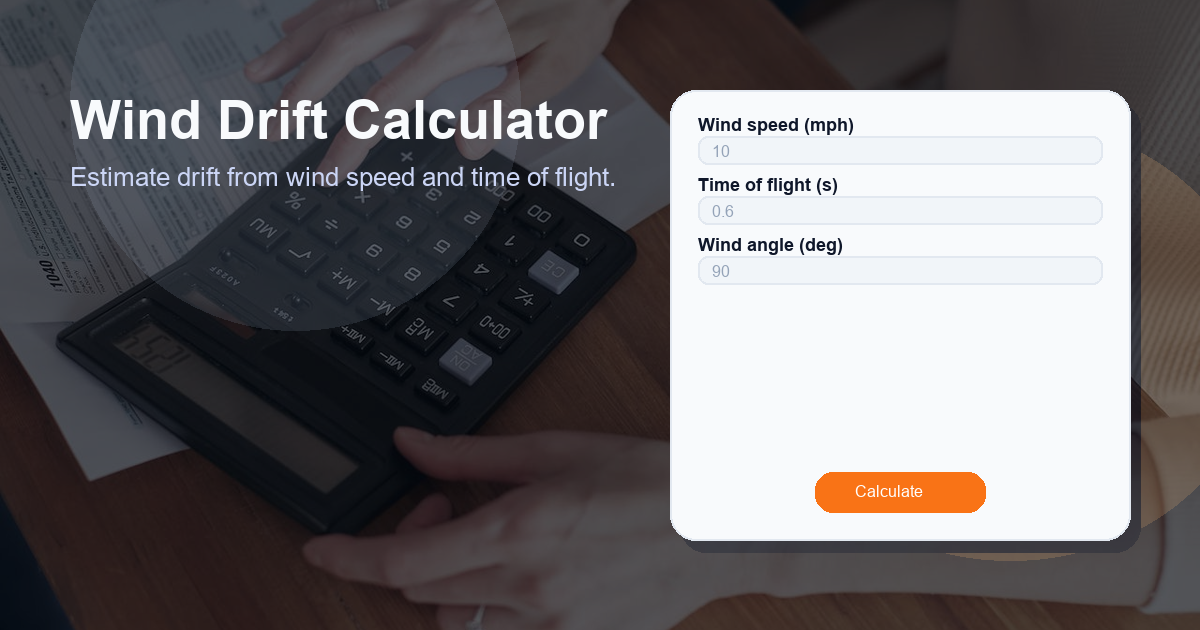
What this Wind Drift Calculator calculator does
The Wind Drift Calculator is a simple, practical tool designed to help you estimate lateral displacement (the Drift) caused by wind acting on a projectile or object while it is in flight. By entering three inputs — Wind speed (mph), Time of flight (s), and Wind angle (deg) — the calculator provides a fast approximation of how far the object will be pushed sideways by wind during its flight.
This calculator is useful for initial planning and quick field checks. It produces an estimated drift in linear units based on a compact formula. The approach is intentionally simplified so it can be used without complex ballistics software or in-depth environmental data.
How to use the Wind Drift Calculator calculator
Using the Wind Drift Calculator is straightforward. Provide the following inputs:
- Wind speed (mph) — the sustained wind speed in miles per hour.
- Time of flight (s) — the duration the object is in the air, in seconds.
- Wind angle (deg) — the angle between the wind direction and the line-of-fire or forward direction, measured in degrees (0° = tailwind/headwind, 90° = full crosswind).
Steps:
- Enter the wind speed in mph.
- Enter the time of flight in seconds.
- Enter the wind angle in degrees (0 to 90). If the angle is greater than 90°, use the supplementary angle relative to the crosswind component; the calculator formula uses the fraction of the full crosswind (angle/90).
- Run the calculation to get the Drift value (lateral displacement).
Example (quick demo):
- Wind speed = 10 mph
- Time of flight = 2 s
- Wind angle = 45°
Using the formula below, the estimated Drift = 10 * 17.6 * 2 * (45 / 90) = 176 inches, which is about 14.67 ft.
How the Wind Drift Calculator formula works
The calculator uses this compact formula:
Drift = wind_speed_mph * 17.6 * time_of_flight_s * (wind_angle_deg / 90)
Breakdown of the formula and why it works:
- wind_speed_mph: Wind speed in miles per hour is the starting point for the lateral velocity component.
- 17.6: This constant converts miles per hour to inches per second. Explanation: 1 mph ≈ 1.4667 feet per second, and 1 foot = 12 inches, so 1.4667 * 12 ≈ 17.6 inches per second.
- time_of_flight_s: Multiplying the wind speed in inches/sec by the time in seconds gives the lateral distance in inches if the wind acted perpendicular to the projectile for the full time.
- (wind_angle_deg / 90): This factor scales the wind effect based on angle. A 90° wind is a full crosswind, producing full lateral drift. A 0° wind is along the flight path and produces no lateral displacement. The linear proportionality (angle/90) approximates the crosswind component as sin(angle) ≈ angle/90 for small-to-moderate angles — a simplifying assumption that is reasonable for quick estimates and typical field use.
Units: The result of the formula is in inches of lateral drift. Convert to feet by dividing by 12 or to meters by dividing by 39.37.
Use cases for the Wind Drift Calculator
The Wind Drift Calculator is valuable in several practical scenarios where a quick drift estimate helps with planning or adjustments:
- Shooting and Ballistics: Estimating approximate wind drift for sight corrections when a full ballistics calculator isn’t available or when you need a quick field estimate.
- Drone and UAV Operations: Predicting approximate lateral displacement during hover-to-hover transfers or short missions where steady wind is expected.
- Sports and Outdoor Activities: Estimating the effect of crosswind on long-range throws, arrows, or other projectiles for training and strategy.
- Field Engineering and Construction: Assessing potential lateral displacement of lightweight materials or components exposed to steady winds during a short period.
- Education and Demonstration: Teaching basic concepts of wind-induced lateral motion and unit conversions in physics or applied science classes.
Key benefits:
- Speed — fast, low-friction calculations for on-the-spot decisions.
- Accessibility — no advanced ballistics inputs required.
- Portability — can be used on mobile devices in the field.
Other factors to consider when calculating x
The simplified formula in this Wind Drift Calculator gives a first-order estimate of lateral displacement, but real-world drift (“x”) can be influenced by many additional factors. Consider the following before relying on the estimate for critical tasks:
- Projectile Aerodynamics — Mass, shape, and drag influence how wind interacts with the object; heavier or more streamlined projectiles will experience less drift than the simple model predicts.
- Variable Wind — Wind often changes speed and direction over the flight path; gusts and varying wind layers can cause deviations from the steady-wind estimate.
- Elevation and Air Density — Altitude, temperature, and humidity change air density, which affects drag and therefore lateral movement.
- Spin and Magnus Effect — For balls, bullets, or other spinning bodies, the Magnus effect can create lift or lateral forces not captured by a linear crosswind scaling.
- Wind Angle Modeling — The factor (wind_angle_deg / 90) is a linear approximation. For precise work, use trigonometric projection of wind velocity (wind_speed * sin(angle)) for the true crosswind component.
- Correlated Motions — Motion of the launch platform or object (e.g., moving vehicle or drone) will change relative wind speed and angle.
- Measurement Error — Inaccurate measurements of wind speed, angle, or time of flight directly degrade the estimate.
For precision applications (competitive shooting, long-range ballistics, critical UAV operations), supplement this calculator with full ballistics software, real-time wind measurements at multiple altitudes, and empirical testing.
Frequently Asked Questions
What units are the results shown in?
The result labeled Drift is provided in inches by the standard formula. You can convert to feet by dividing by 12 or to meters by dividing by 39.37.
Does the Wind Drift Calculator account for projectile weight or shape?
No. This calculator uses a simplified model that assumes wind acts as a steady lateral speed. It does not explicitly account for mass, drag coefficients, or projectile aerodynamics. Use it for quick estimates only.
How should I interpret wind angle input?
Enter the angle between the wind direction and your forward direction in degrees. 0° means wind directly from front or rear (no lateral effect). 90° means a full crosswind (maximum lateral effect). If the wind direction is behind or in front, consider its lateral component only.
Can I use this calculator for very long flight times?
It can be used for longer flight times, but accuracy decreases because real winds vary with time and altitude, and aerodynamic effects accumulate nonlinearly. For long-range applications, use more advanced modeling.
Is the conversion factor 17.6 exact?
The factor 17.6 is a practical rounded value based on 1 mph ≈ 1.46667 ft/s and 1 ft = 12 in, giving ~17.6 in/s. The small rounding difference is negligible for quick estimates but can be refined if ultra-precise conversions are required.
If you need an interactive version of this Wind Drift Calculator embedded on a web page or a conversion tool that shows feet/meters automatically, I can provide HTML form code or a script to perform the calculations live.