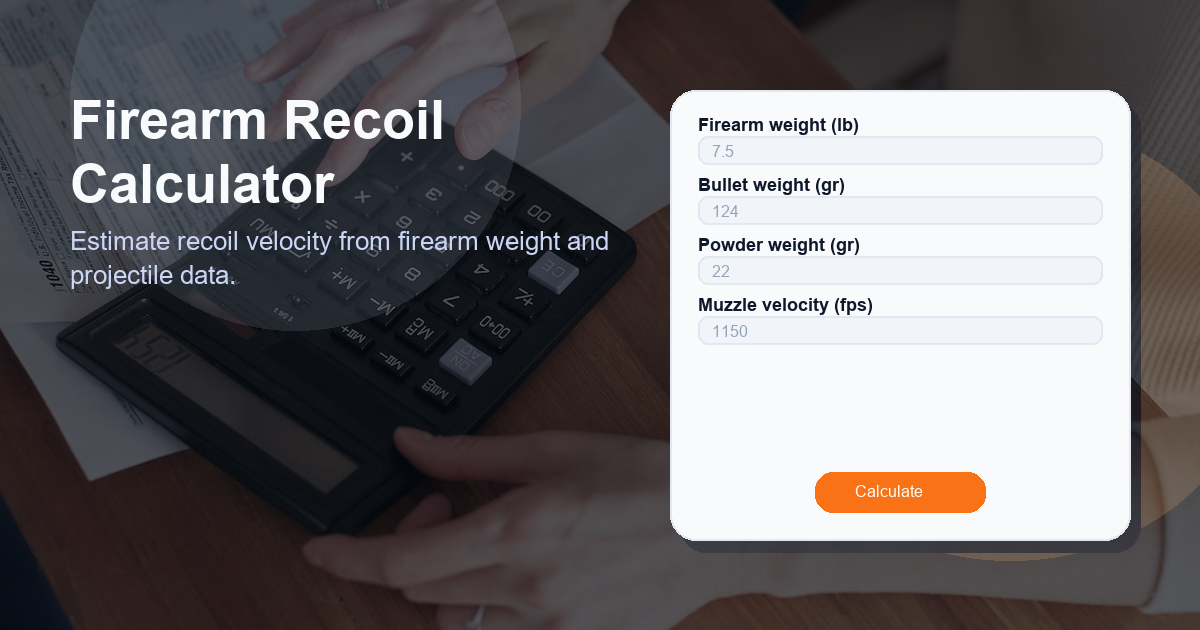
Firearm Recoil Calculator
Description: Estimate recoil velocity from firearm weight and projectile data using the simple, momentum-based Firearm Recoil Calculator.
What this Firearm Recoil Calculator calculator does
The Firearm Recoil Calculator computes an estimated recoil velocity of a firearm using a straightforward momentum balance between the forward-traveling projectile and propellant gases and the rearward motion of the firearm. It is intended to give shooters, reloaders, and designers a quick way to compare how changes in firearm weight, bullet weight, powder charge, and muzzle velocity affect the resulting recoil velocity.
This calculator is optimized for readability and fast comparison. It does not attempt to model complex pressure curves, gas escape dynamics, or shooter biomechanics — instead it provides a useful first-order estimate based on conserved momentum.
- Result: Recoil Velocity (ft/s)
- Primary use: comparative recoil estimation and quick design checks
- Not a replacement for: ballistics measurement tools, chronographs, or detailed recoil impulse analysis
How to use the Firearm Recoil Calculator calculator
Using the Firearm Recoil Calculator is straightforward. Provide the four inputs and the tool returns the estimated Recoil Velocity in feet per second (fps):
- Firearm weight (lb) — the mass of the firearm expressed in pounds.
- Bullet weight (gr) — projectile (bullet) mass in grains.
- Powder weight (gr) — propellant mass in grains (this calculator treats powder as contributing to the forward-moving mass).
- Muzzle velocity (fps) — the velocity of the projectile leaving the muzzle in feet per second.
Step-by-step:
- Enter the firearm weight in pounds (lb).
- Enter bullet and powder masses in grains (gr).
- Enter the muzzle velocity in feet per second (fps).
- Click calculate. The calculator returns Recoil Velocity in fps.
Example calculation (illustrative):
- Firearm weight = 8.0 lb
- Bullet weight = 150 gr
- Powder weight = 50 gr
- Muzzle velocity = 2600 fps
Applying the formula below yields an estimated recoil velocity of approximately 9.29 fps. This gives a quick sense of relative recoil between loads or different firearm weights.
How the Firearm Recoil Calculator formula works
The Firearm Recoil Calculator uses a basic momentum-conservation approach. The formula used by the calculator is:
firearm_weight_lb > 0 ? (((bullet_weight_gr + powder_weight_gr) / 7000) * muzzle_velocity_fps) / firearm_weight_lb : 0
Breaking that down:
- (bullet_weight_gr + powder_weight_gr) — the sum of bullet and powder masses in grains. This calculator treats powder mass as contributing to the forward-traveling mass; some advanced models account for gas velocity separately, but including powder mass gives a conservative momentum estimate.
- / 7000 — converts grains to pounds (1 pound = 7000 grains).
- * muzzle_velocity_fps — multiplies the forward-moving mass (in pounds) by the projectile velocity to get forward momentum (lb·ft/s).
- / firearm_weight_lb — divides the forward momentum by the firearm mass (in pounds), yielding the recoil velocity in ft/s assuming an instantaneous transfer of momentum.
- firearm_weight_lb > 0 ? … : 0 — a simple guard: if firearm weight is zero or not provided, the calculator returns 0 to avoid division by zero.
In short, the formula is momentum = mass × velocity and then firearm recoil velocity = projectile momentum / firearm mass. The output is labeled Recoil Velocity and reported in feet per second (fps).
Use cases for the Firearm Recoil Calculator
This calculator is useful in several practical scenarios:
- Load comparison: Quickly compare how different bullet or powder combinations change the recoil velocity for the same firearm weight.
- Firearm selection: Evaluate how changing firearm weight (e.g., lighter hunting rifle vs. heavier bench rifle) affects expected recoil.
- Design and prototyping: For firearm and stock designers to estimate baseline recoil when iterating on weight and mass distribution.
- Training and safety planning: Shooters can estimate relative recoil to decide on appropriate protective gear, recoil pads, or training approaches.
- Ballistics writing and content: Authors and educators can include a consistent, reproducible metric for recoil comparisons in articles and guides.
Keep in mind: the calculator excels at comparative uses — showing how changes in inputs move recoil velocity up or down — but it is not a full physical simulation.
Other factors to consider when calculating recoil
While the Firearm Recoil Calculator provides a useful first-order estimate, several additional factors influence the felt and measured recoil beyond simple momentum transfer. Consider these when interpreting results:
- Propellant gas velocity and gas escape: Not all powder mass exits the muzzle at bullet velocity. Gas can leave at different speeds and contributes to recoil differently; advanced models include a gas-velocity factor.
- Recoil impulse vs. peak velocity: Perceived recoil depends on impulse (force integrated over time) and its time profile, not just instantaneous velocity. Barrel length, gas system type, and action timing change the impulse shape.
- Stock geometry and ergonomics: How a rifle or shotgun contacts the shooter’s shoulder — pad thickness, comb height, and stock fit — dramatically affects felt recoil.
- Recoil mitigation systems: Muzzle brakes, recoil pads, recoil-reducing stocks, and suppressors alter both measured and felt recoil. Muzzle brakes redirect gas to reduce rearward momentum at the shooter.
- Shooter technique and stance: Body position, grip, and muscle tension change perceived impact; trained shooters often report less perceived recoil for the same numerical value.
- Action type and moving mass: In semi-autos, parts move during firing absorbing some momentum. Bolt-action rifles behave differently than semi-autos or lever actions.
- Measurement method: Recoil can be measured as velocity, energy (ft·lb), or impulse. Each metric has different uses; this calculator reports velocity for clarity and simplicity.
FAQ
Q: What units does the Firearm Recoil Calculator use?
A: The calculator accepts firearm weight in pounds (lb), bullet and powder weights in grains (gr), and muzzle velocity in feet per second (fps). The output Recoil Velocity is in feet per second (fps).
Q: Is the result the same as recoil energy?
A: No. Recoil velocity and recoil energy are related but different. Recoil energy is typically reported in foot-pounds and depends on both the firearm mass and recoil velocity (energy = 0.5 × mass × velocity², with appropriate unit conversions). This calculator provides velocity; you can convert to energy if needed.
Q: Can I use this calculator for handguns and shotguns?
A: Yes, as long as you provide weights in the specified units and understand this is a simplified momentum-based estimate. For shotguns, include combined shot plus wad/powder mass as applicable. For semi-autos, remember internal moving parts and gas systems affect the real result.
Q: How accurate is the Firearm Recoil Calculator?
A: It is a first-order estimate based on momentum conservation. Accuracy depends on how well the inputs reflect actual moving mass and muzzle gas behavior. For precise measurement use chronographs, force sensors, or consult detailed ballistics models.
Q: How can I reduce recoil according to the calculator’s findings?
A: The calculator highlights the easiest levers: increase firearm weight, reduce projectile or powder mass, or reduce muzzle velocity (if safe and practical). In real use, muzzle brakes, recoil pads, and proper ergonomics also substantially reduce felt recoil.
Summary: The Firearm Recoil Calculator is a fast, SEO-friendly tool for estimating recoil velocity from firearm weight and projectile data. It’s most valuable for comparison, planning, and initial design evaluation. Use it alongside real-world testing and consider the other factors that shape felt recoil.