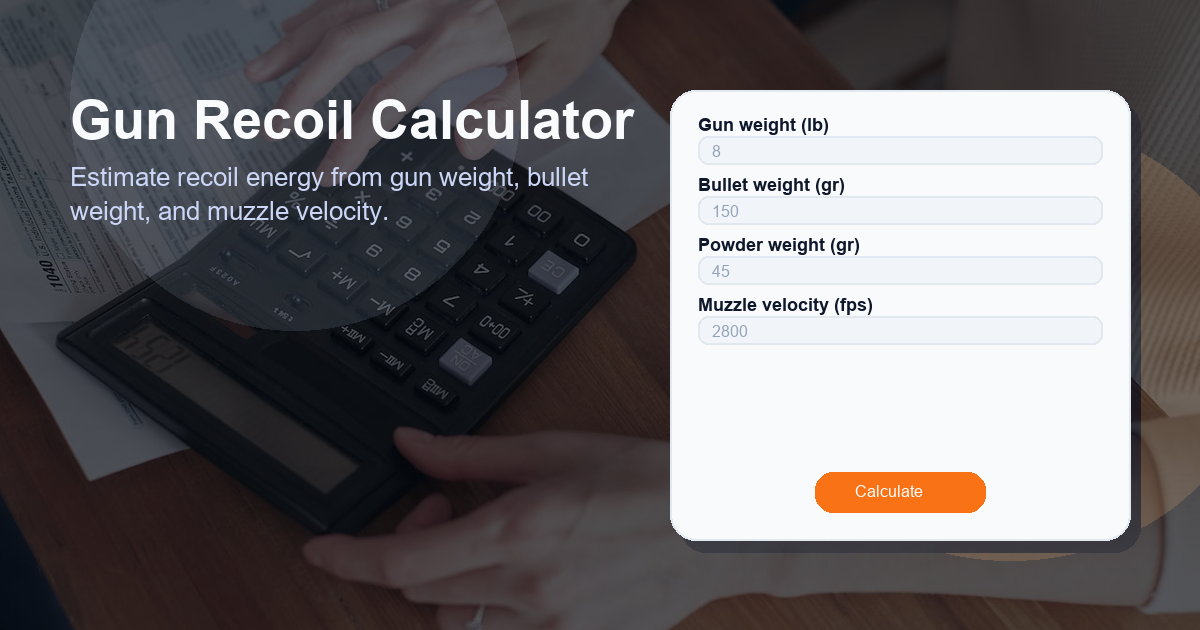
Gun Recoil Calculator
Gun Recoil Calculator helps shooters, reloaders, and firearm enthusiasts estimate the free recoil energy produced when a gun fires. By entering a few simple inputs—gun weight, bullet weight, powder charge, and muzzle velocity—you can get a quick numeric estimate of the expected Recoil Energy in foot-pounds (ft·lb). This is useful for comparing guns and loads, planning recoil mitigation, and making safer, more comfortable shooting choices.
What this Gun Recoil Calculator calculator does
This Gun Recoil Calculator calculates the approximate kinetic energy of the firearm’s recoil (the energy the shooter feels) using mass and velocity inputs for the projectile and powder, plus the mass of the gun. The calculator uses a standard physics-based formula with unit conversions applied so you can enter inputs in common shooting units:
- Gun weight (lb) — weight of the firearm in pounds
- Bullet weight (gr) — projectile mass in grains
- Powder weight (gr) — approximate mass of the powder charge in grains
- Muzzle velocity (fps) — velocity of the bullet at the muzzle in feet per second
The calculator returns the Recoil Energy in foot-pounds (ft·lb), a standard unit used to compare felt recoil among firearms and loads.
How to use the Gun Recoil Calculator calculator
Using the Gun Recoil Calculator is straightforward. Follow these steps:
- Measure or enter the Gun weight in pounds (lb). Use the unloaded weight of the firearm.
- Enter the Bullet weight in grains (gr). This is the projectile mass printed on the ammo box or your reloading data.
- Enter the Powder weight in grains (gr). If you don’t know the exact charge, use the typical charge from your load data or the factory load specification.
- Enter the Muzzle velocity in feet per second (fps). Use chronograph data if available, or the manufacturer’s published velocity.
- Submit the values to compute Recoil Energy. If gun weight is zero or negative, the calculator returns zero to avoid invalid results.
Practical tips:
- Use chronograph data for muzzle velocity whenever possible — published values can vary from real-world results.
- Include powder mass because the ejected powder gases contribute significantly to recoil, especially with lighter bullets or high-velocity loads.
- If you want a conservative estimate, round inputs slightly upward for velocity or charge; if you want a realistic estimate, use measured values.
How the Gun Recoil Calculator formula works
The calculator uses a single-line formula with standard unit conversions so you can input common shooting units directly. The exact expression used is:
gun_weight_lb > 0 ? Math.pow(((bullet_weight_gr + powder_weight_gr) / 7000) * muzzle_velocity_fps, 2) / (64.348 * gun_weight_lb) : 0
What this means, step-by-step:
- Convert grains to pounds: (bullet_weight_gr + powder_weight_gr) / 7000. There are 7000 grains in one pound.
- Compute the momentum-equivalent term by multiplying that mass (in pounds) by muzzle velocity (fps).
- Square the result: momentum^2.
- Divide by a constant factor 64.348 × gun_weight_lb. The constant incorporates unit conversions (pounds to slugs, factor of 2 in kinetic energy calculation, and gravitational conversion factors) so the final answer becomes ft·lb of recoil energy.
- If the gun weight is zero or less, the expression returns zero to prevent division by zero or nonsensical output.
In simpler physical terms, the formula is built from the principle of conservation of momentum and kinetic energy: the momentum of the bullet and gases imparts a backward velocity to the gun, and the kinetic energy corresponding to that backward velocity is the free recoil energy.
Example calculation:
- Gun weight = 7 lb
- Bullet = 150 gr; Powder = 40 gr (total 190 gr)
- Muzzle velocity = 2600 fps
- Converted mass = 190 / 7000 = 0.02714 lb. Momentum term = 0.02714 × 2600 ≈ 70.57. Square it → ≈ 4980.3. Divide by (64.348 × 7 ≈ 450.44) → Recoil Energy ≈ 11.06 ft·lb
Use cases for the Gun Recoil Calculator
The Gun Recoil Calculator is useful in many practical scenarios:
- Hunting decisions: Compare recoil between candidate rifles to choose a setup you can shoot comfortably all day.
- Reloading and load development: Predict how changes in bullet weight, powder charge, or velocity will affect recoil before testing live rounds.
- Firearm selection: Compare factory loads and rifle weights when shopping for the most comfortable combination for a particular shooter.
- Training and safety planning: Estimate recoil to match appropriate coaching, protective gear, and progressive exposure for new shooters.
- Competition tuning: Optimize weight and ammo selection to balance recoil mitigation with handling and swing characteristics.
Other factors to consider when calculating recoil
The numeric Recoil Energy produced by the calculator is an objective metric, but the subjective experience of recoil also depends on many other variables. Consider these factors when interpreting results:
- Stock design and fit: A properly fitted stock spreads recoil across the shooter’s shoulder and reduces felt impact.
- Recoil pad and bedding: Pads, gels, and good bedding reduce felt recoil and improve comfort.
- Muzzle devices: Compensators and muzzle brakes redirect gas and can greatly reduce felt recoil at the expense of increased noise and side blast.
- Barrel length and gas systems: Shorter barrels may increase felt muzzle blast and slightly alter recoil impulse; gas-operated semi-autos reduce felt recoil compared to bolt-action rifles of the same weight.
- Shooter stance and technique: Body position, cheek weld, and grip change how recoil is transmitted and perceived.
- Clothing and padding: Thick jackets or recoil pads alter the felt sensation.
- Projectile shape and pressure curve: Two loads with the same velocity and bullet weight might produce different impulse shapes and therefore different felt recoil.
- Barrel harmonics and stock resonance: Vibration characteristics can slightly affect perceived kick.
Because of these factors, use the calculator for objective comparison and planning, but validate with live-fire testing and personal comfort checks before finalizing equipment or loads.
FAQ
Q: What units does the Gun Recoil Calculator use?
A: The calculator expects Gun weight in pounds (lb), Bullet weight and Powder weight in grains (gr), and Muzzle velocity in feet per second (fps). The output Recoil Energy is given in foot-pounds (ft·lb).
Q: Why does the formula add powder weight to bullet weight?
A: The powder mass and the high-velocity gases contribute to the momentum leaving the muzzle. Including the powder weight provides a more accurate estimate of the total backward impulse and therefore the recoil energy.
Q: Is the calculated recoil energy the same as felt recoil?
A: Not exactly. Calculated recoil energy is an objective physical estimate. Felt recoil depends on many subjective and mechanical factors—stock fit, recoil pads, shooter stance, muzzle brakes, and more—so perceived kick can differ even at the same calculated energy.
Q: Can I use this calculator for pistols and shotguns?
A: Yes, you can use the same formula for pistols and shotguns by entering the appropriate weights and velocities. Keep in mind that shotguns often use shot loads (multiple projectiles) and propellant characteristics that may require more careful interpretation.
Q: What if my gun weight is zero or I don’t know it?
A: The formula requires a positive gun weight. If you enter zero or a negative value, the calculator returns zero to avoid invalid results. If you don’t know the exact weight, use the manufacturer’s unloaded weight or measure the firearm on a scale for best accuracy.